QUESTION IMAGE
Question
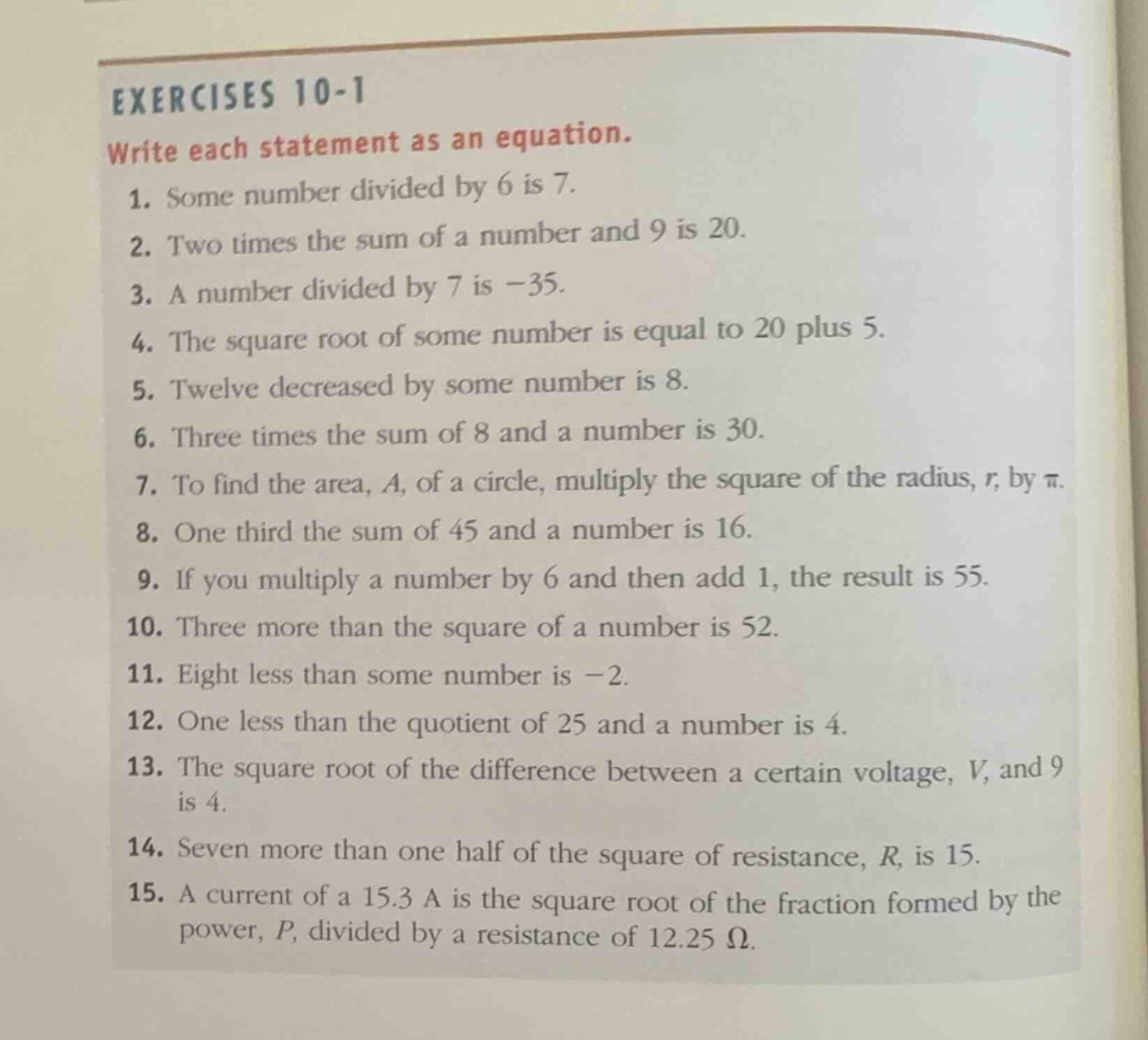
exercises 10-1
write each statement as an equation.
- some number divided by 6 is 7.
- two times the sum of a number and 9 is 20.
- a number divided by 7 is -35.
- the square root of some number is equal to 20 plus 5.
- twelve decreased by some number is 8.
- three times the sum of 8 and a number is 30.
- to find the area, \\(a\\), of a circle, multiply the square of the radius, \\(r\\), by \\(\pi\\).
- one third the sum of 45 and a number is 16.
- if you multiply a number by 6 and then add 1, the result is 55.
- three more than the square of a number is 52.
- eight less than some number is -2.
- one less than the quotient of 25 and a number is 4.
- the square root of the difference between a certain voltage, \\(v\\), and 9 is 4.
- seven more than one half of the square of resistance, \\(r\\), is 15.
- a current of a 15.3 a is the square root of the fraction formed by the power, \\(p\\), divided by a resistance of 12.25 \\(\omega\\).
Translate statements 1 to 5 into algebraic equations
Let \(n\) represent the unknown number in each statement unless specified otherwise.
- "Some number divided by 6 is 7":
$$\frac{n}{6} = 7$$
- "Two times the sum of a number and 9 is 20":
$$2(n + 9) = 20$$
- "A number divided by 7 is -35":
$$\frac{n}{7} = -35$$
- "The square root of some number is equal to 20 plus 5":
$$\sqrt{n} = 20 + 5$$
- "Twelve decreased by some number is 8":
$$12 - n = 8$$
Translate statements 6 to 10 into algebraic equations
- "Three times the sum of 8 and a number is 30":
$$3(8 + n) = 30$$
- "To find the area, \(A\), of a circle, multiply the square of the radius, \(r\), by \(\pi\)":
$$A = \pi r^2$$
- "One third the sum of 45 and a number is 16":
$$\frac{1}{3}(45 + n) = 16$$
- "If you multiply a number by 6 and then add 1, the result is 55":
$$6n + 1 = 55$$
- "Three more than the square of a number is 52":
$$n^2 + 3 = 52$$
Translate statements 11 to 15 into algebraic equations
- "Eight less than some number is -2":
$$n - 8 = -2$$
- "One less than the quotient of 25 and a number is 4":
$$\frac{25}{n} - 1 = 4$$
- "The square root of the difference between a certain voltage, \(V\), and 9 is 4":
$$\sqrt{V - 9} = 4$$
- "Seven more than one half of the square of resistance, \(R\), is 15":
$$\frac{1}{2}R^2 + 7 = 15$$
- "A current of 15.3 A is the square root of the fraction formed by the power, \(P\), divided by a resistance of 12.25 \(\Omega\)":
$$15.3 = \sqrt{\frac{P}{12.25}}$$

Snap & solve any problem in the app
Get step-by-step solutions on Sovi AI
Photo-based solutions with guided steps
Explore more problems and detailed explanations
| No. | Answer |
|---|---|
| 2 | \(2(n + 9) = 20\) |
| 3 | \(\frac{n}{7} = -35\) |
| 4 | \(\sqrt{n} = 20 + 5\) |
| 5 | \(12 - n = 8\) |
| 6 | \(3(8 + n) = 30\) |
| 7 | \(A = \pi r^2\) |
| 8 | \(\frac{1}{3}(45 + n) = 16\) |
| 9 | \(6n + 1 = 55\) |
| 10 | \(n^2 + 3 = 52\) |
| 11 | \(n - 8 = -2\) |
| 12 | \(\frac{25}{n} - 1 = 4\) |
| 13 | \(\sqrt{V - 9} = 4\) |
| 14 | \(\frac{1}{2}R^2 + 7 = 15\) |
| 15 | \(15.3 = \sqrt{\frac{P}{12.25}}\) |