QUESTION IMAGE
Question
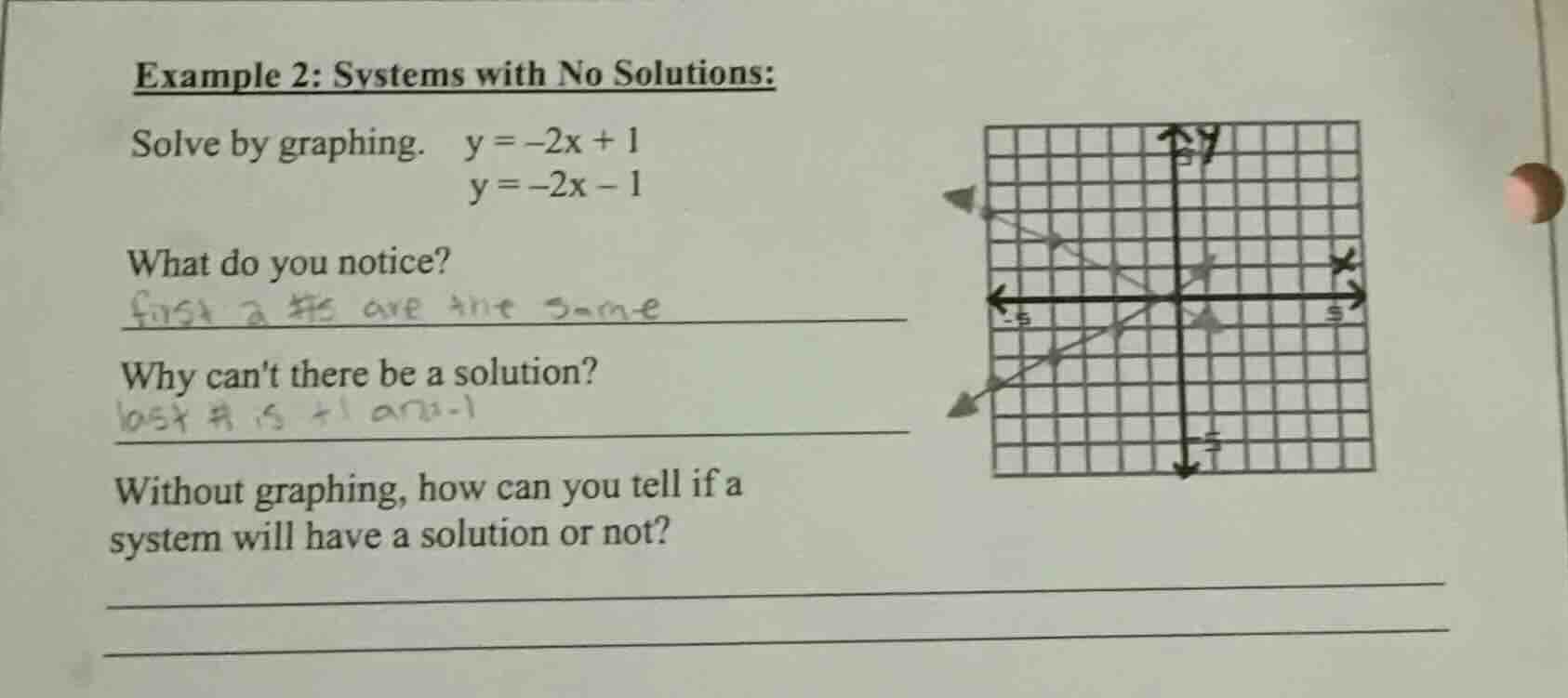
example 2: systems with no solutions:
solve by graphing. y = -2x + 1
y = -2x - 1
what do you notice?
_____________________
why cant there be a solution?
_____________________
without graphing, how can you tell if a
system will have a solution or not?
_____________________
_____________________
Brief Explanations
- For the first question: Observe the coefficients of x in both linear equations.
- For the second question: Parallel lines never intersect, so no shared (x,y) pair exists.
- For the third question: Compare the slopes and y-intercepts of the linear equations in the system.

Snap & solve any problem in the app
Get step-by-step solutions on Sovi AI
Photo-based solutions with guided steps
Explore more problems and detailed explanations
- What do you notice?
The slopes (coefficients of $x$) of the two lines are identical ($-2$), while the y-intercepts are different.
- Why can't there be a solution?
The lines are parallel (same slope, different y-intercepts) and never intersect, so there is no common $(x,y)$ pair that satisfies both equations.
- Without graphing, how can you tell if a system will have a solution or not?
For a linear system in the form $y=mx+b$:
- If the slopes ($m$) are different, the system has exactly one solution.
- If the slopes are equal but y-intercepts ($b$) are different, the system has no solution (parallel lines).
- If the slopes and y-intercepts are both equal, the system has infinitely many solutions (coinciding lines).