QUESTION IMAGE
Question
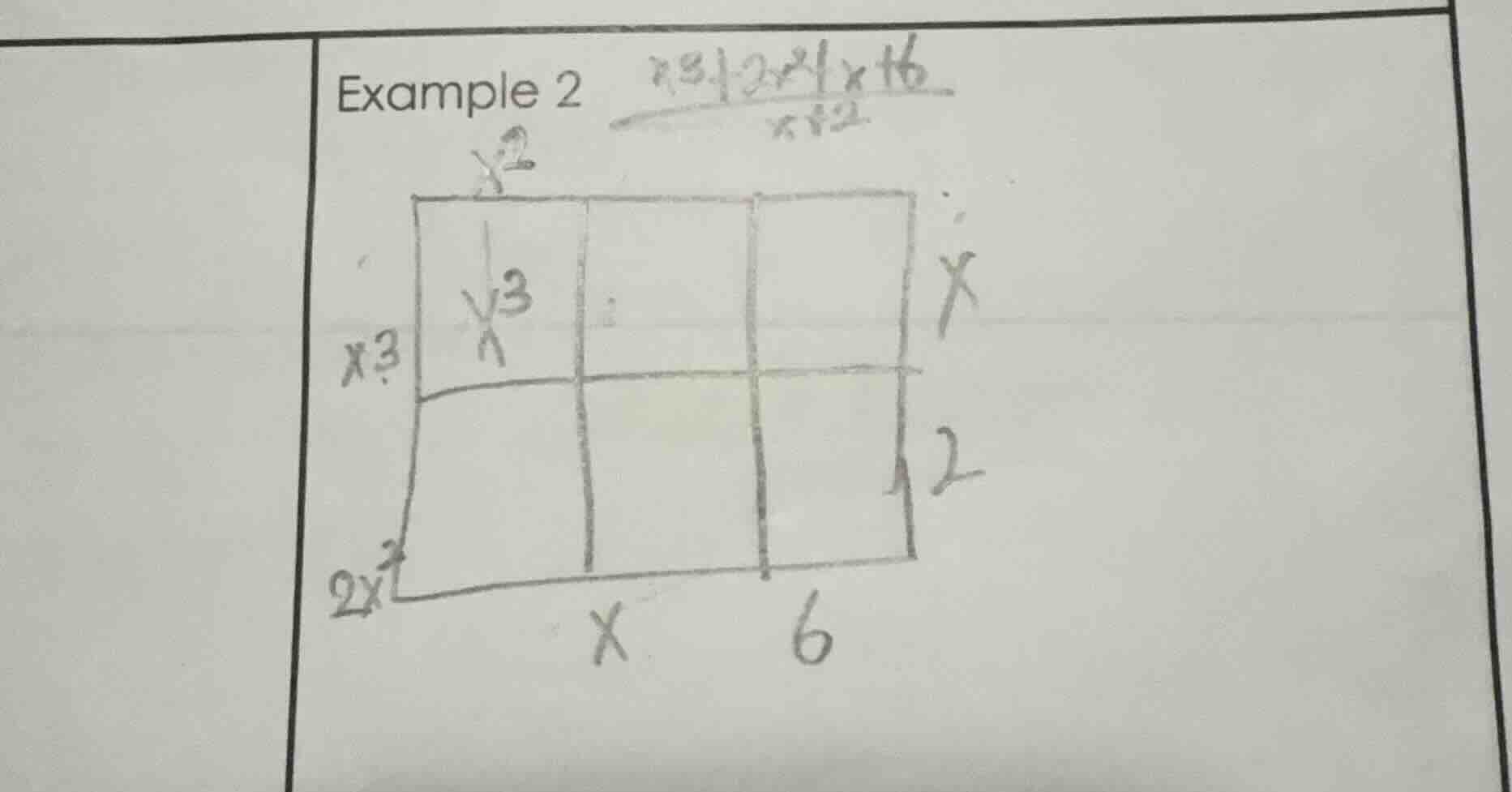
example 2 (x³ + 2x² + x + 6)/(x + 2) (and a diagram with algebraic terms like x³, x², 2x², x, 6, 2, x)
Step1: Analyze the rectangle area model
The diagram seems to represent the multiplication of a polynomial (the height) and another polynomial (the width) to get the area of each small rectangle, and then sum them up. The height appears to be \(x^3 + 2x^2\) (wait, maybe re - examining: the left - hand side has terms \(x^3\) and \(2x^2\)? Wait, no, looking at the vertical sides: one side is \(x^3+2x^2\)? Wait, maybe the horizontal side is \(x^2 + x+6\) and the vertical side is \(x^3 + 2x^2\)? No, maybe the top horizontal is \(x^2+x + 6\) and the left vertical is \(x^3+2x^2\)? Wait, the small rectangles: the top - left is \(x^3\times x^2=x^5\)? Wait, no, the first small rectangle (top - left) is labeled \(x^3\) (vertical) and \(x^2\) (horizontal), so area \(x^3\times x^2 = x^{5}\)? Wait, maybe I misread. Wait, the fraction at the top is \(\frac{x^8 + 2x^7+x + 6}{x + 2}\)? No, the original fraction is maybe a typo, but the rectangle model is for polynomial multiplication or division. Wait, maybe the area of the big rectangle is the sum of the areas of the small rectangles. Let's assume the big rectangle has length \(x^2+x + 6\) and width \(x^3+2x^2\), and we want to find the area.
Wait, maybe the vertical side is \(x^3+2x^2\) (composed of \(x^3\) and \(2x^2\)) and the horizontal side is \(x^2+x + 6\) (composed of \(x^2\), \(x\), and \(6\)). Then the area of the big rectangle is \((x^3 + 2x^2)(x^2+x + 6)\).
Let's expand \((x^3+2x^2)(x^2+x + 6)\) using the distributive property (FOIL for polynomials, i.e., multiply each term in the first polynomial by each term in the second polynomial):
Step2: Distribute \(x^3\)
\(x^3\times x^2=x^5\), \(x^3\times x=x^4\), \(x^3\times6 = 6x^3\)
Step3: Distribute \(2x^2\)
\(2x^2\times x^2 = 2x^4\), \(2x^2\times x=2x^3\), \(2x^2\times6 = 12x^2\)
Step4: Combine like terms
Now, sum up all the terms: \(x^5+(x^4 + 2x^4)+(6x^3+2x^3)+12x^2\)
\(x^5 + 3x^4+8x^3 + 12x^2\)
Wait, but the fraction at the top is \(\frac{x^8+2x^7+x + 6}{x + 2}\), which seems different. Maybe the rectangle model is for polynomial division. Let's assume we are dividing \(x^8+2x^7+x + 6\) by \(x + 2\) using the area model.
In polynomial long division, if we divide \(x^8+2x^7+x + 6\) by \(x + 2\):
First term: \(\frac{x^8}{x}=x^7\), multiply \(x^7\) by \(x + 2\) gives \(x^8+2x^7\). Subtract this from \(x^8+2x^7+x + 6\), we get \(x + 6\). Then \(\frac{x}{x}=1\), multiply \(1\) by \(x + 2\) gives \(x+2\). Subtract from \(x + 6\), we get \(4\). So \(\frac{x^8+2x^7+x + 6}{x + 2}=x^7 + 1+\frac{4}{x + 2}\)
But the rectangle model: Let's see the vertical side as \(x + 2\) and the horizontal side as the quotient \(x^7+1\) with a remainder. The area of the big rectangle (dividend) is \((x + 2)(x^7+1)+4=x^8+2x^7+x + 2 + 4=x^8+2x^7+x + 6\), which matches the dividend.
Step1: Divide the leading terms
Divide the leading term of the dividend \(x^8\) by the leading term of the divisor \(x\), we get \(x^7\).
Step2: Multiply and subtract
Multiply \(x^7\) by the divisor \(x + 2\): \(x^7(x + 2)=x^8+2x^7\)
Subtract \(x^8+2x^7\) from the dividend \(x^8+2x^7+x + 6\): \((x^8+2x^7+x + 6)-(x^8+2x^7)=x + 6\)
Step3: Divide the new leading term
Divide the leading term of the new dividend \(x\) by the leading term of the divisor \(x\), we get \(1\).
Step4: Multiply and subtract
Multiply \(1\) by the divisor \(x + 2\): \(1\times(x + 2)=x + 2\)
Subtract \(x + 2\) from \(x + 6\): \((x + 6)-(x + 2)=4\)
Step5: Write the quotient and remainder
The quotient is \(x^7+1\) and the remainder is \(4\), so \(\frac{x^8+2x^7+x + 6}{x + 2}=x^7…

Snap & solve any problem in the app
Get step-by-step solutions on Sovi AI
Photo-based solutions with guided steps
Explore more problems and detailed explanations
If we are doing polynomial division of \(x^8 + 2x^7+x + 6\) by \(x + 2\), the quotient is \(x^7+1\) and the remainder is \(4\), so \(\frac{x^8+2x^7+x + 6}{x + 2}=x^7 + 1+\frac{4}{x + 2}\)