QUESTION IMAGE
Question
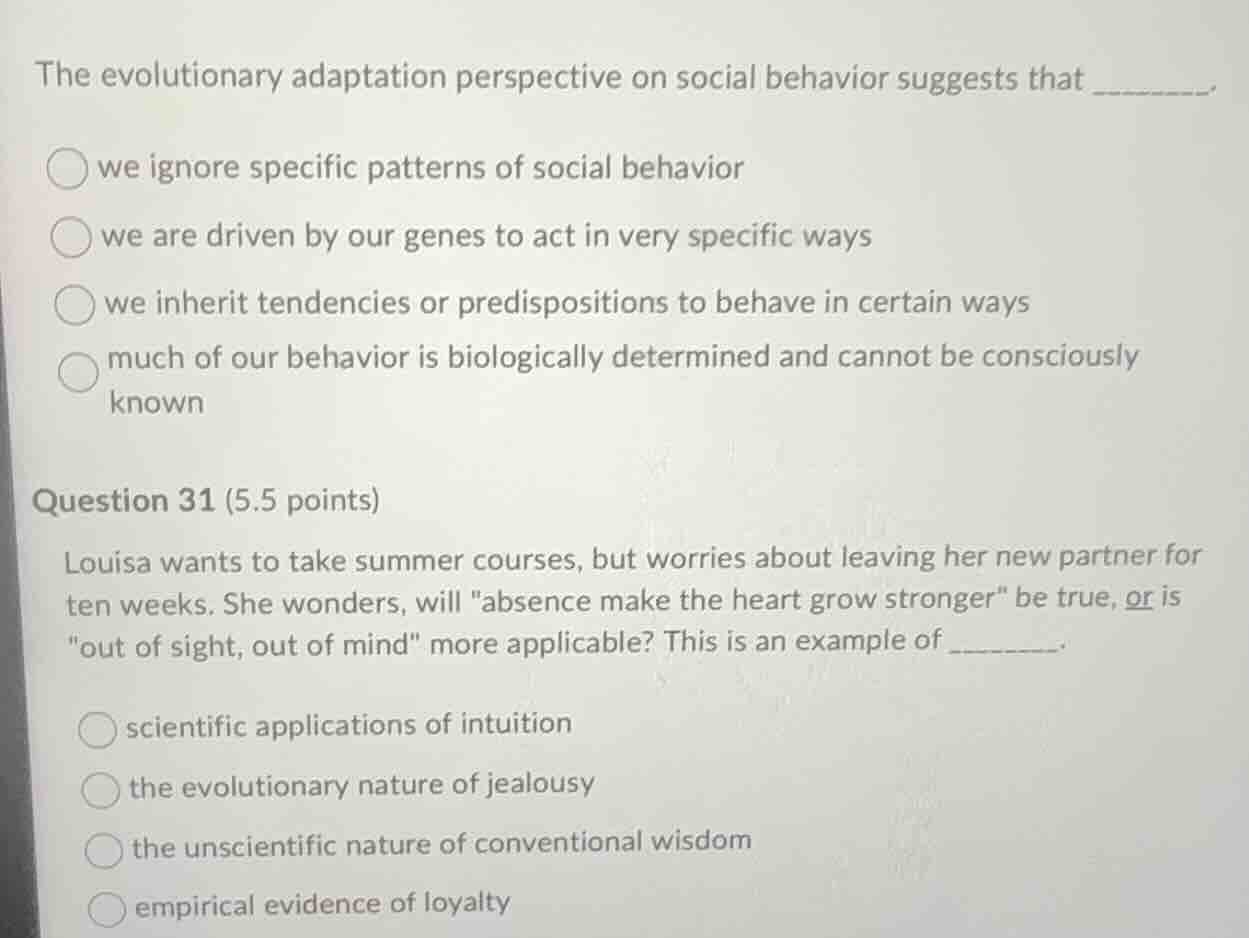
the evolutionary adaptation perspective on social behavior suggests that ______.
we ignore specific patterns of social behavior
we are driven by our genes to act in very specific ways
we inherit tendencies or predispositions to behave in certain ways
much of our behavior is biologically determined and cannot be consciously known
question 31 (5.5 points)
louisa wants to take summer courses, but worries about leaving her new partner for ten weeks. she wonders, will \absence make the heart grow stronger\ be true, or is \out of sight, out of mind\ more applicable? this is an example of ______.
scientific applications of intuition
the evolutionary nature of jealousy
the unscientific nature of conventional wisdom
empirical evidence of loyalty
Analyze the first question
This question asks about the evolutionary adaptation perspective on social behavior.
Evolutionary psychology suggests that humans inherit behavioral predispositions rather than rigid, genetically determined behaviors.
Therefore, we inherit tendencies or predispositions to behave in certain ways.
Analyze the second question
Louisa is comparing two contradictory proverbs: "absence makes the heart grow stronger" and "out of sight, out of mind."
These proverbs represent conventional wisdom (or common sense), which often provides contradictory explanations without scientific testing.
This demonstrates the unscientific nature of conventional wisdom.

Snap & solve any problem in the app
Get step-by-step solutions on Sovi AI
Photo-based solutions with guided steps
Explore more problems and detailed explanations
Question 1
- we ignore specific patterns of social behavior
- we are driven by our genes to act in very specific ways
- we inherit tendencies or predispositions to behave in certain ways (Correct answer)
- much of our behavior is biologically determined and cannot be consciously known
Question 2
- scientific applications of intuition
- the evolutionary nature of jealousy</mcq-correct>
- the unscientific nature of conventional wisdom (Correct answer)
<mcq-option>empirical evidence of loyalty