QUESTION IMAGE
Question
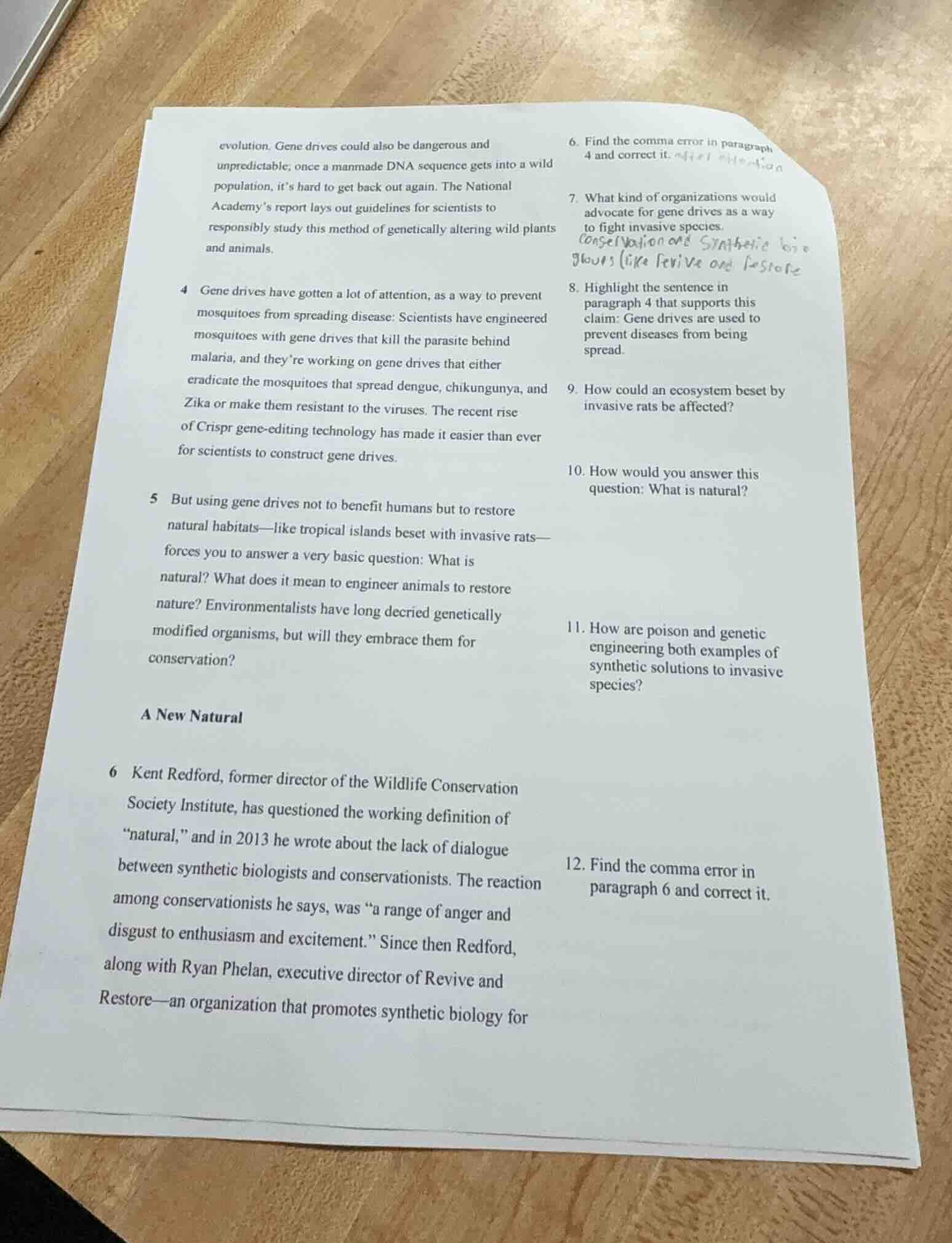
evolution. gene drives could also be dangerous and unpredictable; once a manmade dna sequence gets into a wild population, its hard to get back out again. the national academys report lays out guidelines for scientists to responsibly study this method of genetically altering wild plants and animals.
4 gene drives have gotten a lot of attention, as a way to prevent mosquitoes from spreading disease: scientists have engineered mosquitoes with gene drives that kill the parasite behind malaria, and theyre working on gene drives that either eradicate the mosquitoes that spread dengue, chikungunya, and zika or make them resistant to the viruses. the recent rise of crispr gene-editing technology has made it easier than ever for scientists to construct gene drives.
5 but using gene drives not to benefit humans but to restore natural habitats-like tropical islands beset with invasive rats-forces you to answer a very basic question: what is natural? what does it mean to engineer animals to restore nature? environmentalists have long decried genetically modified organisms, but will they embrace them for conservation?
a new natural
6 kent redford, former director of the wildlife conservation society institute, has questioned the working definition of
atural,\ and in 2013 he wrote about the lack of dialogue between synthetic biologists and conservationists. the reaction among conservationists he says, was \a range of anger and disgust to enthusiasm and excitement.\ since then redford, along with ryan phelan, executive director of revive and restore-an organization that promotes synthetic biology for
- find the comma error in paragraph 4 and correct it.
- what kind of organizations would advocate for gene drives as a way to fight invasive species.
- highlight the sentence in paragraph 4 that supports this claim: gene drives are used to prevent diseases from being spread.
- how could an ecosystem beset by invasive rats be affected?
- how would you answer this question: what is natural?
- how are poison and genetic engineering both examples of synthetic solutions to invasive species?
- find the comma error in paragraph 6 and correct it.
Identify comma error in paragraph 4
Paragraph 4 contains a comma splice: "...prevent mosquitoes from spreading disease: Scientists have engineered..." where the colon is fine, but the second sentence contains "...malaria, and they're working..." which is correct, but the first sentence has a comma splice before "Scientists" if it were a comma, or there is a missing comma in a compound predicate/clause. Looking closely at paragraph 4: "Gene drives have gotten a lot of attention, as a way to prevent..." The comma after "attention" is unnecessary and incorrect because "as a way..." is an essential prepositional phrase/modifier.
Analyze questions 7 to 12
- Question 7: Conservation and synthetic biology organizations (e.g., Revive and Restore).
- Question 8: "Scientists have engineered mosquitoes with gene drives that kill the parasite behind malaria, and they're working on gene drives that either eradicate the mosquitoes that spread dengue, chikungunya, and Zika or make them resistant to the viruses."
- Question 9: Invasive rats can devastate native bird populations, eat native plants, disrupt food webs, and cause extinctions of island species.
- Question 10: "Natural" traditionally refers to ecosystems and organisms that develop and exist without human genetic intervention or engineering.
- Question 11: Both are human-created, artificial interventions designed to control or eliminate pest populations rather than relying on natural ecological processes.
- Question 12: In paragraph 6: "The reaction among conservationists he says, was..." There is a missing comma before "he says" to set off the parenthetical interrupter. It should be: "The reaction among conservationists, he says, was..."

Snap & solve any problem in the app
Get step-by-step solutions on Sovi AI
Photo-based solutions with guided steps
Explore more problems and detailed explanations
Question 6
The comma after "attention" is incorrect.
Correction: "Gene drives have gotten a lot of attention as a way to prevent mosquitoes from spreading disease..."
Question 7
Conservation and synthetic biology organizations (such as Revive and Restore).
Question 8
"Scientists have engineered mosquitoes with gene drives that kill the parasite behind malaria, and they're working on gene drives that either eradicate the mosquitoes that spread dengue, chikungunya, and Zika or make them resistant to the viruses."
Question 9
Invasive rats can devastate native plant and animal populations, prey on native bird eggs, and disrupt the entire island ecosystem.
Question 10
"Natural" refers to organisms and environments that exist, grow, and evolve without human technological or genetic modification.
Question 11
Both are artificial, human-made interventions designed to manipulate or eliminate specific wild populations rather than letting nature regulate itself.
Question 12
There is a missing comma before the parenthetical phrase "he says".
Correction: "The reaction among conservationists, he says, was..."