QUESTION IMAGE
Question
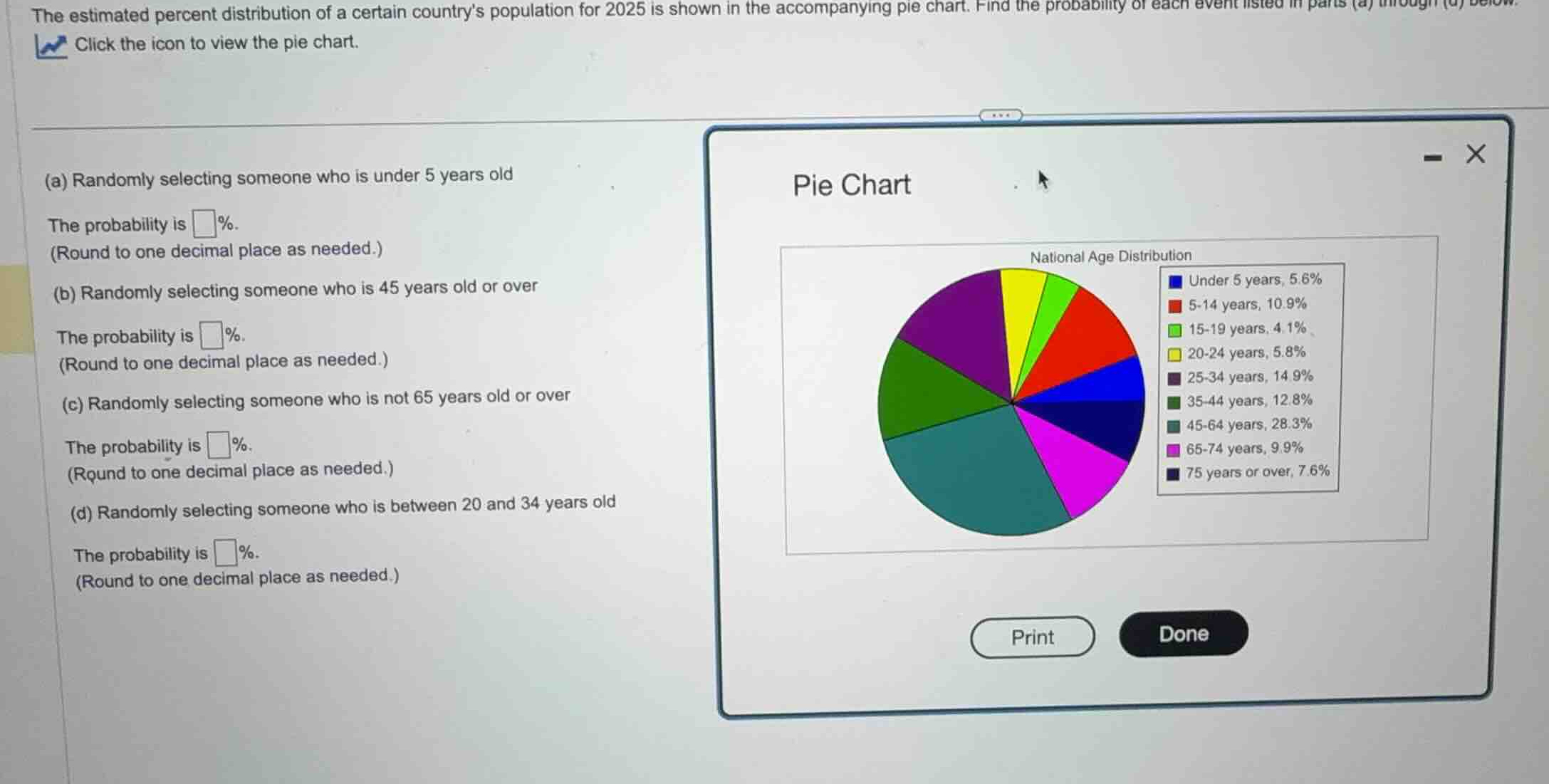
the estimated percent distribution of a certain countrys population for 2025 is shown in the accompanying pie chart. find the probability of each event listed in parts (a) through (d) below.
(a) randomly selecting someone who is under 5 years old
the probability is \\(\square\\)%.
(round to one decimal place as needed.)
(b) randomly selecting someone who is 45 years old or over
the probability is \\(\square\\)%.
(round to one decimal place as needed.)
(c) randomly selecting someone who is not 65 years old or over
the probability is \\(\square\\)%.
(round to one decimal place as needed.)
(d) randomly selecting someone who is between 20 and 34 years old
the probability is \\(\square\\)%.
(round to one decimal place as needed.)
Identify the given distribution data
Using the Pie Chart Construction knowledge point, we extract the percentage distribution for each age group from the provided chart:
- Under 5 years: \(5.6\%\)
- 5-14 years: \(10.9\%\)
- 15-19 years: \(4.1\%\)
- 20-24 years: \(5.8\%\)
- 25-34 years: \(14.9\%\)
- 35-44 years: \(12.8\%\)
- 45-64 years: \(28.3\%\)
- 65-74 years: \(9.9\%\)
- 75 years or over: \(7.6\%\)
Calculate probability for part (a)
The event is selecting someone who is under 5 years old.
From the data, the percentage for "Under 5 years" is \(5.6\%\).
Thus, the probability is:
Calculate probability for part (b)
Using the Addition Rule for Probability knowledge point
The event is selecting someone who is 45 years old or over. This includes the following mutually exclusive categories:
- 45-64 years: \(28.3\%\)
- 65-74 years: \(9.9\%\)
- 75 years or over: \(7.6\%\)
Summing these percentages:
Calculate probability for part (c)
Using the Complementary Events knowledge point
The event is selecting someone who is not 65 years old or over.
First, find the probability of the complement, which is being 65 years old or over:
- 65-74 years: \(9.9\%\)
- 75 years or over: \(7.6\%\)
Using the complement rule:
Calculate probability for part (d)
Using the Addition Rule for Probability knowledge point
The event is selecting someone who is between 20 and 34 years old. This includes:
- 20-24 years: \(5.8\%\)
- 25-34 years: \(14.9\%\)
Summing these percentages:

Snap & solve any problem in the app
Get step-by-step solutions on Sovi AI
Photo-based solutions with guided steps
Explore more problems and detailed explanations
Question 1
(a) Randomly selecting someone who is under 5 years old
The probability is <blank>5.6</blank>%.
Question 2
(b) Randomly selecting someone who is 45 years old or over
The probability is <blank>45.8</blank>%.
Question 3
(c) Randomly selecting someone who is not 65 years old or over
The probability is <blank>82.5</blank>%.
Question 4
(d) Randomly selecting someone who is between 20 and 34 years old
The probability is <blank>20.7</blank>%.