QUESTION IMAGE
Question
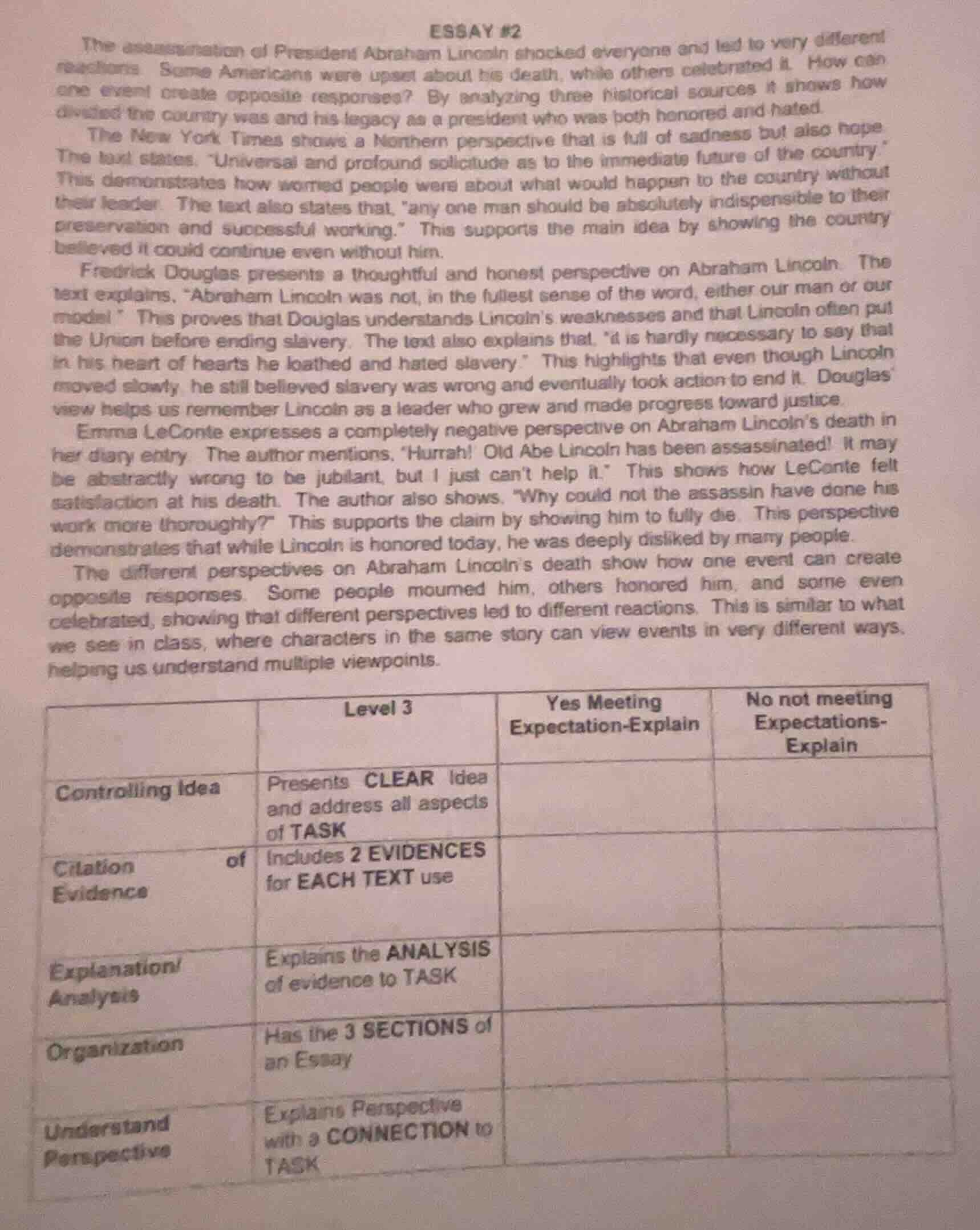
essay #2
the assassination of president abraham lincoln shocked everyone and led to very different reactions. some americans were upset about his death, while others celebrated it. how can one event create opposite responses? by analyzing three historical sources it shows how divided the country was and his legacy as a president who was both honored and hated.
the new york times shows a northern perspective that is full of sadness but also hope. the text states, “universal and profound solicitude as to the immediate future of the country.” this demonstrates how worried people were about what would happen to the country without their leader. the text also states that, “any one man should be absolutely indispensible to their preservation and successful working.” this supports the main idea by showing the country believed it could continue even without him.
fredrick douglas presents a thoughtful and honest perspective on abraham lincoln. the text explains, “abraham lincoln was not, in the fullest sense of the word, either our man or our model.” this proves that douglas understands lincoln’s weaknesses and that lincoln often put the union before ending slavery. the text also explains that, “it is hardly necessary to say that in his heart of hearts he loathed and hated slavery.” this highlights that even though lincoln moved slowly, he still believed slavery was wrong and eventually took action to end it. douglas’ view helps us remember lincoln as a leader who grew and made progress toward justice.
emma leconte expresses a completely negative perspective on abraham lincoln’s death in her diary entry. the author mentions, “hurrah! old abe lincoln has been assassinated! it may be abstractly wrong to be jubilant, but i just can’t help it.” this shows how leconte felt satisfaction at his death. the author also shows, “why could not the assassin have done his work more thoroughly?” this supports the claim by showing him to fully die. this perspective demonstrates that while lincoln is honored today, he was deeply disliked by many people.
the different perspectives on abraham lincoln’s death show how one event can create opposite responses. some people mourned him, others honored him, and some even celebrated, showing that different perspectives led to different reactions. this is similar to what we see in class, where characters in the same story can view events in very different ways, helping us understand multiple viewpoints.
| level 3 | yes meeting expectation-explain | no not meeting expectations-explain | |
|---|---|---|---|
| citation of evidence | includes 2 evidences for each text use | ||
| explanation/analysis | explains the analysis of evidence to task | ||
| organization | has the 3 sections of an essay | ||
| understand perspective | explains perspective with a connection to task |
- Controlling Idea: The essay clearly states a central idea about divided reactions to Lincoln's assassination and addresses all parts of the task (explaining opposing responses via historical sources).
- Citation of Evidence: For each of the three sources (New York Times, Frederick Douglas, Emma LeConte), the essay includes two direct textual evidences.
- Explanation/Analysis: Each cited evidence is linked back to the task, explaining how it shows divided perspectives or reactions to Lincoln's death.
- Organization: The essay has the 3 core essay sections: an introductory paragraph stating the controlling idea, body paragraphs analyzing each source, and a concluding paragraph summarizing the argument.
- Understand Perspective: Each source's perspective (Northern sadness, Douglas's nuanced view, LeConte's celebration) is explained and connected to the task of showing opposing responses to the assassination.

Snap & solve any problem in the app
Get step-by-step solutions on Sovi AI
Photo-based solutions with guided steps
Explore more problems and detailed explanations
| Category | Yes Meeting Expectation-Explain | No not meeting Expectations-Explain |
|---|---|---|
| Citation of Evidence | Yes: 2 evidences per source (3 total sources) | - |
| Explanation/Analysis | Yes: Links evidence to task's core question | - |
| Organization | Yes: Has intro, body, conclusion sections | - |
| Understand Perspective | Yes: Explains each source's view tied to task | - |