QUESTION IMAGE
Question
the engineering feat of roman aqueducts
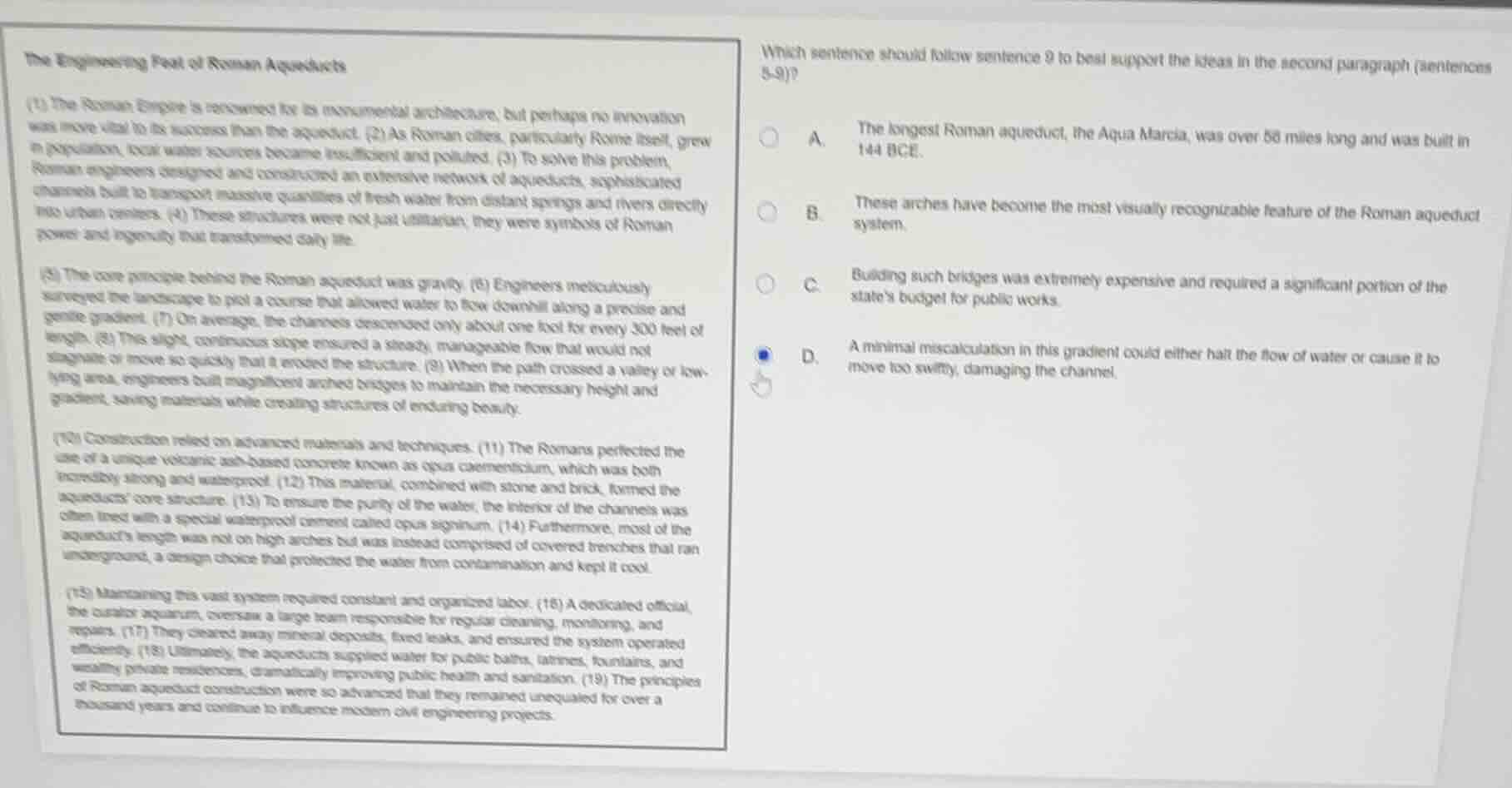
(1) the roman empire is renowned for its monumental architecture, but perhaps no innovation was more vital to its success than the aqueduct. (2) as roman cities, particularly rome itself, grew in population, local water sources became insufficient and polluted. (3) to solve this problem, roman engineers designed and constructed an extensive network of aqueducts, sophisticated channels built to transport massive quantities of fresh water from distant springs and rivers directly into urban centers. (4) these structures were not just utilitarian; they were symbols of roman power and ingenuity that transformed daily life.
(5) the core principle behind the roman aqueduct was gravity. (6) engineers meticulously surveyed the landscape to plot a course that allowed water to flow downhill along a precise and gentle gradient. (7) on average, the channels descended only about one foot for every 300 feet of length. (8) this slight, continuous slope ensured a steady, manageable flow that would not stagnate or move so quickly that it eroded the structure. (9) when the path crossed a valley or low-lying area, engineers built magnificent arched bridges to maintain the necessary height and gradient, saving materials while creating structures of enduring beauty.
(10) construction relied on advanced materials and techniques. (11) the romans perfected the use of a unique volcanic ash-based concrete known as opus caementicium, which was both incredibly strong and waterproof. (12) this material, combined with stone and brick, formed the aqueducts core structure. (13) to ensure the purity of the water, the interior of the channels was often lined with a special waterproof cement called opus signinum. (14) furthermore, most of the aqueducts length was not on high arches but was instead comprised of covered trenches that ran underground, a design choice that protected the water from contamination and kept it cool.
(15) maintaining this vast system required constant and organized labor. (16) a dedicated official, the curator aquarum, oversaw a large team responsible for regular cleaning, monitoring, and repairs. (17) they cleared away mineral deposits, fixed leaks, and ensured the system operated efficiently. (18) ultimately, the aqueducts supplied water for public baths, latrines, fountains, and wealthy private residences, dramatically improving public health and sanitation. (19) the principles of roman aqueduct construction were so advanced that they remained unequaled for over a thousand years and continue to influence modern civil engineering projects.
which sentence should follow sentence 9 to best support the ideas in the second paragraph (sentences 5-9)?
a. the longest roman aqueduct, the aqua marcia, was over 58 miles long and was built in 144 bce.
b. these arches have become the most visually recognizable feature of the roman aqueduct system.
c. building such bridges was extremely expensive and required a significant portion of the states budget for public works.
d. a minimal miscalculation in this gradient could either halt the flow of water or cause it to move too swiftly, damaging the channel.
Analyze the paragraph's main idea
The second paragraph (sentences 5–9) focuses on the core engineering principle of Roman aqueducts: gravity and the precise gradient required to keep water flowing. It describes how engineers surveyed the landscape to plot a precise, gentle gradient (sentences 5–6), details the specific slope of about one foot for every 300 feet of length (sentence 7), explains how this slight slope kept water moving at a manageable speed (sentence 8), and mentions how bridges were built to maintain this gradient across valleys (sentence 9).
Evaluate the connection of each option
- Option A introduces a specific historical fact about the Aqua Marcia. This does not support the paragraph's focus on the engineering principles of gravity and gradient.
- Option B discusses the visual recognition of arches. While sentence 9 mentions arched bridges, the paragraph's primary focus is engineering functionality, not visual aesthetics.
- Option C introduces the financial cost of building bridges, which is off-topic for a paragraph about physical engineering and gravity.
- Option D directly addresses the gradient and the consequences of a miscalculation ("halt the flow of water or cause it to move too swiftly, damaging the channel"). This perfectly reinforces and concludes the discussion of the precise slope and flow speed described in sentences 6–8.
Apply textual analysis
Using Textual Analysis, we see that Option D provides the strongest logical continuation. It directly connects back to the central theme of the paragraph—the necessity of a precise gradient to control water flow speed—by explaining the high stakes of engineering precision.

Snap & solve any problem in the app
Get step-by-step solutions on Sovi AI
Photo-based solutions with guided steps
Explore more problems and detailed explanations
- (A) The longest Roman aqueduct, the Aqua Marcia, was over 58 miles long and was built in 144 BCE.
- (B) These arches have become the most visually recognizable feature of the Roman aqueduct system.
- (C) Building such bridges was extremely expensive and required a significant portion of the state's budget for public works.
- (D) A minimal miscalculation in this gradient could either halt the flow of water or cause it to move too swiftly, damaging the channel. (Correct answer)