Sovi.AI - AI Math Tutor

Scan to solve math questions

QUESTION IMAGE

the embryonic heart begins to beat in the ______ week after fertilizati…

Question

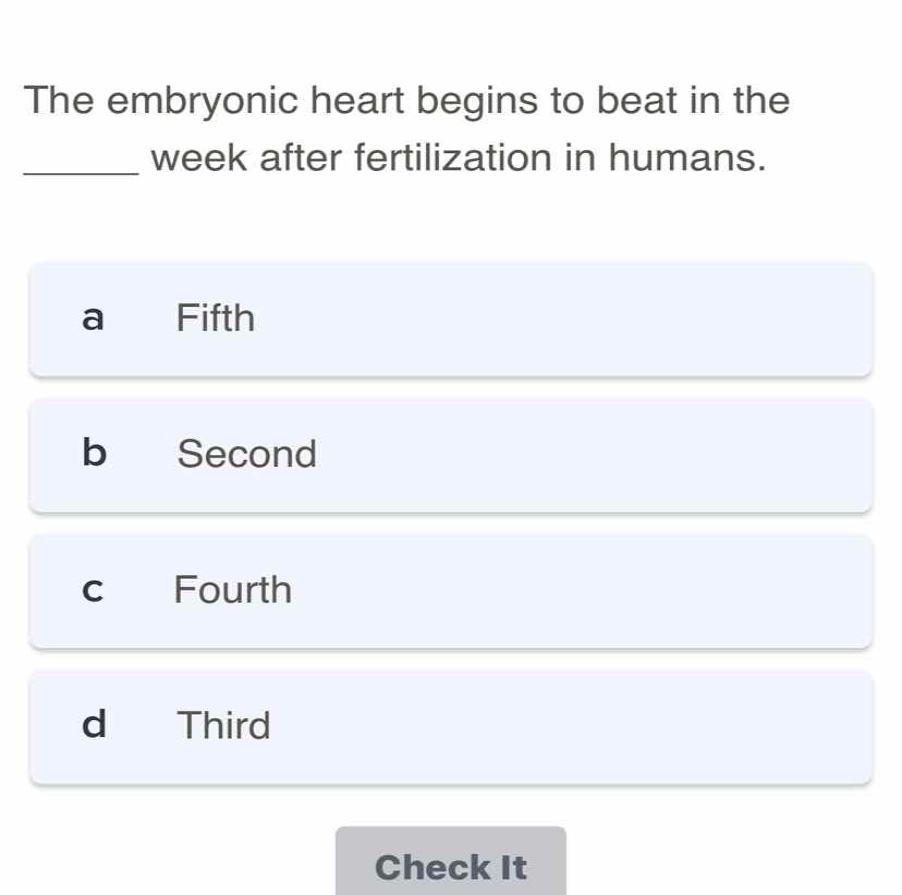
the embryonic heart begins to beat in the ______ week after fertilization in humans.

a fifth
b second
c fourth
d third

Explanation:

Response

<pre_analysis>
{
"quality": "clear",
"question_count": 1,
"skills_matched": [
"direct_cot",
"multiple_choice_formatter",
"explain_then_answer",
"tutor"
],
"needs_drawing": false,
"concepts_used": [
"Human Prenatal Development",
"Embryonic Stage",
"Organogenesis Timeline"
],
"new_concepts": [
"Embryonic Heart Development"
],
"current_concepts": [
"Human Prenatal Development",
"Embryonic Stage",
"Organogenesis Timeline",
"Embryonic Heart Development"
]
}
</pre_analysis>

<reasoning>

Identify the developmental milestone

The question asks for the specific week after fertilization when the embryonic heart begins to beat in humans. This relates to Human Prenatal Development and the Embryonic Stage.

Analyze the organogenesis timeline

During Organogenesis Timeline, the cardiovascular system is the first major organ system to become functional. The heart begins as a simple tube-like structure.

Determine the exact timing

The heart tube begins to beat rhythmically approximately 21 to 22 days after fertilization. This corresponds to the beginning of the fourth week after fertilization (specifically, during week 3 of development, which is the 4th week of gestation if counting from the last menstrual period, but precisely the fourth week after fertilization).

Evaluate the given options

  • (a) Fifth: Too late; the heart is already beating.
  • (b) Second: Too early; gastrulation is occurring.
  • (c) Fourth: Correct, as 21–22 days falls in the fourth week (days 22–28).
  • (d) Third: The heart tube forms but does not yet beat.

</reasoning>

<answer>
<mcq-option>a Fifth</mcq-option>
<mcq-option>b Second</mcq-option>
<mcq-correct>c Fourth</mcq-correct>
<mcq-option>d Third</mcq-option>
</answer>

<post_analysis>
{
"subject": "Natural Science",
"question_type": "Multiple Choice",
"knowledge_point": [
"Natural Science",
"Biology",
"Human Prenatal Development"
]
}
</post_analysis>

Answer:

<pre_analysis>
{
"quality": "clear",
"question_count": 1,
"skills_matched": [
"direct_cot",
"multiple_choice_formatter",
"explain_then_answer",
"tutor"
],
"needs_drawing": false,
"concepts_used": [
"Human Prenatal Development",
"Embryonic Stage",
"Organogenesis Timeline"
],
"new_concepts": [
"Embryonic Heart Development"
],
"current_concepts": [
"Human Prenatal Development",
"Embryonic Stage",
"Organogenesis Timeline",
"Embryonic Heart Development"
]
}
</pre_analysis>

<reasoning>

Identify the developmental milestone

The question asks for the specific week after fertilization when the embryonic heart begins to beat in humans. This relates to Human Prenatal Development and the Embryonic Stage.

Analyze the organogenesis timeline

During Organogenesis Timeline, the cardiovascular system is the first major organ system to become functional. The heart begins as a simple tube-like structure.

Determine the exact timing

The heart tube begins to beat rhythmically approximately 21 to 22 days after fertilization. This corresponds to the beginning of the fourth week after fertilization (specifically, during week 3 of development, which is the 4th week of gestation if counting from the last menstrual period, but precisely the fourth week after fertilization).

Evaluate the given options

  • (a) Fifth: Too late; the heart is already beating.
  • (b) Second: Too early; gastrulation is occurring.
  • (c) Fourth: Correct, as 21–22 days falls in the fourth week (days 22–28).
  • (d) Third: The heart tube forms but does not yet beat.

</reasoning>

<answer>
<mcq-option>a Fifth</mcq-option>
<mcq-option>b Second</mcq-option>
<mcq-correct>c Fourth</mcq-correct>
<mcq-option>d Third</mcq-option>
</answer>

<post_analysis>
{
"subject": "Natural Science",
"question_type": "Multiple Choice",
"knowledge_point": [
"Natural Science",
"Biology",
"Human Prenatal Development"
]
}
</post_analysis>