QUESTION IMAGE
Question
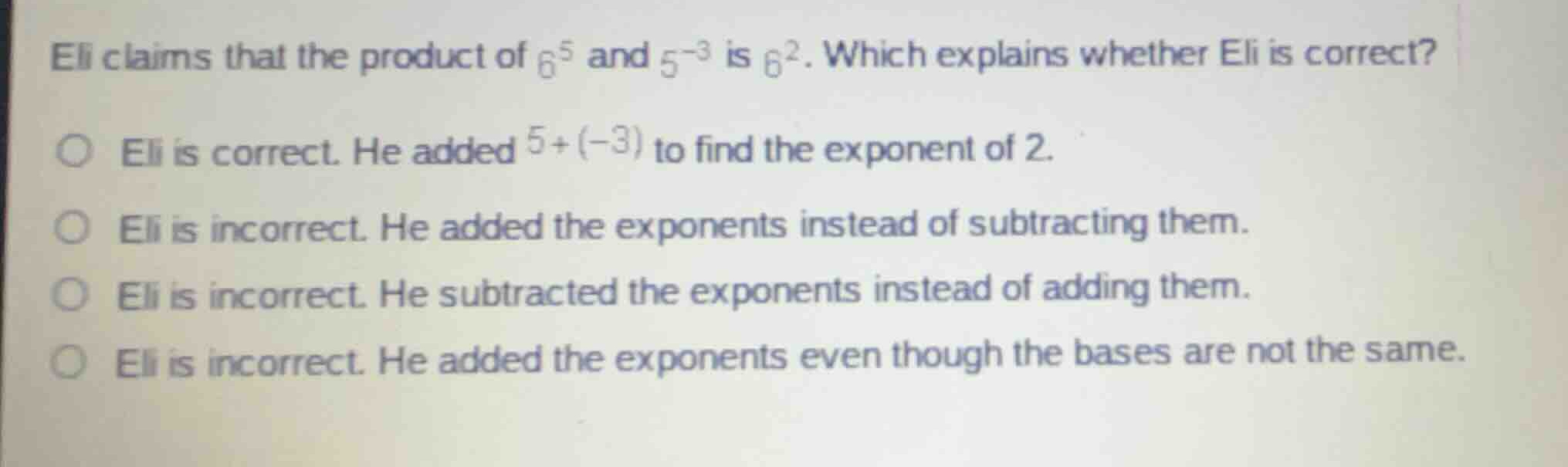
eli claims that the product of (6^5) and (5^{-3}) is (6^2). which explains whether eli is correct?
eli is correct. he added (5 + (-3)) to find the exponent of 2.
eli is incorrect. he added the exponents instead of subtracting them.
eli is incorrect. he subtracted the exponents instead of adding them.
eli is incorrect. he added the exponents even though the bases are not the same.
Analyze the product of the exponential expressions
$$
6^5 \cdot 5^{-3}
$$
Apply exponent rules for different bases
$$
a^m \cdot b^n
eq (ab)^{m+n} \quad \text{and} \quad a^m \cdot b^n
eq a^{m+n} \quad \text{for } a
eq b
$$
$$
6^5 \cdot 5^{-3} = \frac{6^5}{5^3} = \frac{7776}{125} = 62.208
$$
$$
6^2 = 36
$$
$$
6^5 \cdot 5^{-3}
eq 6^2
$$
Identify Eli's error
$$
5 + (-3) = 2
$$
Eli added the exponents \(5\) and \(-3\) to get the exponent \(2\), but this rule only applies when the bases are the same:
$$
a^m \cdot a^n = a^{m+n}
$$
Since the bases are \(6\) and \(5\) (which are not the same), this rule cannot be applied.

Snap & solve any problem in the app
Get step-by-step solutions on Sovi AI
Photo-based solutions with guided steps
Explore more problems and detailed explanations
- Eli is correct. He added \(5 + (-3)\) to find the exponent of 2.
- Eli is incorrect. He added the exponents instead of subtracting them.
- Eli is incorrect. He subtracted the exponents instead of adding them.
- Eli is incorrect. He added the exponents even though the bases are not the same. (Correct answer)