QUESTION IMAGE
Question
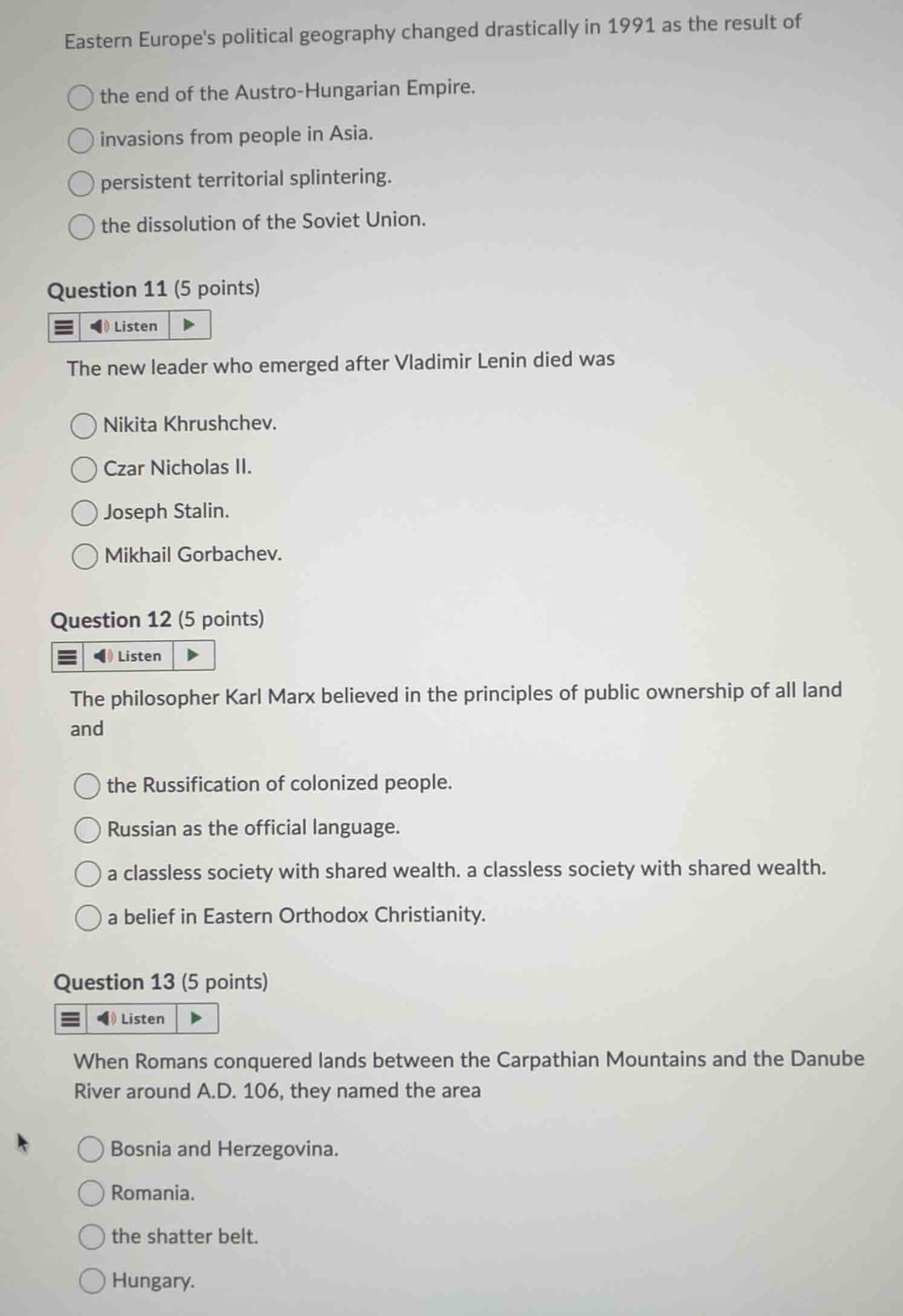
eastern europes political geography changed drastically in 1991 as the result of
the end of the austro-hungarian empire.
invasions from people in asia.
persistent territorial splintering.
the dissolution of the soviet union.
question 11 (5 points)
the new leader who emerged after vladimir lenin died was
nikita khrushchev.
czar nicholas ii.
joseph stalin.
mikhail gorbachev.
question 12 (5 points)
the philosopher karl marx believed in the principles of public ownership of all land and
the russification of colonized people.
russian as the official language.
a classless society with shared wealth. a classless society with shared wealth.
a belief in eastern orthodox christianity.
question 13 (5 points)
when romans conquered lands between the carpathian mountains and the danube river around a.d. 106, they named the area
bosnia and herzegovina.
romania.
the shatter belt.
hungary.
Analyze the political changes in Eastern Europe in 1991
The year 1991 marked the official dissolution of the Soviet Union (USSR), which fundamentally redrew the political boundaries of Eastern Europe as former Soviet republics gained independence.
Identify the successor to Vladimir Lenin
Following the death of Vladimir Lenin in 1924, Joseph Stalin consolidated power and emerged as the undisputed leader of the Soviet Union.
Determine Karl Marx's core principles
Karl Marx advocated for the abolition of private property in favor of public ownership, aiming to establish a classless society where wealth and resources are shared collectively.
Identify the Roman province between the Carpathians and the Danube
In A.D. 106, Emperor Trajan conquered the region situated between the Carpathian Mountains and the Danube River, establishing the Roman province of Dacia, which corresponds to modern-day Romania.

Snap & solve any problem in the app
Get step-by-step solutions on Sovi AI
Photo-based solutions with guided steps
Explore more problems and detailed explanations
Question 10
- (A) the end of the Austro-Hungarian Empire.
- (B) invasions from people in Asia.
- (C) persistent territorial splintering.
- (D) the dissolution of the Soviet Union. (Correct answer)
Question 11
- (A) Nikita Khrushchev.
- (B) Czar Nicholas II.
- (C) Joseph Stalin. (Correct answer)
- (D) Mikhail Gorbachev.
Question 12
- (A) the Russification of colonized people.
- (B) Russian as the official language.
- (C) a classless society with shared wealth. a classless society with shared wealth. (Correct answer)
- (D) a belief in Eastern Orthodox Christianity.
Question 13
- (A) Bosnia and Herzegovina.
- (B) Romania. (Correct answer)
- (C) the shatter belt.
- (D) Hungary.