QUESTION IMAGE
Question
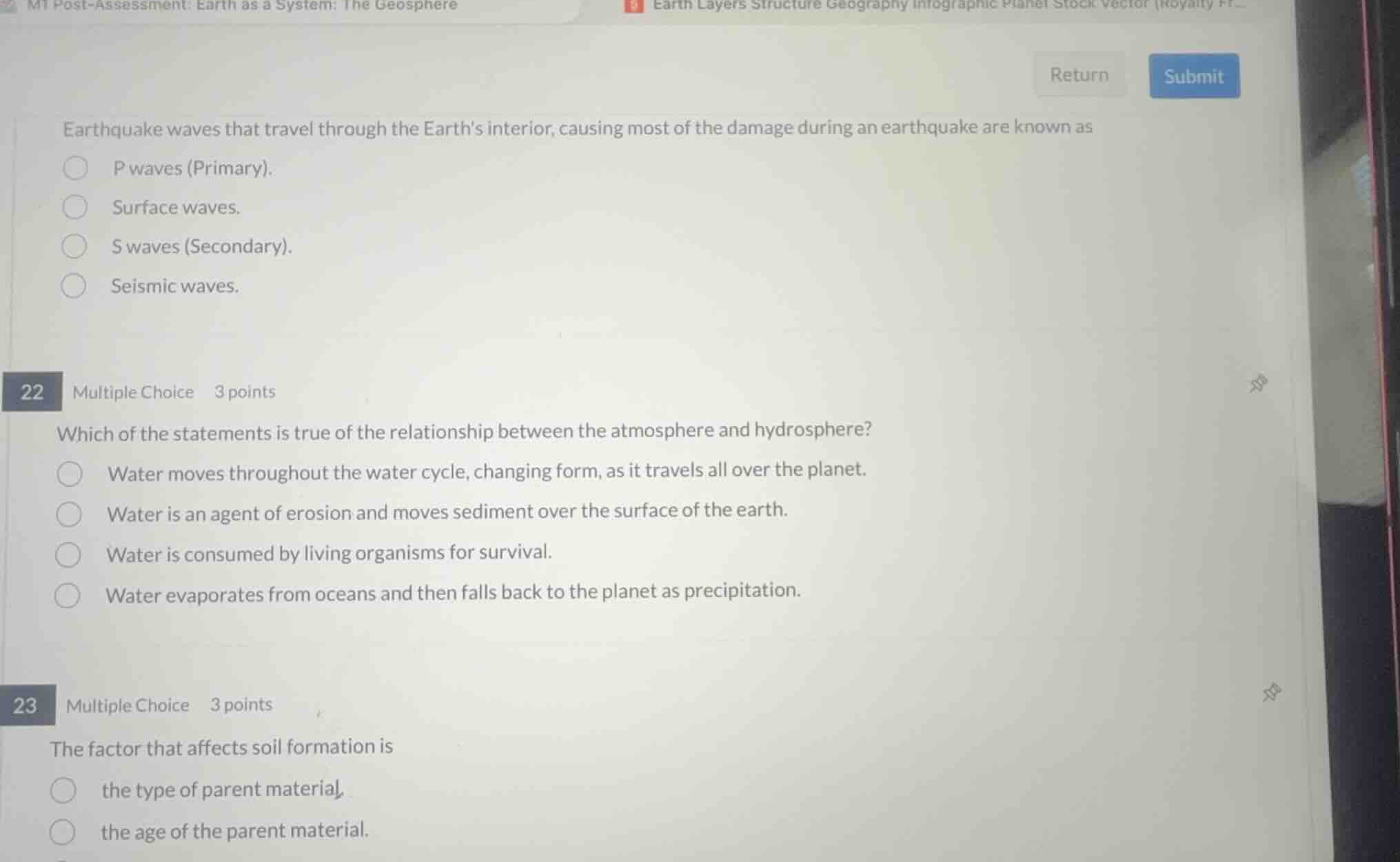
earthquake waves that travel through the earths interior, causing most of the damage during an earthquake are known as
p waves (primary).
surface waves.
s waves (secondary).
seismic waves.
22 multiple choice 3 points
which of the statements is true of the relationship between the atmosphere and hydrosphere?
water moves throughout the water cycle, changing form, as it travels all over the planet.
water is an agent of erosion and moves sediment over the surface of the earth.
water is consumed by living organisms for survival.
water evaporates from oceans and then falls back to the planet as precipitation.
23 multiple choice 3 points
the factor that affects soil formation is
the type of parent material,
the age of the parent material.
Analyze the first question on seismic waves
The question asks for the name of earthquake waves that travel through Earth's interior and cause most of the damage.
- Body waves (P waves and S waves) travel through Earth's interior.
- Surface waves travel along Earth's surface and cause the most severe ground movement and damage.
- "Seismic waves" is the general term for all earthquake waves.
- The phrasing "Earthquake waves that travel through the Earth's interior, causing most of the damage..." contains a slight conceptual tension (surface waves cause most damage, but body waves travel through the interior). However, looking at standard curriculum questions, "Seismic waves" is the overarching term for all waves generated by an earthquake. Let's re-evaluate: "Earthquake waves... are known as" points directly to the general definition of "Seismic waves".
Analyze Question 22 on sphere interactions
The question asks for a true statement regarding the relationship between the atmosphere (air) and hydrosphere (water).
- Option 1 describes the water cycle generally.
- Option 2 describes hydrosphere-geosphere interaction (erosion).
- Option 3 describes hydrosphere-biosphere interaction (living organisms).
- Option 4 ("Water evaporates from oceans and then falls back to the planet as precipitation") directly involves the hydrosphere (oceans, precipitation) and the atmosphere (where evaporation, condensation, and transport occur).
Analyze Question 23 on soil formation
The question asks for a factor that affects soil formation.
- The visible options are "the type of parent material" and "the age of the parent material".
- Both parent material type (composition/structure) and time (age/duration of weathering) are key factors in soil formation.
- Since the image is cropped and only shows these two options, and both are scientifically correct factors of soil formation (often part of a "all of the above" or we must select the primary one, usually "the type of parent material" is the first listed standard factor). Let's provide the best-fit option from the visible choices. "the type of parent material" is a primary active factor.

Snap & solve any problem in the app
Get step-by-step solutions on Sovi AI
Photo-based solutions with guided steps
Explore more problems and detailed explanations
Question 1
- (A) P waves (Primary).
- (B) Surface waves.
- (C) S waves (Secondary).
- (D) Seismic waves. (Correct answer)
Question 22
- (A) Water moves throughout the water cycle, changing form, as it travels all over the planet.
- (B) Water is an agent of erosion and moves sediment over the surface of the earth.
- (C) Water is consumed by living organisms for survival.
- (D) Water evaporates from oceans and then falls back to the planet as precipitation. (Correct answer)
Question 23
- (A) the type of parent material (Correct answer)
- (B) the age of the parent material.