QUESTION IMAGE
Question
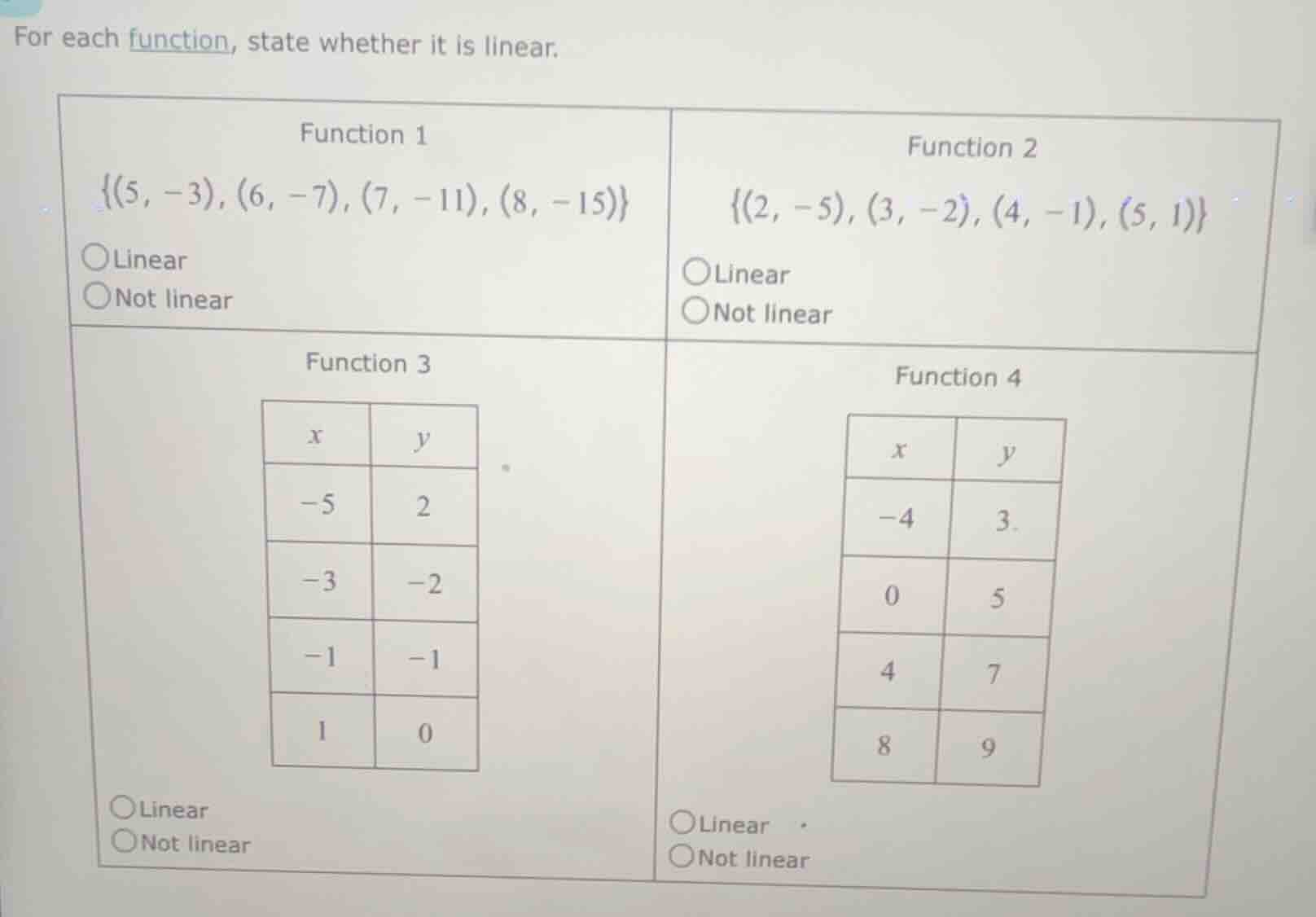
for each function, state whether it is linear.
function 1
{(5, -3), (6, -7), (7, -11), (8, -15)}
○linear
○not linear
function 2
{(2, -5), (3, -2), (4, -1), (5, 1)}
○linear
○not linear
function 3
| x | y |
| -5 | 2 |
| -3 | -2 |
| -1 | -1 |
| 1 | 0 |
○linear
○not linear
function 4
| x | y |
| -4 | 3 |
| 0 | 5 |
| 4 | 7 |
| 8 | 9 |
○linear
○not linear
Function 1
Step1: Calculate the slope between consecutive points.
For points \((5, -3)\) and \((6, -7)\), the slope \(m_1=\frac{-7 - (-3)}{6 - 5}=\frac{-4}{1}=-4\).
For points \((6, -7)\) and \((7, -11)\), the slope \(m_2=\frac{-11 - (-7)}{7 - 6}=\frac{-4}{1}=-4\).
For points \((7, -11)\) and \((8, -15)\), the slope \(m_3=\frac{-15 - (-11)}{8 - 7}=\frac{-4}{1}=-4\).
Step2: Check if slopes are equal.
Since \(m_1 = m_2 = m_3=-4\), the function has a constant slope.
Step1: Calculate the slope between consecutive points.
For points \((2, -5)\) and \((3, -2)\), the slope \(m_1=\frac{-2 - (-5)}{3 - 2}=\frac{3}{1}=3\).
For points \((3, -2)\) and \((4, -1)\), the slope \(m_2=\frac{-1 - (-2)}{4 - 3}=\frac{1}{1}=1\).
Step2: Check if slopes are equal.
Since \(m_1 = 3\) and \(m_2 = 1\) are not equal, the function does not have a constant slope.
Step1: Calculate the slope between consecutive points.
For points \((-5, 2)\) and \((-3, -2)\), the slope \(m_1=\frac{-2 - 2}{-3 - (-5)}=\frac{-4}{2}=-2\).
For points \((-3, -2)\) and \((-1, -1)\), the slope \(m_2=\frac{-1 - (-2)}{-1 - (-3)}=\frac{1}{2}=0.5\).
Step2: Check if slopes are equal.
Since \(m_1=-2\) and \(m_2 = 0.5\) are not equal, the function does not have a constant slope.

Snap & solve any problem in the app
Get step-by-step solutions on Sovi AI
Photo-based solutions with guided steps
Explore more problems and detailed explanations
Linear