QUESTION IMAGE
Question
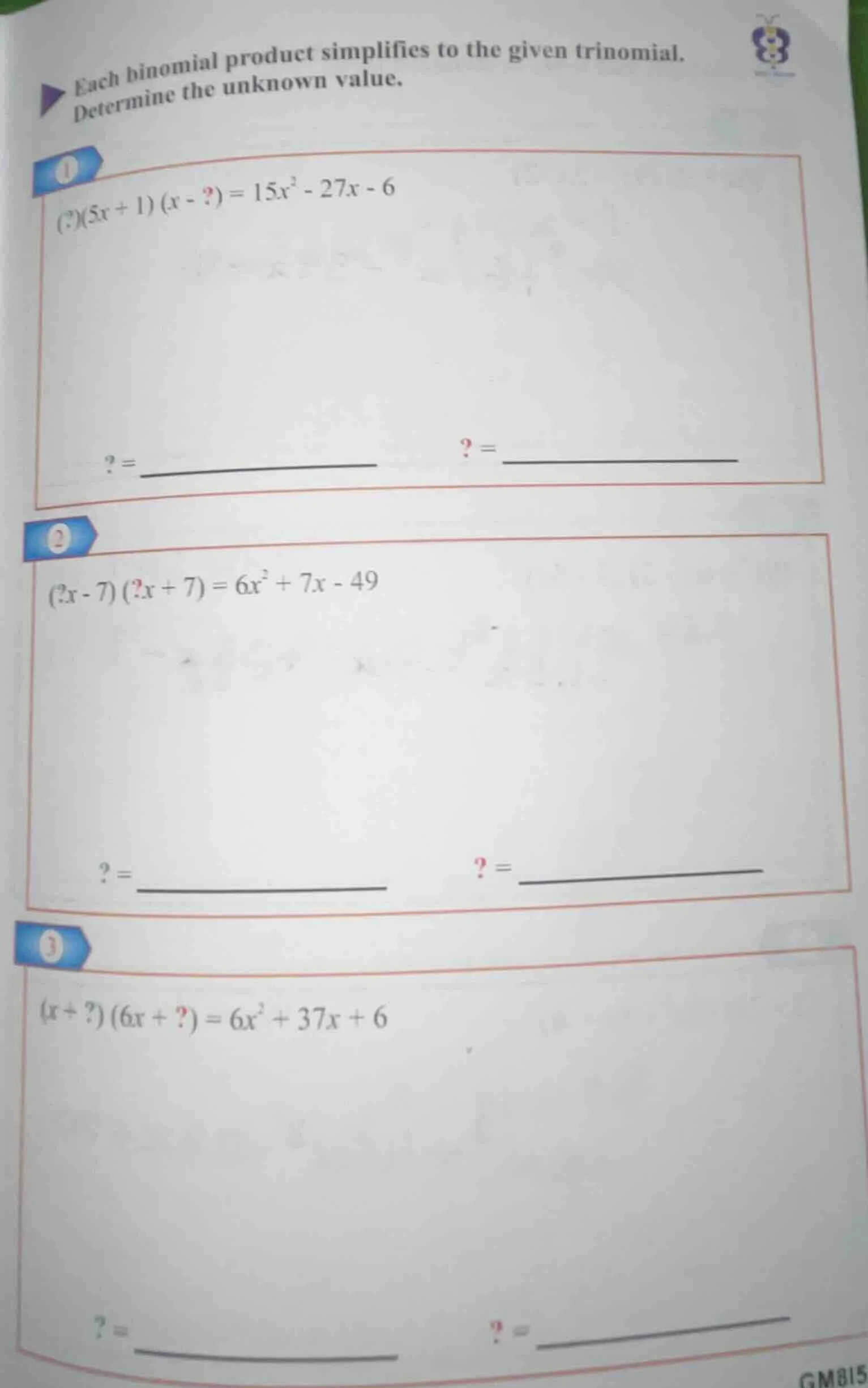
each binomial product simplifies to the given trinomial. determine the unknown value.
1
(?) (5x + 1)(x - ?) = 15x² - 27x - 6
? =
? =
2
(?x - 7)(?x + 7) = 6x² + 7x - 49
? =
? =
3
(x + ?)(6x + ?) = 6x² + 37x + 6
? =
? =
Problem 1
Step 1: Find the first unknown (coefficient of the first binomial)
Let the first unknown be \( a \), so the left - hand side is \( a(5x + 1)(x - b)=15x^{2}-27x - 6 \) (let the second unknown be \( b \)). First, expand \( (5x + 1)(x - b)=5x^{2}-5bx+x - b = 5x^{2}+(1 - 5b)x - b \). Then multiply by \( a \): \( a(5x^{2}+(1 - 5b)x - b)=5ax^{2}+a(1 - 5b)x - ab \).
Compare the coefficient of \( x^{2} \): \( 5a = 15 \), so \( a=\frac{15}{5}=3 \).
Step 2: Find the second unknown \( b \)
Now that \( a = 3 \), compare the constant term: \( -ab=-6 \). Substitute \( a = 3 \), we get \( - 3b=-6 \), so \( b = 2 \). We can also check the linear term: \( a(1 - 5b)=3(1 - 5b) \). Substitute \( b = 2 \), \( 3(1-10)=3\times(-9)=-27 \), which matches the linear term of the right - hand side.
Step 1: Find the first unknown (coefficient of \( x \) in the binomials)
Let the unknown coefficient be \( a \), so the left - hand side is \( (ax - 7)(ax + 7)=a^{2}x^{2}-49 \). The right - hand side is \( 6x^{2}+7x - 49 \). Compare the coefficient of \( x^{2} \): \( a^{2}=6 \)? No, wait, there is a linear term on the right - hand side. Wait, actually, the left - hand side as a difference of squares is \( a^{2}x^{2}-49 \), but the right - hand side is \( 6x^{2}+7x - 49 \). So our initial assumption is wrong. Let's expand \( (ax - 7)(bx + 7)=abx^{2}+7ax-7bx - 49=abx^{2}+(7a - 7b)x - 49 \). Compare with \( 6x^{2}+7x - 49 \).
So \( ab = 6 \) and \( 7(a - b)=7 \), which implies \( a - b = 1 \). Solve the system \(
\). From \( a=b + 1 \), substitute into \( ab = 6 \): \( (b + 1)b=6 \), \( b^{2}+b - 6=0 \), factor: \( (b + 3)(b - 2)=0 \). So \( b=-3 \) or \( b = 2 \). If \( b = 2 \), then \( a=3 \); if \( b=-3 \), then \( a=-2 \). Let's check the linear term: \( 7(a - b) \). If \( a = 3 \), \( b = 2 \), \( 7(3 - 2)=7 \), which matches. So \( a = 3 \), \( b = 3 \)? Wait, no, \( (3x-7)(3x + 7)=9x^{2}-49
eq6x^{2}+7x - 49 \). Wait, I made a mistake. Let's expand \( (ax-7)(bx + 7)=abx^{2}+7ax-7bx - 49=abx^{2}+7(a - b)x - 49 \). We have \( ab = 6 \) and \( 7(a - b)=7\Rightarrow a - b = 1 \). Let's solve \( ab = 6 \) and \( a=b + 1 \). Substitute \( a=b + 1 \) into \( ab = 6 \): \( b(b + 1)=6\Rightarrow b^{2}+b - 6 = 0\Rightarrow(b + 3)(b - 2)=0\Rightarrow b = 2\) or \( b=-3 \). If \( b = 3 \), no, wait, when \( b = 3 \), \( a=4 \), \( ab = 12
eq6 \). Wait, the correct way: Let the first binomial be \( (ax-7) \) and the second be \( (bx + 7) \). Expand: \( abx^{2}+7ax-7bx - 49=abx^{2}+7(a - b)x - 49 \). We need \( ab = 6 \) and \( 7(a - b)=7\Rightarrow a - b = 1 \). So \( a=b + 1 \), then \( (b + 1)b=6\Rightarrow b^{2}+b - 6=0\Rightarrow b = 2 \) (since \( b=-3 \) gives \( a=-2 \), and \( (-2x-7)(-2x + 7)=4x^{2}-49
eq6x^{2}+7x - 49 \)). So \( b = 3 \)? No, \( b = 2 \), \( a=3 \). Wait, \( (3x-7)(2x + 7)=6x^{2}+21x-14x - 49=6x^{2}+7x - 49 \). Ah! So the first binomial is \( (3x-7) \) and the second is \( (2x + 7) \)? No, the problem has \( (?x-7)(?x + 7) \), so both coefficients of \( x \) are the same? Wait, no, the original problem is \( (?x - 7)(?x + 7) \), so it's a product of two binomials with the same coefficient of \( x \), so it should be a difference of squares \( a^{2}x^{2}-49 \), but the right - hand side is \( 6x^{2}+7x - 49 \), which is not a difference of squares. So there is a mistake in my initial approach. Let's expand \( (ax-7)(bx + 7)=abx^{2}+(7a - 7b)x - 49 \). Set equal to \( 6x^{2}+7x - 49 \). So:
- \( ab = 6 \) (coefficient of \( x^{2} \))
- \( 7(a - b)=7\Rightarrow a - b = 1 \) (coefficient of \( x \))
- \( - 49=-49 \) (constant term)
From \( a - b = 1 \), we have \( a=b + 1 \). Substitute into \( ab = 6 \): \( b(b + 1)=6\Rightarrow b^{2}+b - 6=0\Rightarrow(b + 3)(b - 2)=0\). So \( b = 2 \) or \( b=-3 \).
If \( b = 2 \), then \( a=3 \). Let's check \( (3x-7)(2x + 7)=6x^{2}+21x-14x - 49=6x^{2}+7x - 49 \). Yes! So the first \(? = 3 \) and the second \(? = 2 \)? But the problem has \( (?x - 7)(?x + 7) \), so the coefficients of \( x \) are different. Wait, the problem's notation is \( (?x - 7)(?x + 7) \), maybe it's a typo, and it's supposed to be \( (ax - 7)(bx + 7) \). So the first \(? = 3 \) and the second \(? = 2 \).
Step 1: Let the unknowns be \( a \) and \( b \)
Let the first binomial be \( (x + a) \) and the second be \( (6x + b) \). Expand \( (x + a)(6x + b)=6x^{2}+bx+6ax+ab=6x^{2}+(b + 6a)x+ab \).
Step 2: Compare coefficients
We have the system of equations:
- Coefficient of \( x^{2} \): \( 6 = 6 \) (which is always true)
- Coefficient of \( x \): \( b + 6a=37 \)
- Constant term: \( ab = 6 \)
From \( ab = 6 \), the possible pairs of positive integers \( (a,b) \) are \( (1,6) \), \( (2,3) \), \( (3,2) \), \( (6,1) \).
Test \( a = 6 \), \( b = 1 \): \( b + 6a=1+36 = 37 \), which matches the coefficient of \( x \).
Test \( a = 1 \), \( b = 6 \): \( 6 + 6\times1=12
eq37 \)
Test \( a = 2 \), \( b = 3 \): \( 3+6\times2 = 15
eq37 \)
Test \( a = 3 \), \( b = 2 \): \( 2+6\times3=20
eq37 \)

Snap & solve any problem in the app
Get step-by-step solutions on Sovi AI
Photo-based solutions with guided steps
Explore more problems and detailed explanations
First \(? = 3 \), second \(? = 2 \)