QUESTION IMAGE
Question
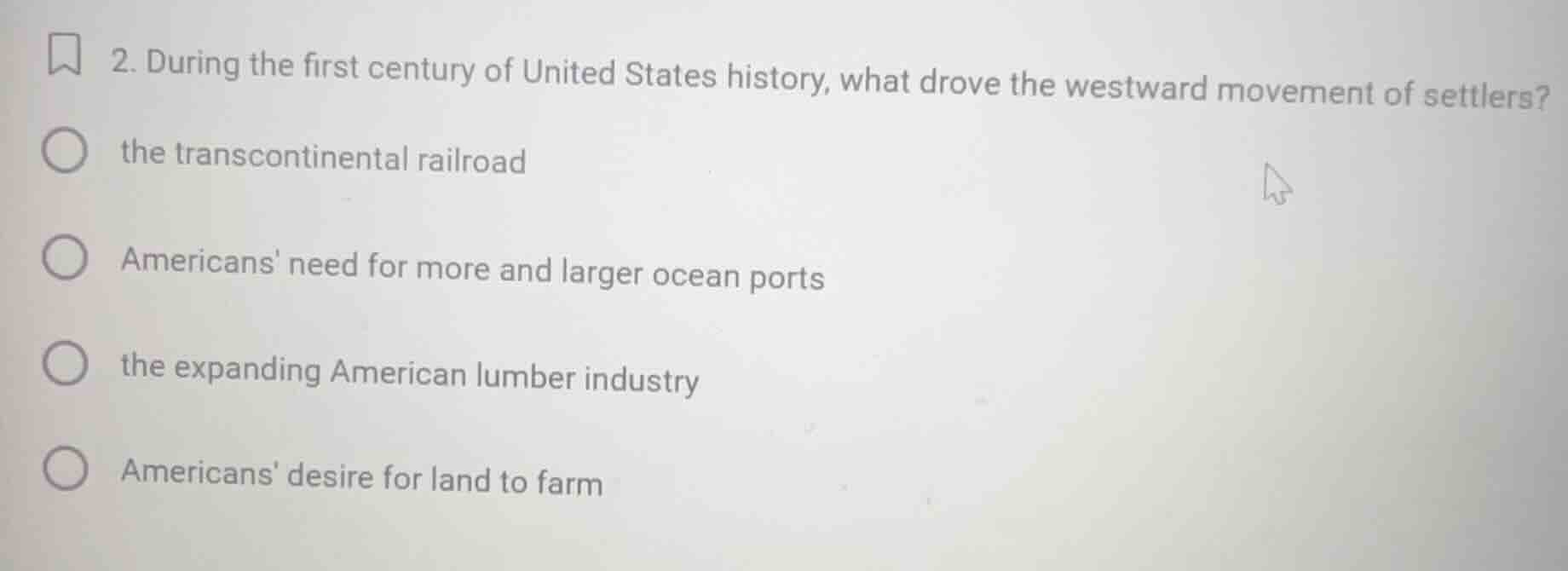
- during the first century of united states history, what drove the westward movement of settlers?
the transcontinental railroad
americans need for more and larger ocean ports
the expanding american lumber industry
americans desire for land to farm
Analyze the historical timeframe
The question asks about the primary driver of westward movement during the first century of United States history. The first century of US history spans from approximately 1776 to 1876. During this era, the nation expanded from the Atlantic coast across the Mississippi River to the Pacific Ocean.
Evaluate the agricultural motivation
Throughout the late 18th and 19th centuries, the United States was predominantly an agrarian society. The vast majority of citizens made their living through farming. As the population grew rapidly due to natural increase and immigration, the demand for fertile, affordable agricultural land became the primary pull factor drawing families westward. This is deeply connected to North American Geography and the availability of arable land in the Great Plains and Midwest.
Assess the alternative options
- The transcontinental railroad: While highly influential, it was completed in 1869, near the end of the first century of US history. Westward migration was already heavily underway decades prior via trails and rivers.
- Need for more and larger ocean ports: Westward expansion moved settlers inland, away from ocean ports, making this choice geographically illogical.
- The expanding American lumber industry: While timber was an important resource, it was a localized industry and not the primary driver for the millions of individual settlers migrating west.
Connect to historical push-pull factors
The desire to own and cultivate land was the foundational element of the American Dream during this period. Government policies, such as the Homestead Act of 1862, directly supported this by offering free or cheap land to citizens willing to farm it, cementing agricultural opportunity as the main driver of westward migration.

Snap & solve any problem in the app
Get step-by-step solutions on Sovi AI
Photo-based solutions with guided steps
Explore more problems and detailed explanations
- the transcontinental railroad
- Americans' need for more and larger ocean ports
- the expanding American lumber industry
- Americans' desire for land to farm (Correct answer)