QUESTION IMAGE
Question
due thursday
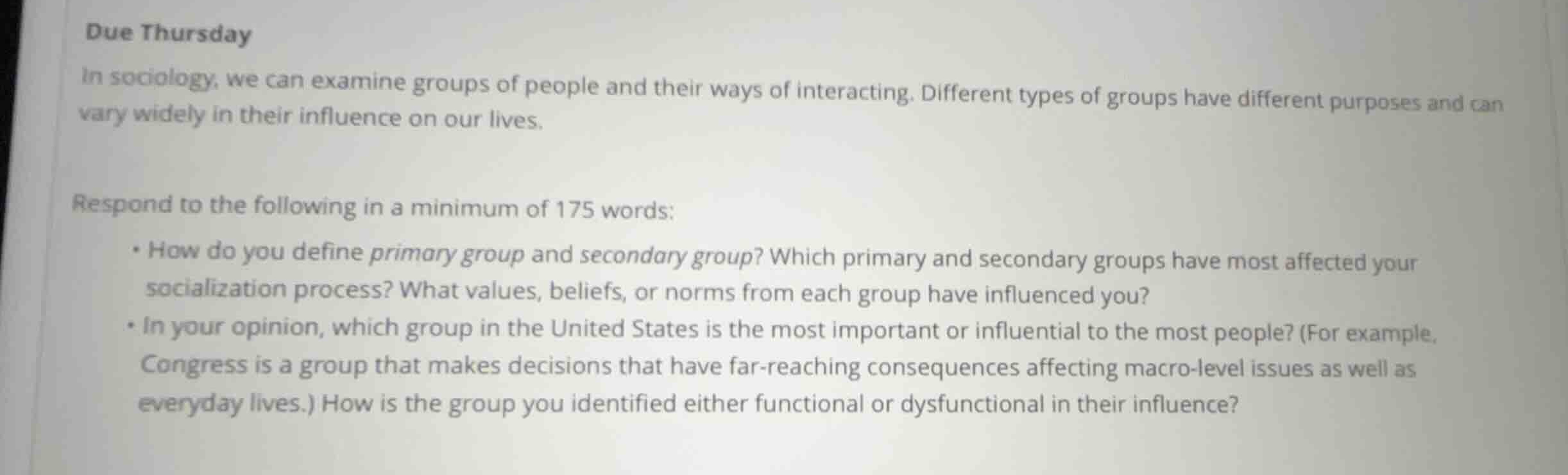
in sociology, we can examine groups of people and their ways of interacting. different types of groups have different purposes and can vary widely in their influence on our lives.
respond to the following in a minimum of 175 words:
- how do you define primary group and secondary group? which primary and secondary groups have most affected your socialization process? what values, beliefs, or norms from each group have influenced you?
- in your opinion, which group in the united states is the most important or influential to the most people? (for example, congress is a group that makes decisions that have far-reaching consequences affecting macro-level issues as well as everyday lives.) how is the group you identified either functional or dysfunctional in their influence?
Define primary and secondary groups
In sociology, a primary group is a small, informal social group whose members share close, personal, and enduring relationships (e.g., family, close friends). A secondary group is a larger, impersonal, and often temporary group focused on a specific task, goal, or activity (e.g., co-workers, classmates, or political organizations).
Connect to the socialization process
Using the Socialization Process knowledge point, we analyze how these groups transmit values, beliefs, and norms. Primary groups (like family) serve as the primary agent of socialization, instilling foundational values such as honesty, empathy, and cultural traditions. Secondary groups (like a university class or workplace) socialize individuals into specific roles, teaching professional norms, punctuality, and formal communication.
Identify the most influential macro-level group
At a macro-level, the family remains the most universally influential group in the United States, though formal secondary institutions like the education system or the federal government (e.g., Congress) also hold massive structural influence. For most people, the family is the foundational unit that shapes early life, class position, and initial worldview.
Evaluate functional and dysfunctional aspects
From a functionalist perspective, the family is highly functional because it stabilizes adult personalities, socializes children, and provides emotional support. However, it can be dysfunctional if it perpetuates inequality, reinforces harmful stereotypes, or fails to provide a safe environment, thereby disrupting social cohesion.

Snap & solve any problem in the app
Get step-by-step solutions on Sovi AI
Photo-based solutions with guided steps
Explore more problems and detailed explanations
Primary vs. Secondary Groups and Socialization
A primary group is a small, intimate social group characterized by close, personal, and long-term relationships. Examples include immediate family members and lifelong friends. These groups are critical to our emotional well-being and identity. In contrast, a secondary group is larger, more impersonal, and task-oriented. These groups are often temporary and organized around a specific goal, such as co-workers, classmates, or members of a professional association.
In the Socialization Process, primary groups play the most fundamental role. For most individuals, the family is the primary group that shapes early development, instilling core values like empathy, respect, and cultural traditions, alongside norms like sharing and basic manners. Secondary groups, such as a school peer group or workplace team, influence later socialization by teaching secondary norms like professional etiquette, punctuality, and competitive teamwork.
Macro-Level Influence: Functional vs. Dysfunctional
At a macro-level, the family remains the most influential group in the United States because it serves as the primary institution reproducing society.
- Functional Influence: The family is functional because it socializes new members of society, provides economic and emotional security, and establishes social identity and status.
- Dysfunctional Influence: The family can be dysfunctional when it transmits systemic biases, experiences severe conflict, or fails to support its members, which can lead to broader social instability and perpetuate cycles of inequality.