QUESTION IMAGE
Question
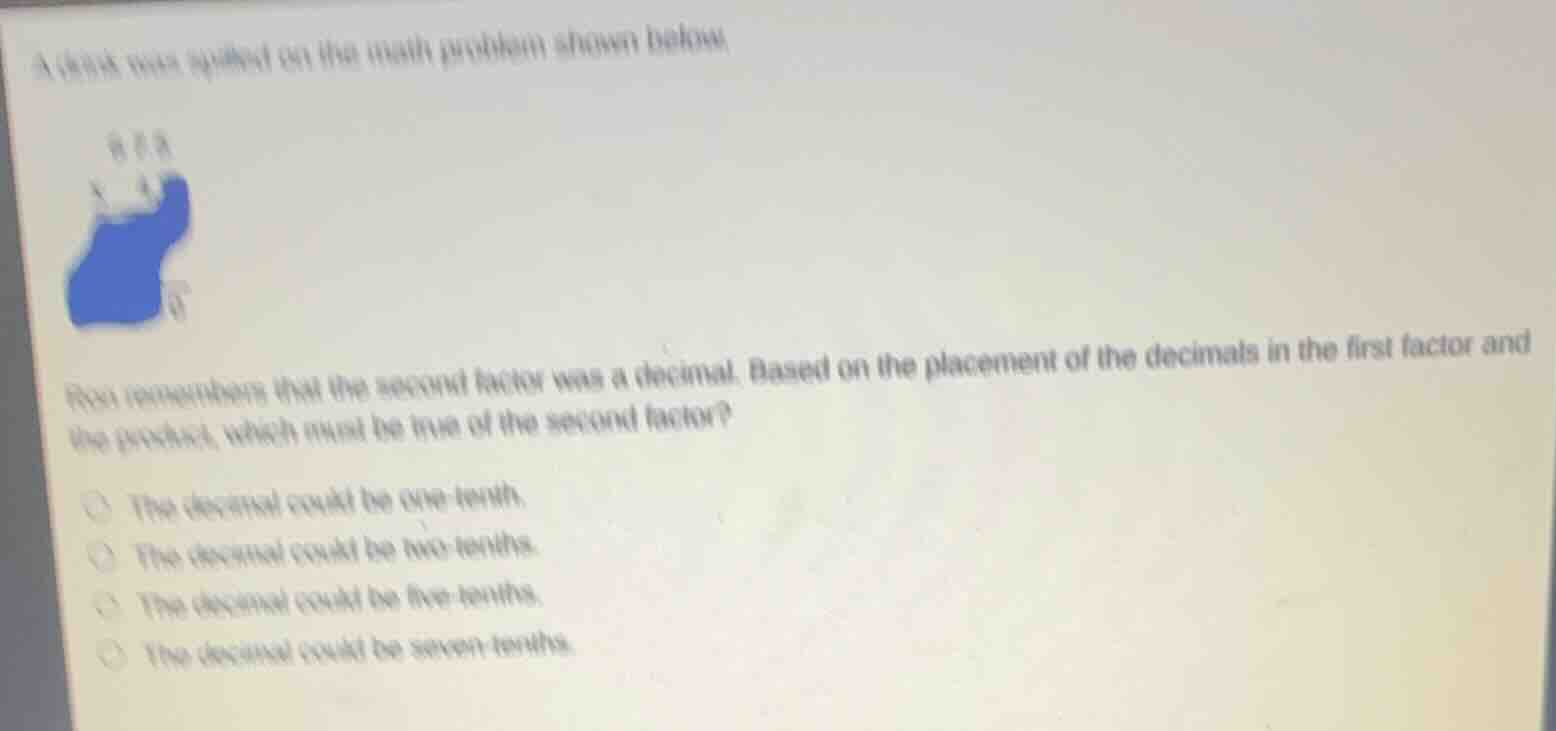
a drink was spilled on the math problem shown below.
\
ron remembers that the second factor was a decimal. based on the placement of the decimals in the first factor and the product, which must be true of the second factor?
- the decimal could be one-tenth.
- the decimal could be two-tenths.
- the decimal could be five-tenths.
- the decimal could be seven-tenths.
Identify the visible numbers
The image shows a multiplication problem partially covered by a spill.
The first factor is \(8.78\).
The product is \(7.024\).
The second factor is covered, but we can see a decimal point and a \(0\) at the end of the calculation, with a decimal point visible in the second factor.
Analyze decimal places
Using the Decimal Places concept, we know that when multiplying decimals, the number of decimal places in the product is equal to the sum of the decimal places in the factors.
The first factor, \(8.78\), has \(2\) decimal places.
The product, \(7.024\), has \(3\) decimal places.
Determine the decimal places of the second factor
Using the Decimal Multiplication concept, we set up the relationship:
Therefore, the second factor must have exactly \(1\) decimal place (which means it is in the tenths place).
Evaluate the options
Let's check the options provided:
- "The decimal could be one-tenth." (This means \(1\) decimal place, which is tenths).
- "The decimal could be two-tenths." (This would mean hundredths, i.e., \(2\) decimal places).
- "The decimal could be five-tenths." (This would mean tenths, but let's look at the wording: "one-tenth" refers to the place value of the decimal, meaning it has one decimal place, i.e., tenths).
In standard place value terminology, "one-tenth" refers to having a single digit after the decimal point (the tenths place). Therefore, the second factor must be in the tenths place (one-tenth).

Snap & solve any problem in the app
Get step-by-step solutions on Sovi AI
Photo-based solutions with guided steps
Explore more problems and detailed explanations
- The decimal could be one-tenth. (Correct answer)
- The decimal could be two-tenths.
- The decimal could be five-tenths.
- The decimal could be seven-tenths.