QUESTION IMAGE
Question
drag each description to the correct image.
fossils help researchers learn more about living beings that existed long ago. match each fossil with its related information about early humans.
the ability of early humans to express themselves through art
the posture and bipedalism of early humans
the ability of early humans to use natural resources for survival
the size of the early human brain
Analyze the fossil images
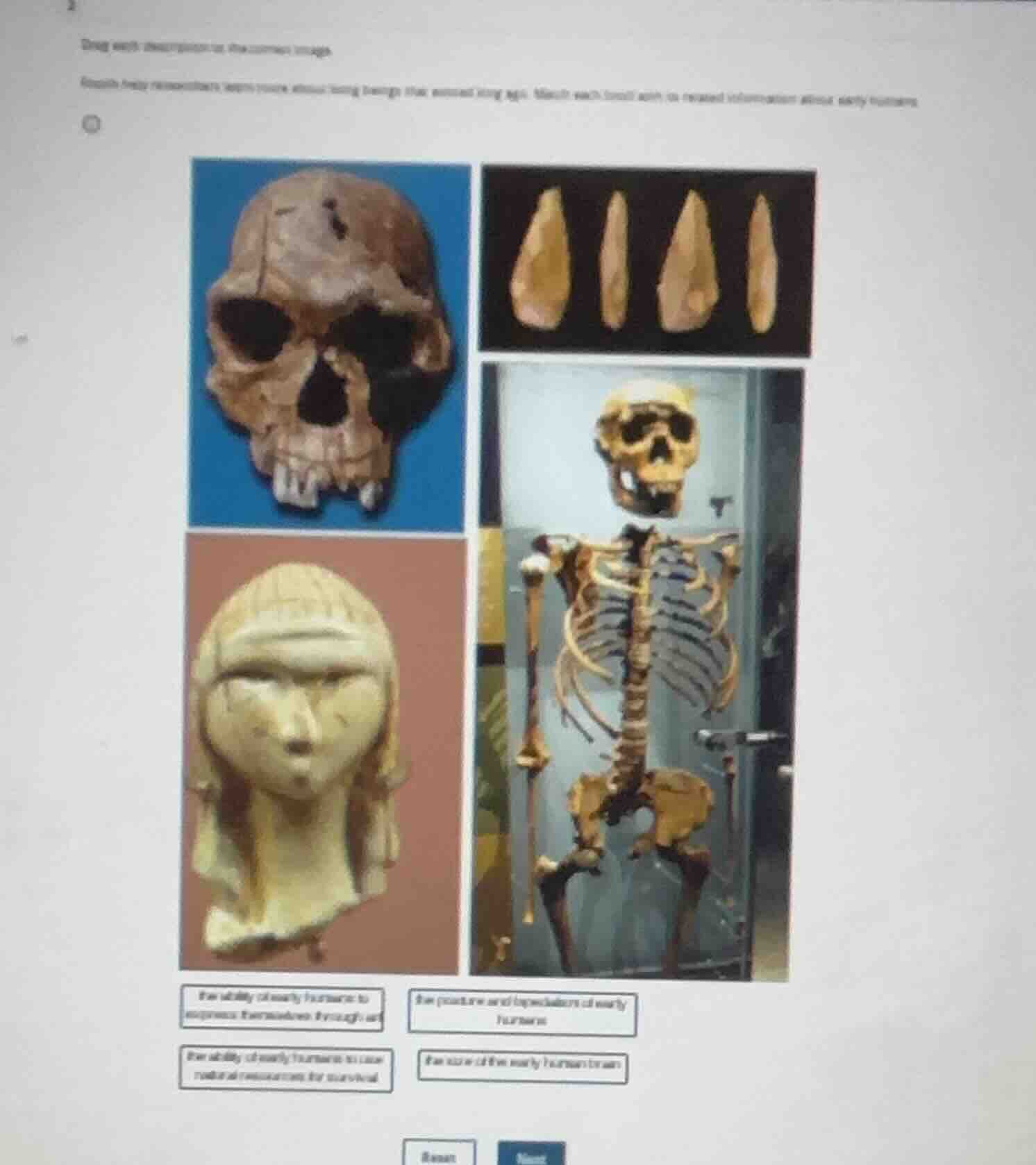
The image displays four distinct archaeological and paleoanthropological finds:
- A fossilized skull (top-left).
- Pointed stone tools (top-right).
- A carved ivory figurine head (bottom-left, known as the Venus of Brassempouy).
- A nearly complete fossilized skeleton (right, Lucy / Australopithecus afarensis).
Match descriptions to artifacts
We evaluate the four descriptions provided at the bottom:
- "the size of the early human brain": This directly relates to the fossilized skull, which allows scientists to measure cranial capacity.
- "the ability of early humans to use natural resources for survival": This matches the stone tools, which were shaped from natural rocks to hunt and process food during the Paleolithic Era.
- "the ability of early humans to express themselves through art": This corresponds to the carved ivory head figurine, representing early artistic expression.
- "the posture and bipedalism of early humans": This relates to the full skeleton, which provides anatomical evidence of upright walking (bipedalism) through the structure of the pelvis, spine, and leg bones.

Snap & solve any problem in the app
Get step-by-step solutions on Sovi AI
Photo-based solutions with guided steps
Explore more problems and detailed explanations
- Fossilized Skull (Top-Left): the size of the early human brain
- Stone Tools (Top-Right): the ability of early humans to use natural resources for survival
- Carved Figurine Head (Bottom-Left): the ability of early humans to express themselves through art
- Full Skeleton (Right): the posture and bipedalism of early humans