Sovi.AI - AI Math Tutor

Scan to solve math questions

QUESTION IMAGE

doug bought a new car for $25,000. he estimates his car will depreciate…

Question

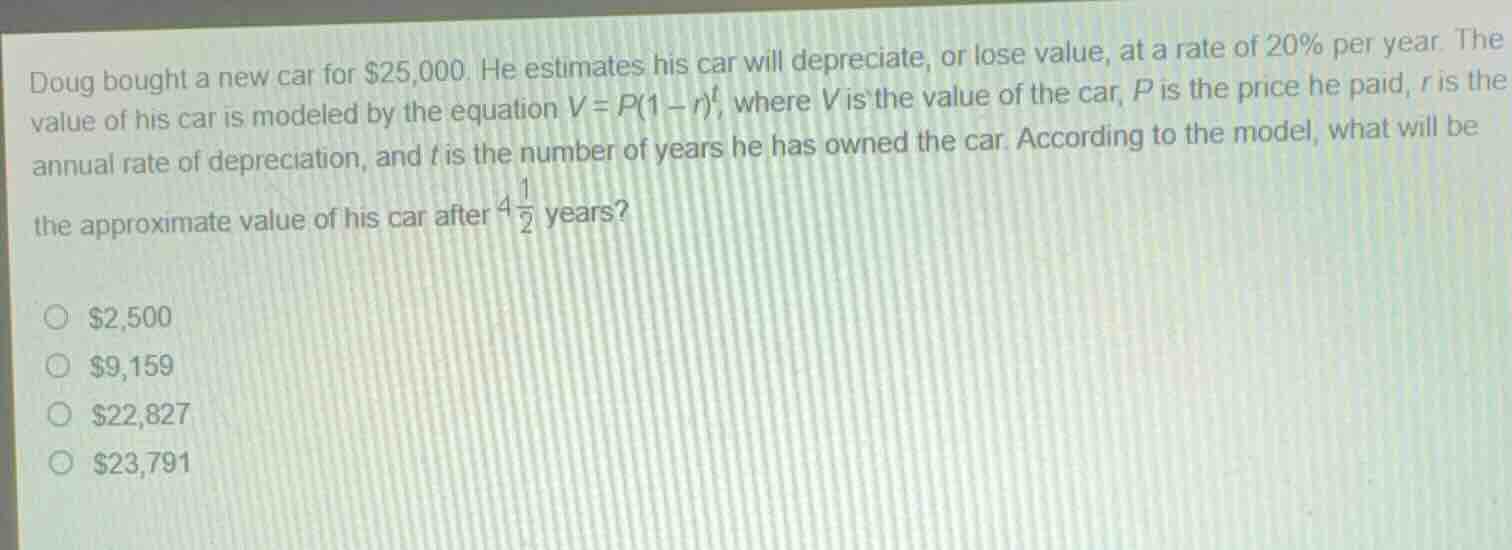
doug bought a new car for $25,000. he estimates his car will depreciate, or lose value, at a rate of 20% per year. the value of his car is modeled by the equation \\(v = p(1-r)^t\\), where \\(v\\) is the value of the car, \\(p\\) is the price he paid, \\(r\\) is the annual rate of depreciation, and \\(t\\) is the number of years he has owned the car. according to the model, what will be the approximate value of his car after \\(4\frac{1}{2}\\) years?

  • $2,500
  • $9,159
  • $22,827
  • $23,791

Explanation:

Response

<pre_analysis>
{
"quality": "clear",
"question_count": 1,
"skills_matched": [
"step_cot",
"multiple_choice_formatter",
"explain_then_answer",
"tutor"
],
"needs_drawing": false,
"concepts_used": [],
"new_concepts": [
"Exponential Decay Modeling",
"Fractional Exponents"
],
"current_concepts": [
"Exponential Decay Modeling",
"Fractional Exponents",
"Depreciation Modeling"
]
}
</pre_analysis>

<reasoning>

Identify given parameters

We extract the values from the problem statement:

  • Initial price \(P = 25,000\)
  • Annual depreciation rate \(r = 20\% = 0.20\)
  • Time in years \(t = 4\frac{1}{2} = 4.5\)

Set up the model equation

The depreciation model is given by:
\[V = P(1 - r)^t\]

Substituting the known values into the equation:
\[V = 25,000(1 - 0.20)^{4.5}\]

Simplify the base

Subtract the rate from 1:
\[1 - 0.20 = 0.80\]
Thus, the equation becomes:
\[V = 25,000(0.8)^{4.5}\]

Calculate the exponential term

We compute the value of \((0.8)^{4.5}\):
\[(0.8)^{4.5} \approx 0.366356\]

Calculate the final value

Multiply the initial price by the decay factor:
\[V \approx 25,000 \times 0.366356 \approx 9,158.9\]

Rounding to the nearest whole dollar gives approximately \(\$9,159\).
</reasoning>

<answer>
<mcq-option>(A) \$2,500</mcq-option>
<mcq-correct>(B) \$9,159</mcq-correct>
<mcq-option>(C) \$22,827</mcq-option>
<mcq-option>(D) \$23,791</mcq-option>
</answer>

<post_analysis>
{
"subject": "Mathematics",
"question_type": "Multiple Choice",
"knowledge_point": [
"Mathematics",
"Algebra",
"Exponential Decay Modeling"
]
}
</post_analysis>

Answer:

<pre_analysis>
{
"quality": "clear",
"question_count": 1,
"skills_matched": [
"step_cot",
"multiple_choice_formatter",
"explain_then_answer",
"tutor"
],
"needs_drawing": false,
"concepts_used": [],
"new_concepts": [
"Exponential Decay Modeling",
"Fractional Exponents"
],
"current_concepts": [
"Exponential Decay Modeling",
"Fractional Exponents",
"Depreciation Modeling"
]
}
</pre_analysis>

<reasoning>

Identify given parameters

We extract the values from the problem statement:

  • Initial price \(P = 25,000\)
  • Annual depreciation rate \(r = 20\% = 0.20\)
  • Time in years \(t = 4\frac{1}{2} = 4.5\)

Set up the model equation

The depreciation model is given by:
\[V = P(1 - r)^t\]

Substituting the known values into the equation:
\[V = 25,000(1 - 0.20)^{4.5}\]

Simplify the base

Subtract the rate from 1:
\[1 - 0.20 = 0.80\]
Thus, the equation becomes:
\[V = 25,000(0.8)^{4.5}\]

Calculate the exponential term

We compute the value of \((0.8)^{4.5}\):
\[(0.8)^{4.5} \approx 0.366356\]

Calculate the final value

Multiply the initial price by the decay factor:
\[V \approx 25,000 \times 0.366356 \approx 9,158.9\]

Rounding to the nearest whole dollar gives approximately \(\$9,159\).
</reasoning>

<answer>
<mcq-option>(A) \$2,500</mcq-option>
<mcq-correct>(B) \$9,159</mcq-correct>
<mcq-option>(C) \$22,827</mcq-option>
<mcq-option>(D) \$23,791</mcq-option>
</answer>

<post_analysis>
{
"subject": "Mathematics",
"question_type": "Multiple Choice",
"knowledge_point": [
"Mathematics",
"Algebra",
"Exponential Decay Modeling"
]
}
</post_analysis>