QUESTION IMAGE
Question
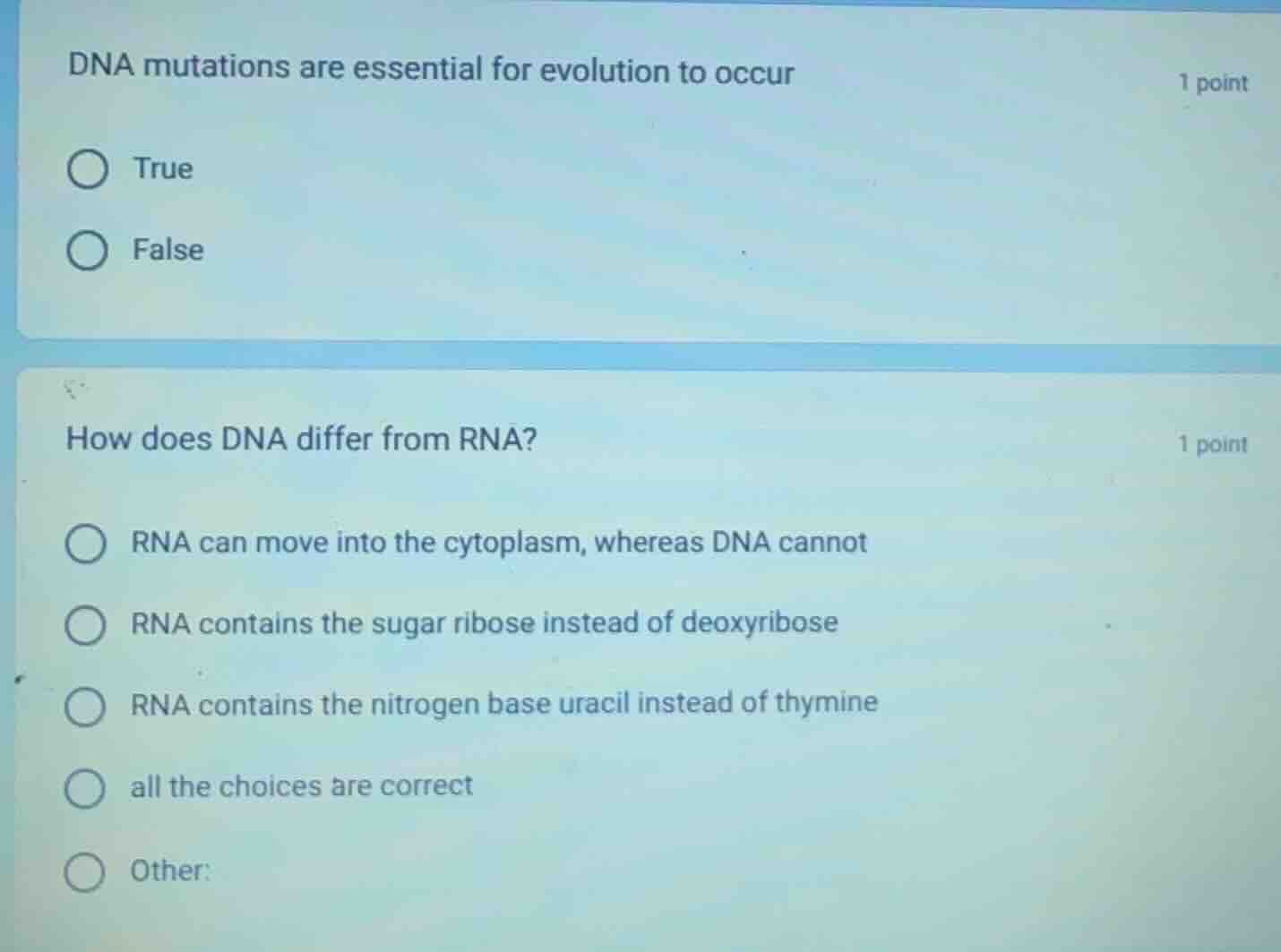
dna mutations are essential for evolution to occur
true
false
how does dna differ from rna?
rna can move into the cytoplasm, whereas dna cannot
rna contains the sugar ribose instead of deoxyribose
rna contains the nitrogen base uracil instead of thymine
all the choices are correct
other:
<pre_analysis>
{
"quality": "clear",
"question_count": 2,
"skills_matched": [
"direct_cot",
"multiple_choice_formatter",
"explain_then_answer",
"tutor"
],
"needs_drawing": false,
"concepts_used": [
"Genetic Mutations",
"RNA Structure"
],
"new_concepts": [],
"current_concepts": [
"Genetic Mutations",
"RNA Structure",
"DNA Double Helix"
]
}
</pre_analysis>
<reasoning>
Analyze the role of mutations in evolution
The first question states: "DNA mutations are essential for evolution to occur."
- Genetic Mutations introduce new genetic variations (alleles) into a population's gene pool.
- Without mutations, there would be no new genetic traits for natural selection, genetic drift, or other evolutionary mechanisms to act upon.
- Therefore, mutations are the ultimate source of all genetic variation, making them essential for evolution. This statement is True.
Compare the structural and functional differences between DNA and RNA
The second question asks: "How does DNA differ from RNA?"
- Let's evaluate each option based on RNA Structure and DNA characteristics:
- RNA can move into the cytoplasm, whereas DNA cannot: In eukaryotic cells, DNA is confined to the nucleus, while RNA (like mRNA) is synthesized in the nucleus and transported to the cytoplasm for translation. This is correct.
- RNA contains the sugar ribose instead of deoxyribose: DNA contains deoxyribose sugar, whereas RNA contains ribose sugar. This is correct.
- RNA contains the nitrogen base uracil instead of thymine: DNA uses adenine, thymine, cytosine, and guanine. RNA uses adenine, uracil, cytosine, and guanine. This is correct.
- Since all three individual statements are biologically accurate differences, the option "all the choices are correct" is the correct choice.
</reasoning>
<answer>
Question 1
<mcq-correct>(A) True</mcq-correct>
<mcq-option>(B) False</mcq-option>
Question 2
<mcq-option>(A) RNA can move into the cytoplasm, whereas DNA cannot</mcq-option>
<mcq-option>(B) RNA contains the sugar ribose instead of deoxyribose</mcq-option>
<mcq-option>(C) RNA contains the nitrogen base uracil instead of thymine</mcq-option>
<mcq-correct>(D) all the choices are correct</mcq-correct>
<mcq-option>(E) Other:</mcq-option>
</answer>
<post_analysis>
{
"subject": "Natural Science",
"question_type": "Multiple Choice",
"knowledge_point": [
"Natural Science",
"Biology",
"Molecular Genetics"
]
}
</post_analysis>
Snap & solve any problem in the app
Get step-by-step solutions on Sovi AI
Photo-based solutions with guided steps
Explore more problems and detailed explanations
<pre_analysis>
{
"quality": "clear",
"question_count": 2,
"skills_matched": [
"direct_cot",
"multiple_choice_formatter",
"explain_then_answer",
"tutor"
],
"needs_drawing": false,
"concepts_used": [
"Genetic Mutations",
"RNA Structure"
],
"new_concepts": [],
"current_concepts": [
"Genetic Mutations",
"RNA Structure",
"DNA Double Helix"
]
}
</pre_analysis>
<reasoning>
Analyze the role of mutations in evolution
The first question states: "DNA mutations are essential for evolution to occur."
- Genetic Mutations introduce new genetic variations (alleles) into a population's gene pool.
- Without mutations, there would be no new genetic traits for natural selection, genetic drift, or other evolutionary mechanisms to act upon.
- Therefore, mutations are the ultimate source of all genetic variation, making them essential for evolution. This statement is True.
Compare the structural and functional differences between DNA and RNA
The second question asks: "How does DNA differ from RNA?"
- Let's evaluate each option based on RNA Structure and DNA characteristics:
- RNA can move into the cytoplasm, whereas DNA cannot: In eukaryotic cells, DNA is confined to the nucleus, while RNA (like mRNA) is synthesized in the nucleus and transported to the cytoplasm for translation. This is correct.
- RNA contains the sugar ribose instead of deoxyribose: DNA contains deoxyribose sugar, whereas RNA contains ribose sugar. This is correct.
- RNA contains the nitrogen base uracil instead of thymine: DNA uses adenine, thymine, cytosine, and guanine. RNA uses adenine, uracil, cytosine, and guanine. This is correct.
- Since all three individual statements are biologically accurate differences, the option "all the choices are correct" is the correct choice.
</reasoning>
<answer>
Question 1
<mcq-correct>(A) True</mcq-correct>
<mcq-option>(B) False</mcq-option>
Question 2
<mcq-option>(A) RNA can move into the cytoplasm, whereas DNA cannot</mcq-option>
<mcq-option>(B) RNA contains the sugar ribose instead of deoxyribose</mcq-option>
<mcq-option>(C) RNA contains the nitrogen base uracil instead of thymine</mcq-option>
<mcq-correct>(D) all the choices are correct</mcq-correct>
<mcq-option>(E) Other:</mcq-option>
</answer>
<post_analysis>
{
"subject": "Natural Science",
"question_type": "Multiple Choice",
"knowledge_point": [
"Natural Science",
"Biology",
"Molecular Genetics"
]
}
</post_analysis>