QUESTION IMAGE
Question
distinguishing between restrictive and nonrestrictive phrases
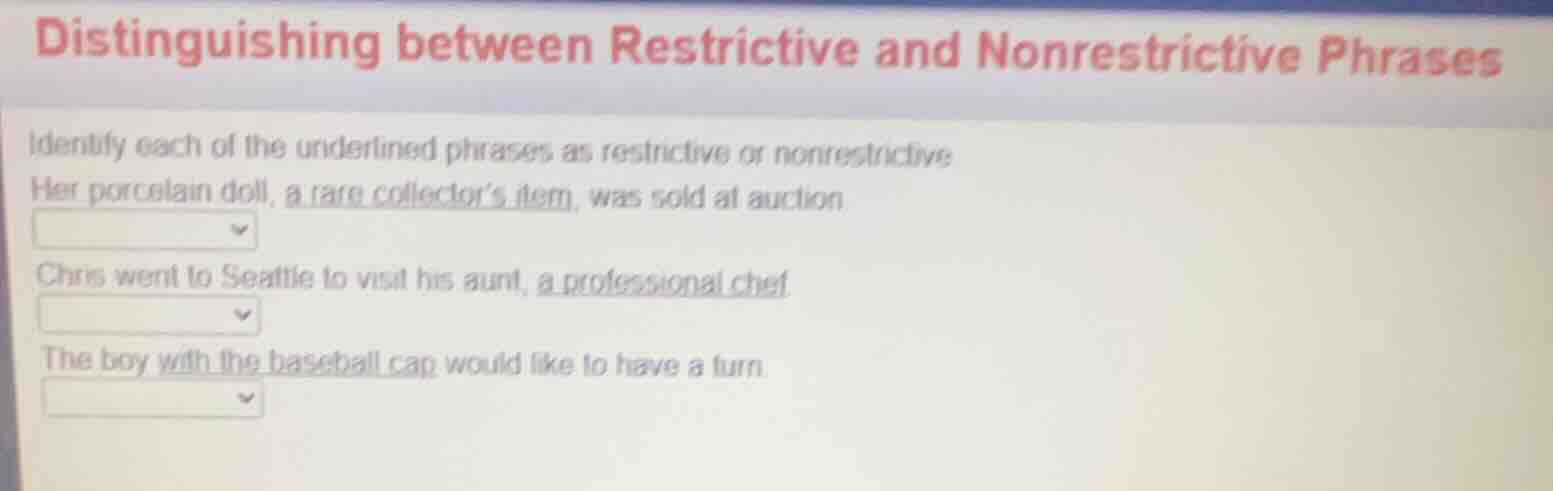
identify each of the underlined phrases as restrictive or nonrestrictive.
her porcelain doll, a rare collectors item, was sold at auction.
chris went to seattle to visit his aunt, a professional chef.
the boy with the baseball cap would like to have a turn.
<pre_analysis>
{
"quality": "clear",
"question_count": 3,
"skills_matched": [
"direct_cot",
"blank_filling_formatter",
"explain_then_answer",
"tutor"
],
"needs_drawing": false,
"concepts_used": [
"Clauses vs Phrases"
],
"new_concepts": [
"Restrictive Phrases",
"Nonrestrictive Phrases"
],
"current_concepts": [
"Clauses vs Phrases",
"Restrictive Phrases",
"Nonrestrictive Phrases"
]
}
</pre_analysis>
<reasoning>
Define restrictive and nonrestrictive phrases
A restrictive phrase is essential to the meaning of a sentence. If removed, the meaning changes or becomes unclear. It is not set off by commas. A nonrestrictive phrase adds extra, nonessential information. If removed, the core meaning remains clear. It is set off by commas.
Analyze the first sentence
The sentence is: "Her porcelain doll, a rare collector's item, was sold at auction."
The underlined phrase is "a rare collector's item". This phrase is set off by commas and adds extra information about the doll. Removing it leaves "Her porcelain doll was sold at auction," which is grammatically complete and retains its core meaning. Thus, it is nonrestrictive.
Analyze the second sentence
The sentence is: "Chris went to Seattle to visit his aunt, a professional chef."
The underlined phrase is "a professional chef". It is set off by a comma and adds extra information about his aunt. Removing it leaves "Chris went to Seattle to visit his aunt," which is a complete and clear sentence. Thus, it is nonrestrictive.
Analyze the third sentence
The sentence is: "The boy with the baseball cap would like to have a turn."
The underlined phrase is "with the baseball cap". This phrase identifies which specific boy is being referred to. Without it, "The boy would like to have a turn" becomes ambiguous if there are multiple boys. It is not set off by commas. Thus, it is restrictive.
</reasoning>
<answer>
Question 1
Her porcelain doll, a rare collector's item, was sold at auction.
<blank>nonrestrictive</blank>
Question 2
Chris went to Seattle to visit his aunt, a professional chef.
<blank>nonrestrictive</blank>
Question 3
The boy with the baseball cap would like to have a turn.
<blank>restrictive</blank>
</answer>
<post_analysis>
{
"subject": "Others",
"question_type": "Fill-in-the-blank",
"knowledge_point": [
"Others",
"Grammar and Mechanics",
"Restrictive and Nonrestrictive Elements"
]
}
</post_analysis>
Snap & solve any problem in the app
Get step-by-step solutions on Sovi AI
Photo-based solutions with guided steps
Explore more problems and detailed explanations
<pre_analysis>
{
"quality": "clear",
"question_count": 3,
"skills_matched": [
"direct_cot",
"blank_filling_formatter",
"explain_then_answer",
"tutor"
],
"needs_drawing": false,
"concepts_used": [
"Clauses vs Phrases"
],
"new_concepts": [
"Restrictive Phrases",
"Nonrestrictive Phrases"
],
"current_concepts": [
"Clauses vs Phrases",
"Restrictive Phrases",
"Nonrestrictive Phrases"
]
}
</pre_analysis>
<reasoning>
Define restrictive and nonrestrictive phrases
A restrictive phrase is essential to the meaning of a sentence. If removed, the meaning changes or becomes unclear. It is not set off by commas. A nonrestrictive phrase adds extra, nonessential information. If removed, the core meaning remains clear. It is set off by commas.
Analyze the first sentence
The sentence is: "Her porcelain doll, a rare collector's item, was sold at auction."
The underlined phrase is "a rare collector's item". This phrase is set off by commas and adds extra information about the doll. Removing it leaves "Her porcelain doll was sold at auction," which is grammatically complete and retains its core meaning. Thus, it is nonrestrictive.
Analyze the second sentence
The sentence is: "Chris went to Seattle to visit his aunt, a professional chef."
The underlined phrase is "a professional chef". It is set off by a comma and adds extra information about his aunt. Removing it leaves "Chris went to Seattle to visit his aunt," which is a complete and clear sentence. Thus, it is nonrestrictive.
Analyze the third sentence
The sentence is: "The boy with the baseball cap would like to have a turn."
The underlined phrase is "with the baseball cap". This phrase identifies which specific boy is being referred to. Without it, "The boy would like to have a turn" becomes ambiguous if there are multiple boys. It is not set off by commas. Thus, it is restrictive.
</reasoning>
<answer>
Question 1
Her porcelain doll, a rare collector's item, was sold at auction.
<blank>nonrestrictive</blank>
Question 2
Chris went to Seattle to visit his aunt, a professional chef.
<blank>nonrestrictive</blank>
Question 3
The boy with the baseball cap would like to have a turn.
<blank>restrictive</blank>
</answer>
<post_analysis>
{
"subject": "Others",
"question_type": "Fill-in-the-blank",
"knowledge_point": [
"Others",
"Grammar and Mechanics",
"Restrictive and Nonrestrictive Elements"
]
}
</post_analysis>