QUESTION IMAGE
Question
discussion topic
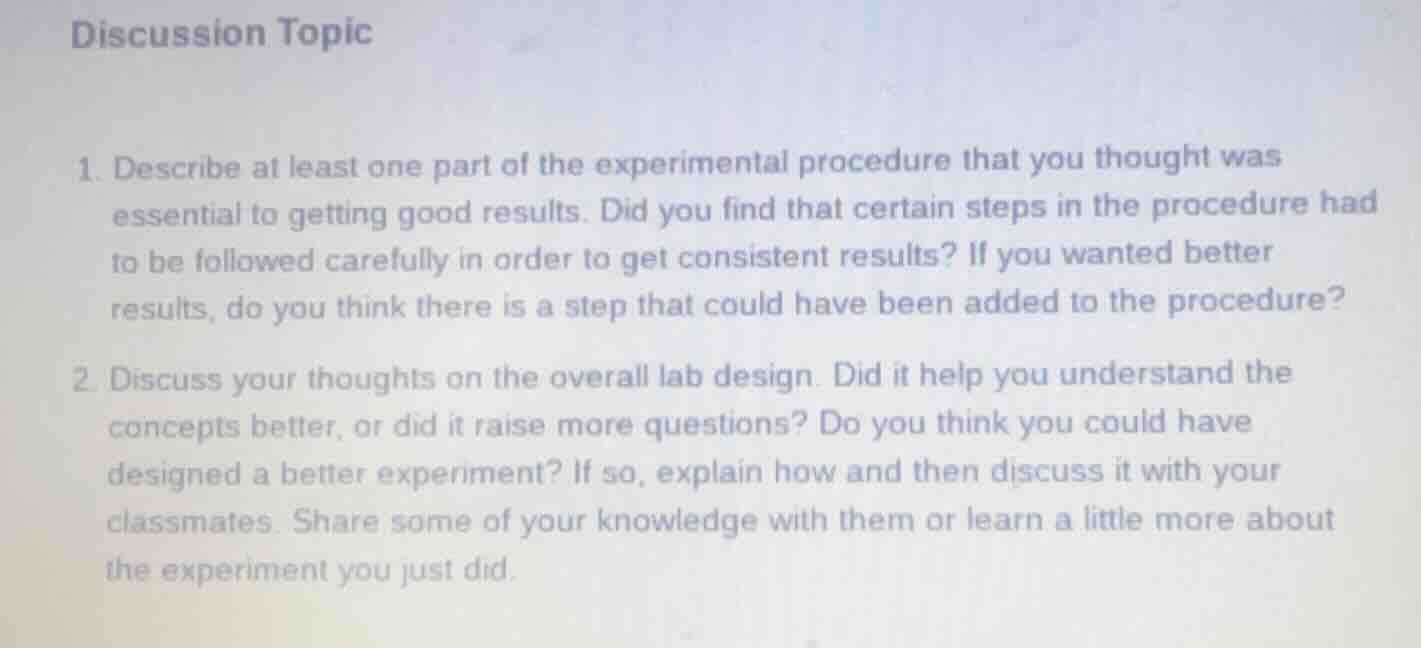
- describe at least one part of the experimental procedure that you thought was essential to getting good results. did you find that certain steps in the procedure had to be followed carefully in order to get consistent results? if you wanted better results, do you think there is a step that could have been added to the procedure?
- discuss your thoughts on the overall lab design. did it help you understand the concepts better, or did it raise more questions? do you think you could have designed a better experiment? if so, explain how and then discuss it with your classmates. share some of your knowledge with them or learn a little more about the experiment you just did.
<pre_analysis>
{
"quality": "clear",
"question_count": 2,
"skills_matched": [
"direct_cot",
"explain_then_answer",
"quick"
],
"needs_drawing": false,
"concepts_used": [],
"new_concepts": [
"Experimental Design",
"Scientific Method"
],
"current_concepts": [
"Experimental Design",
"Scientific Method",
"Lab Evaluation"
]
</pre_analysis>
<reasoning>
Analyze experimental procedure requirements
Identify key aspects of a standard scientific procedure:
- Calibration and measurement precision ensure accuracy.
- Consistent execution of trials minimizes random error.
- Adding control groups or automated data logging improves reliability.
Evaluate overall lab design
Assess the educational and structural value of a typical lab:
- Hands-on manipulation connects abstract theory to physical observations.
- Limitations in manual measurement often prompt ideas for design improvements.
- Peer discussion helps resolve anomalies in experimental data.
</reasoning>
<answer>
Question 1
An essential part of any experimental procedure is the calibration of measuring instruments (such as balances or sensors) and the consistent execution of trials under identical environmental conditions. To obtain consistent results, steps involving manual measurement or timing must be followed with extreme care to minimize human error. To improve the results further, an additional step of performing multiple trials (at least three) and calculating the average, or utilizing automated data-logging software to record real-time changes, could be added to the procedure.
Question 2
The overall lab design is highly effective because it translates theoretical concepts into observable physical phenomena, reinforcing conceptual understanding. However, manual limitations often raise questions regarding experimental uncertainty and systematic errors. A better experiment could be designed by integrating digital sensors to reduce measurement lag and by introducing a control group to isolate the independent variable more clearly, which can then be discussed with peers to compare data variations and resolve outstanding questions.
</answer>
<post_analysis>
{
"subject": "Natural Science",
"question_type": "Free Response",
"knowledge_point": [
"Natural Science",
"Scientific Method",
"Experimental Design"
]
}
</post_analysis>
Snap & solve any problem in the app
Get step-by-step solutions on Sovi AI
Photo-based solutions with guided steps
Explore more problems and detailed explanations
<pre_analysis>
{
"quality": "clear",
"question_count": 2,
"skills_matched": [
"direct_cot",
"explain_then_answer",
"quick"
],
"needs_drawing": false,
"concepts_used": [],
"new_concepts": [
"Experimental Design",
"Scientific Method"
],
"current_concepts": [
"Experimental Design",
"Scientific Method",
"Lab Evaluation"
]
</pre_analysis>
<reasoning>
Analyze experimental procedure requirements
Identify key aspects of a standard scientific procedure:
- Calibration and measurement precision ensure accuracy.
- Consistent execution of trials minimizes random error.
- Adding control groups or automated data logging improves reliability.
Evaluate overall lab design
Assess the educational and structural value of a typical lab:
- Hands-on manipulation connects abstract theory to physical observations.
- Limitations in manual measurement often prompt ideas for design improvements.
- Peer discussion helps resolve anomalies in experimental data.
</reasoning>
<answer>
Question 1
An essential part of any experimental procedure is the calibration of measuring instruments (such as balances or sensors) and the consistent execution of trials under identical environmental conditions. To obtain consistent results, steps involving manual measurement or timing must be followed with extreme care to minimize human error. To improve the results further, an additional step of performing multiple trials (at least three) and calculating the average, or utilizing automated data-logging software to record real-time changes, could be added to the procedure.
Question 2
The overall lab design is highly effective because it translates theoretical concepts into observable physical phenomena, reinforcing conceptual understanding. However, manual limitations often raise questions regarding experimental uncertainty and systematic errors. A better experiment could be designed by integrating digital sensors to reduce measurement lag and by introducing a control group to isolate the independent variable more clearly, which can then be discussed with peers to compare data variations and resolve outstanding questions.
</answer>
<post_analysis>
{
"subject": "Natural Science",
"question_type": "Free Response",
"knowledge_point": [
"Natural Science",
"Scientific Method",
"Experimental Design"
]
}
</post_analysis>