QUESTION IMAGE
Question
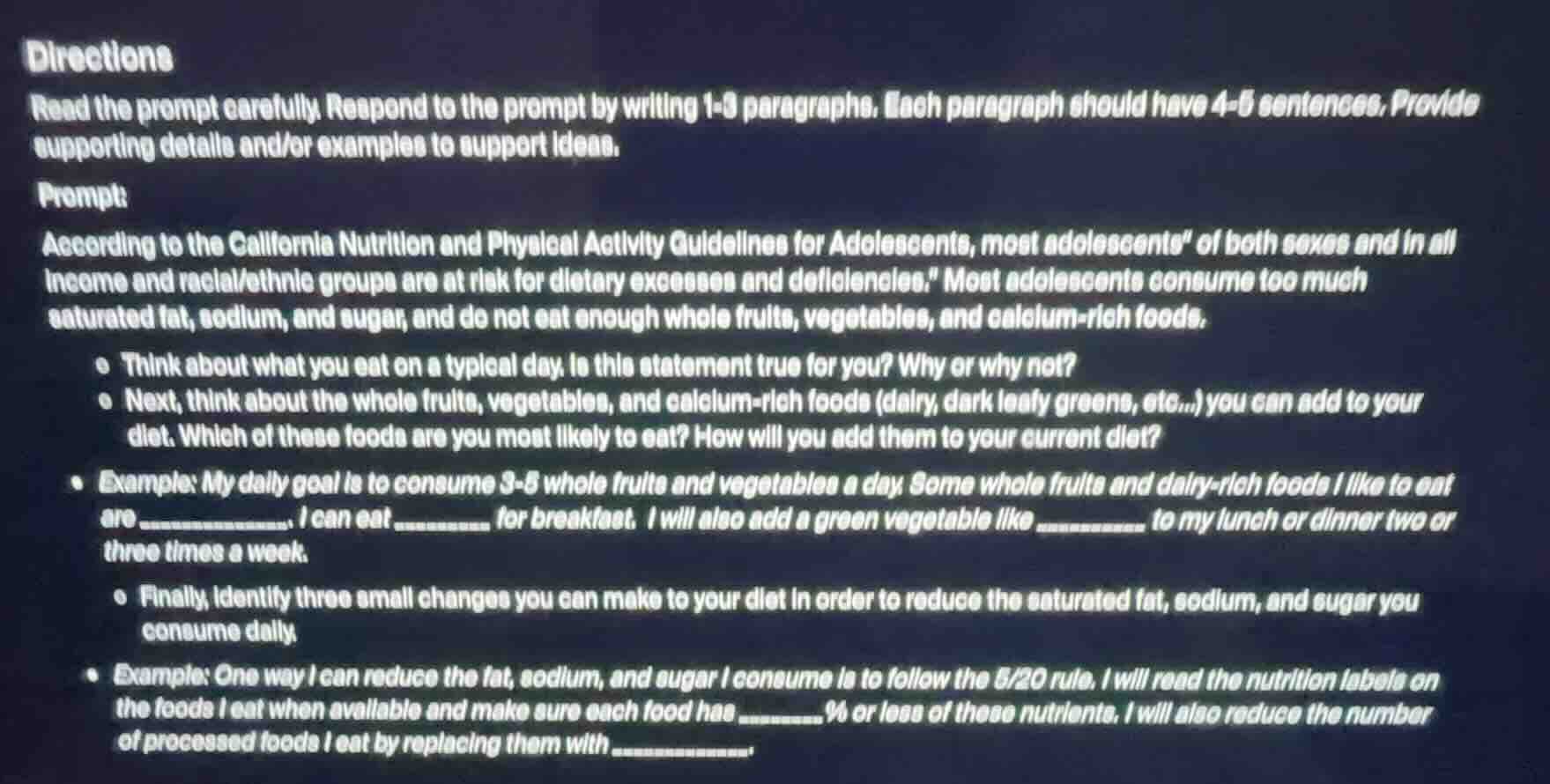
directions
read the prompt carefully. respond to the prompt by writing 1-3 paragraphs. each paragraph should have 4-5 sentences. provide supporting details and/or examples to support ideas.
prompt:
according to the california nutrition and physical activity guidelines for adolescents, \most adolescents of both sexes and in all income and racial/ethnic groups are at risk for dietary excesses and deficiencies.\ most adolescents consume too much saturated fat, sodium, and sugar, and do not eat enough whole fruits, vegetables, and calcium-rich foods.
- think about what you eat on a typical day. is this statement true for you? why or why not?
- next, think about the whole fruits, vegetables, and calcium-rich foods (dairy, dark leafy greens, etc...) you can add to your diet. which of these foods are you most likely to eat? how will you add them to your current diet?
- example: my daily goal is to consume 3-5 whole fruits and vegetables a day. some whole fruits and dairy-rich foods i like to eat are ________, i can eat ______ for breakfast. i will also add a green vegetable like ________ to my lunch or dinner two or three times a week.
- finally, identify three small changes you can make to your diet in order to reduce the saturated fat, sodium, and sugar you consume daily.
- example: one way i can reduce the fat, sodium, and sugar i consume is to follow the 5/20 rule. i will read the nutrition labels on the foods i eat when available and make sure each food has ________% or less of these nutrients. i will also reduce the number of processed foods i eat by replacing them with ________.
Evaluate personal diet against guidelines
The guideline states adolescents consume too much saturated fat, sodium, and sugar, and lack whole fruits, vegetables, and calcium. Reflecting on a typical daily diet, this statement is partially true because processed snacks often introduce excess sodium and added sugars, while fresh produce and calcium-rich foods are frequently underrepresented due to convenience.
Plan additions of nutrient-dense foods
To improve intake, whole fruits like bananas and apples are highly accessible and likely to be consumed as quick snacks. Calcium-rich foods and vegetables can be integrated by adding low-fat yogurt to breakfast and incorporating dark leafy greens, such as spinach, into dinner meals at least three times a week.
Identify three dietary reduction strategies
First, apply the 5/20 rule on nutrition labels to ensure daily values of saturated fat, sodium, and sugar are 5% or less per serving. Second, replace processed snacks with whole foods like raw almonds or fresh fruit. Third, substitute sugary beverages with water or unsweetened herbal teas to lower daily sugar intake.

Snap & solve any problem in the app
Get step-by-step solutions on Sovi AI
Photo-based solutions with guided steps
Explore more problems and detailed explanations
The statement from the California Nutrition and Physical Activity Guidelines is true for my diet because processed snacks and convenience foods often introduce excess sodium and added sugars, while fresh produce is sometimes overlooked. To address these deficiencies, I am most likely to add whole fruits like bananas and apples as snacks, and I can easily incorporate calcium-rich low-fat yogurt into my breakfast routine. Additionally, I will add a green vegetable like spinach to my dinner meals three times a week to boost my intake of essential vitamins and minerals.
To reduce my daily consumption of saturated fat, sodium, and sugar, I will make three small, actionable changes to my diet. First, I will follow the 5/20 rule by reading nutrition labels and choosing foods where these three nutrients make up 5% or less of the Daily Value per serving. Second, I will reduce the number of processed foods I eat by replacing packaged chips and cookies with whole-food alternatives like raw almonds and fresh berries. Finally, I will substitute sugary sodas and juices with water or unsweetened sparkling water to significantly lower my daily sugar intake.