QUESTION IMAGE
Question
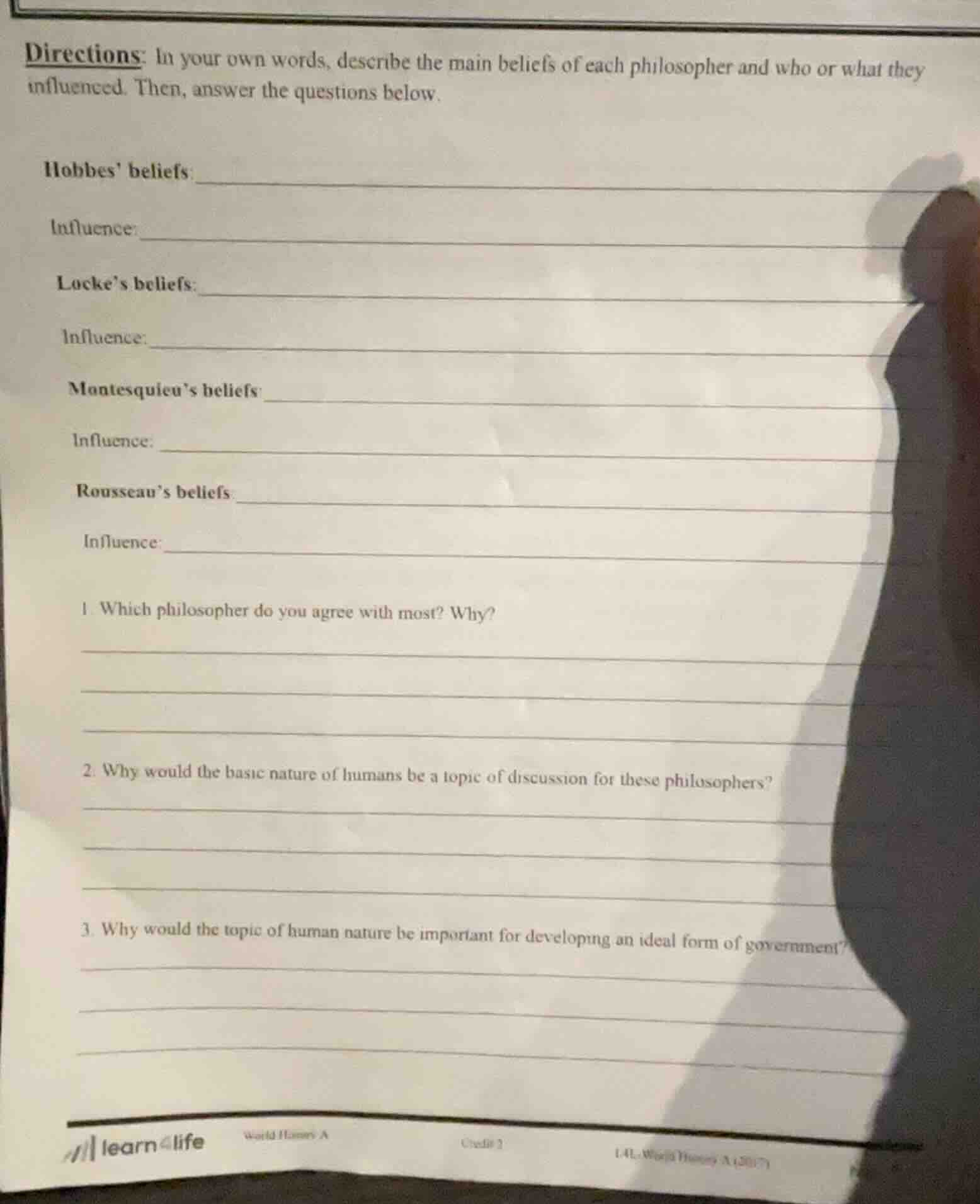
directions: in your own words, describe the main beliefs of each philosopher and who or what they influenced. then, answer the questions below.
hobbes beliefs:
influence:
lockes beliefs:
influence:
montesquieus beliefs:
influence:
rousseaus beliefs:
influence:
- which philosopher do you agree with most? why?
- why would the basic nature of humans be a topic of discussion for these philosophers?
- why would the topic of human nature be important for developing an ideal form of government?
Analyze the beliefs and influences of the four philosophers
To address the first part of the worksheet, we must summarize the core ideas of Thomas Hobbes, John Locke, Baron de Montesquieu, and Jean-Jacques Rousseau, along with their historical impacts.
- Hobbes: Believed humans are naturally selfish and violent. He argued that to escape this "state of nature," people must enter a Social Contract Theory to surrender their freedom to an absolute ruler (Leviathan) in exchange for order and security. His ideas influenced absolute monarchies and the realist school of political thought.
- Locke: Argued that humans are born with Natural Rights to life, liberty, and property. He believed the government's sole purpose is to protect these rights under a Social Contract Theory; if it fails, citizens have a right to rebel. His ideas heavily influenced the American Declaration of Independence and democratic constitutions.
- Montesquieu: Believed that to prevent tyranny, government power must be divided. He proposed the separation of powers into legislative, executive, and judicial branches, with a system of checks and balances. This directly influenced the structure of the United States Constitution.
- Rousseau: Believed that humans are naturally good but corrupted by society. He argued for popular sovereignty, where the government should be ruled by the "general will" of the people. His ideas influenced the French Revolution and democratic participation.
Evaluate personal philosophical alignment (Question 1)
This question is subjective, but a strong academic response typically aligns with John Locke or Montesquieu due to their foundational roles in modern constitutional democracies. Aligning with Locke emphasizes the protection of individual liberties and Natural Rights, while aligning with Montesquieu emphasizes structural safeguards against tyranny.
Explain the focus on human nature (Question 2)
The basic nature of humans was a central topic because it served as the starting point (the "state of nature") for their political theories. One's view of human nature dictates the type of government required. If humans are inherently bad (Hobbes), they need a strong, authoritarian government to maintain order. If humans are inherently reasonable and cooperative (Locke), they can govern themselves through a representative system.
Connect human nature to ideal government design (Question 3)
Understanding human nature is crucial for designing an ideal government because the government must be structured to either restrain human vices or foster human virtues. For example, because Montesquieu believed power corrupts human beings, he designed a system of checks and balances to limit that corruption. A government built without considering human behavior would either be too weak to maintain order or too oppressive to protect freedom.

Snap & solve any problem in the app
Get step-by-step solutions on Sovi AI
Photo-based solutions with guided steps
Explore more problems and detailed explanations
Hobbes' beliefs:
Humans are naturally selfish, cruel, and greedy. In a state of nature, life is "solitary, poor, nasty, brutish, and short." To maintain order, people must enter a social contract and yield their power to an absolute ruler.
Influence:
Influenced the justification of absolute monarchies and the development of political realism.
Locke's beliefs:
Humans are naturally reasonable and possess inherent rights to life, liberty, and property. Government is a social contract designed solely to protect these rights, and citizens have the right to overthrow it if it fails.
Influence:
Heavily influenced the American Revolution, the Declaration of Independence, and the development of modern liberal democracies.
Montesquieu's beliefs:
To prevent the abuse of power and protect political liberty, government power must be divided into separate legislative, executive, and judicial branches that check and balance one another.
Influence:
Directly shaped the structure of the United States Constitution and the separation of powers in modern democratic states.
Rousseau's beliefs:
Humans are naturally good but corrupted by civilization and inequality. Government should be based on popular sovereignty and rule according to the "general will" of the citizens.
Influence:
Greatly influenced the French Revolution, the rise of nationalism, and theories of direct democracy.
Question 1
I agree most with John Locke. His belief that governments exist solely to protect individual rights to life, liberty, and property is the foundation of a free society, ensuring that state power remains accountable to the people.
Question 2
The basic nature of humans was a central topic because it served as the baseline assumption for each philosopher's theory. To design a system of laws and authority, they first had to understand how humans behave without any government (the "state of nature").
Question 3
Human nature is the blueprint for government design. If you believe humans are inherently chaotic, the ideal government must be strong and centralized to enforce order. If you believe humans are cooperative, the government can be decentralized and focused on protecting individual freedoms.