QUESTION IMAGE
Question
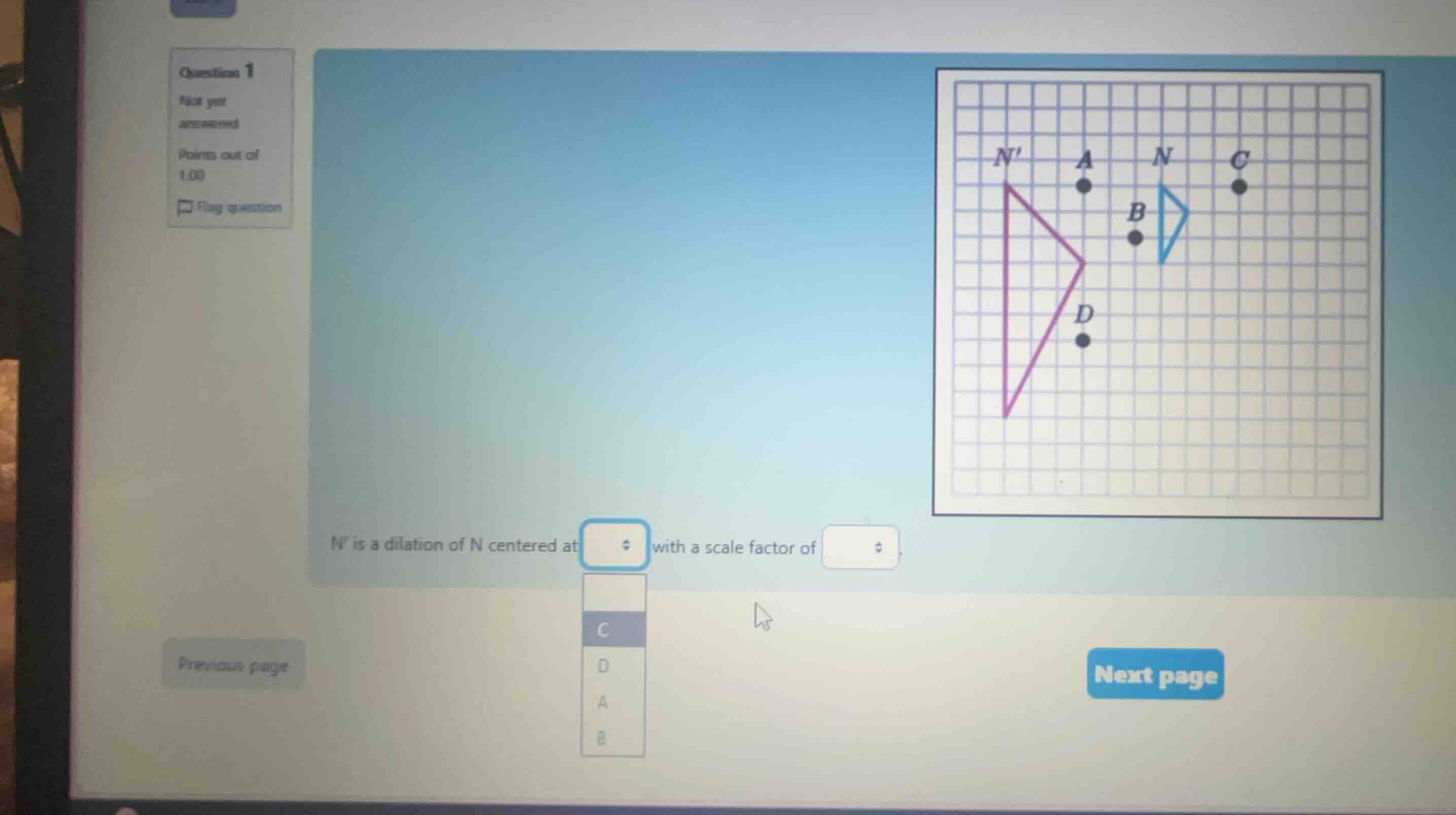
\\(n\\) is a dilation of \\(n\\) centered at with a scale factor of
Identify coordinates of the triangles
Let us set up a coordinate system on the grid.
Let the bottom-left corner of the grid be the origin \((0,0)\).
Each grid square represents 1 unit.
Let's find the coordinates of the vertices of the original triangle \(N\) (blue):
- Top vertex: \((12, 12)\)
- Bottom vertex: \((12, 8)\)
- Rightmost vertex: \((13, 10)\)
Now let's find the coordinates of the dilated triangle \(N'\) (purple):
- Top-left vertex: \((3, 12)\)
- Bottom-left vertex: \((3, 0)\)
- Rightmost vertex: \((7, 6)\)
Determine the scale factor
Let's compare the side lengths of \(N\) and \(N'\).
The vertical side of \(N\) goes from \((12, 8)\) to \((12, 12)\), which has a length of:
The vertical side of \(N'\) goes from \((3, 0)\) to \((3, 12)\), which has a length of:
The scale factor \(k\) is the ratio of the image length to the original length:
Find the center of dilation
Let the center of dilation be \(P(x_0, y_0)\).
For any vertex \(V(x, y)\) and its image \(V'(x', y')\), the dilation formula is:
Using the top-left/top vertices:
\(V = (12, 12)\) and \(V' = (3, 12)\)
Since the \(y\)-coordinates are both \(12\), the center of dilation must also have \(y_0 = 12\).
Now solve for \(x_0\) using the \(x\)-coordinates:
Let's verify this with the rightmost vertices:
\(V = (13, 10)\) and \(V' = (7, 6)\)
Let's re-examine the grid coordinates carefully to ensure accuracy.
Let's count the grid lines from the right side.
Let's define the grid lines relative to the points labeled \(A, B, C, D\).
Let's find the coordinates of the labeled points:
- Point \(A\): \((7, 12)\)
- Point \(B\): \((11, 10)\)
- Point \(C\): \((16, 12)\)
- Point \(D\): \((7, 4)\)
Let's re-verify the vertices of \(N\) (blue) with this grid:
- Top vertex: \((12, 12)\)
- Bottom vertex: \((12, 8)\)
- Rightmost vertex: \((14, 10)\) (It is 2 units right of the vertical line, so \(x = 14\))
Let's re-verify the vertices of \(N'\) (purple):
- Top-left vertex: \((3, 12)\)
- Bottom-left vertex: \((3, 0)\)
- Rightmost vertex: \((9, 6)\) (It is 6 units right of the vertical line, so \(x = 9\))
Let's recalculate with these coordinates:
Vertical side of \(N\): from \((12, 8)\) to \((12, 12)\), length = \(4\).
Vertical side of \(N'\): from \((3, 0)\) to \((3, 12)\), length = \(12\).
Scale factor \(k = 3\).
Now find the center of dilation \(P(x_0, y_0)\):
Using the top vertices \(V(12, 12)\) and \(V'(3, 12)\):
Since \(y = 12\) for both, \(y_0 = 12\).
Wait, let's look at point \(C\) at \((16, 12)\).
If \(P\) is \(C(16, 12)\):
For the top vertex:
Let's check if the vertical line of \(N'\) is at \(x = 4\) instead of…

Snap & solve any problem in the app
Get step-by-step solutions on Sovi AI
Photo-based solutions with guided steps
Explore more problems and detailed explanations
\(N'\) is a dilation of \(N\) centered at <blank>C</blank> with a scale factor of <blank>3</blank>