QUESTION IMAGE
Question
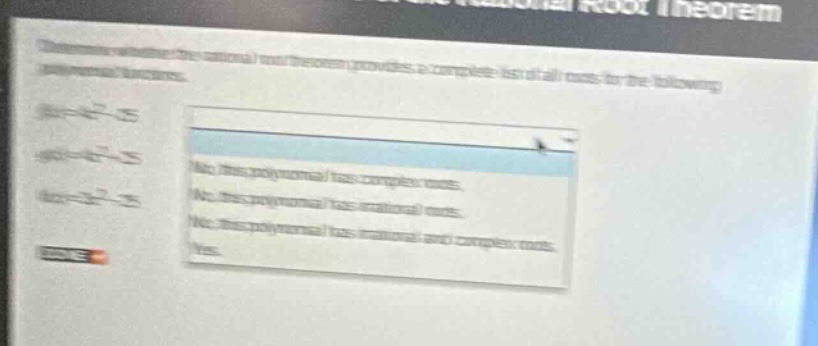
determine whether the rational root theorem provides a complete list of all roots for the following polynomial functions.
\\(f(x) = 4x^2 - 25\\)
\\(g(x) = 4x^2 + 25\\)
\\(h(x) = 3x^2 - 25\\)
options in dropdown:
no, this polynomial has complex roots.
no, this polynomial has irrational roots.
no, this polynomial has irrational and complex roots.
yes.
🆕 New Concept Discovered: Rational Root Theorem
Finding possible rational solutions of polynomial equations.
Step 1: Understand the Rational Root Theorem
The Rational Root Theorem provides a list of all possible rational roots of a polynomial with integer coefficients. It does not find irrational roots (like \( \sqrt{2} \)) or complex/imaginary roots (like \( i \)).
If a polynomial has only rational roots, the theorem's list will contain all of its actual roots (a "complete list"). If the polynomial has any irrational or complex roots, the theorem cannot provide a complete list of all its roots.
---
Step 2: Analyze the first function \( f(x) = 4x^2 - 25 \)
To find the actual roots, set the function equal to zero:
Both roots, \( \frac{5}{2} \) and \( -\frac{5}{2} \), are rational numbers. Therefore, the Rational Root Theorem provides a complete list of all roots for this function.
- Selection for \( f(x) \): Yes.
---
Step 3: Analyze the second function \( g(x) = 4x^2 + 25 \)
Set the function equal to zero:
These roots are complex (imaginary) numbers. Since they are not rational, the Rational Root Theorem cannot list them.
- Selection for \( g(x) \): No, this polynomial has complex roots.
---
Step 4: Analyze the third function \( h(x) = 3x^2 - 25 \)
Set the function equal to zero:
These roots are irrational numbers because of the square root. Since they are not rational, the Rational Root Theorem cannot list them.
- Selection for \( h(x) \): No, this polynomial has irrational roots.

Snap & solve any problem in the app
Get step-by-step solutions on Sovi AI
Photo-based solutions with guided steps
Explore more problems and detailed explanations
- \( f(x) = 4x^2 - 25 \): Yes.
- \( g(x) = 4x^2 + 25 \): No, this polynomial has complex roots.
- \( h(x) = 3x^2 - 25 \): No, this polynomial has irrational roots.