QUESTION IMAGE
Question
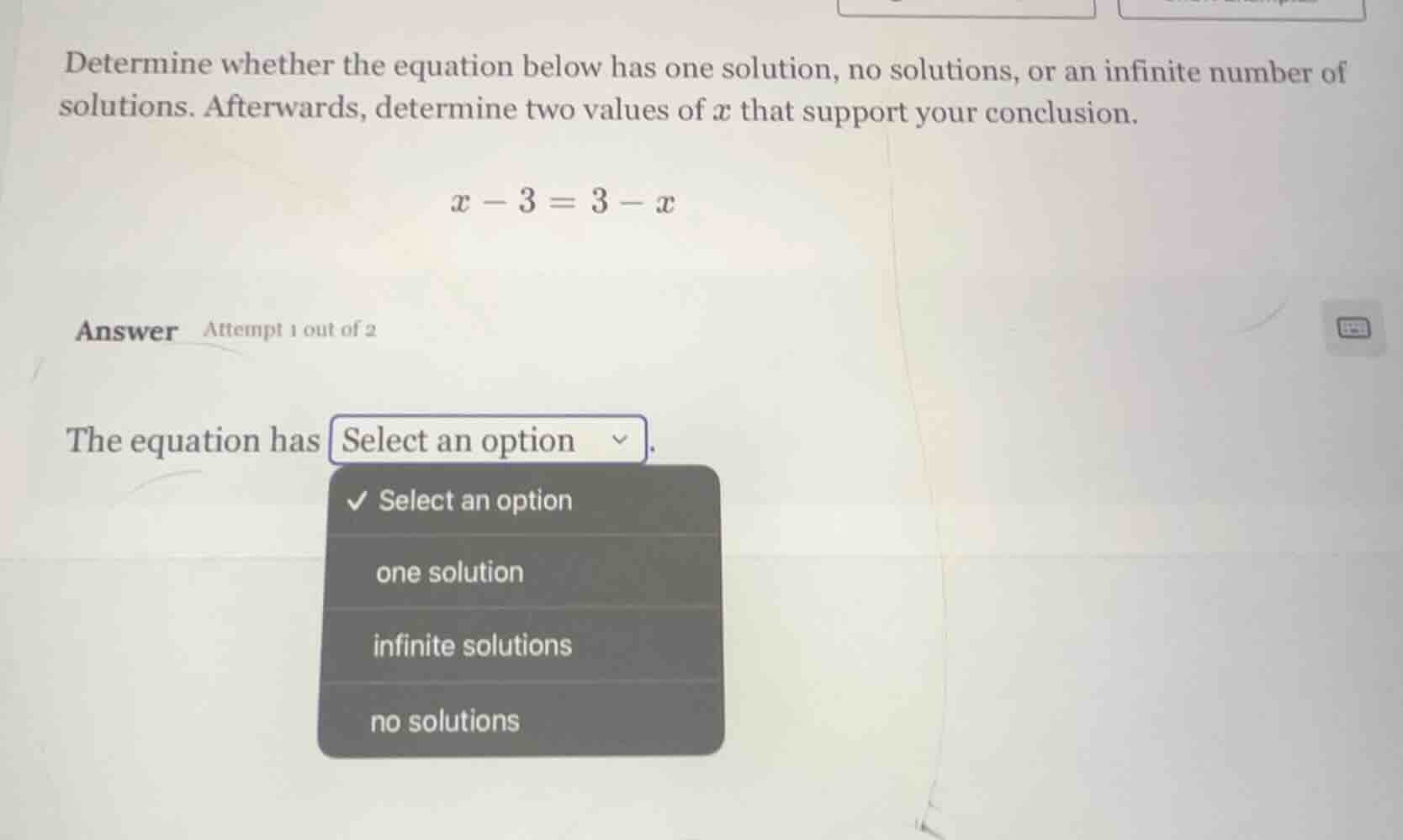
determine whether the equation below has one solution, no solutions, or an infinite number of solutions. afterwards, determine two values of ( x ) that support your conclusion.
( x - 3 = 3 - x )
answer attempt 1 out of 2
the equation has select an option
select an option
one solution
infinite solutions
no solutions
Step1: Solve the equation \( x - 3 = 3 - x \)
Add \( x \) to both sides: \( x + x - 3 = 3 - x + x \), which simplifies to \( 2x - 3 = 3 \).
Step2: Isolate the variable term
Add 3 to both sides: \( 2x - 3 + 3 = 3 + 3 \), so \( 2x = 6 \).
Step3: Solve for \( x \)
Divide both sides by 2: \( \frac{2x}{2} = \frac{6}{2} \), giving \( x = 3 \). Since we found a unique solution, the equation has one solution.
Step4: Test values
- For \( x = 3 \): Left side \( 3 - 3 = 0 \), Right side \( 3 - 3 = 0 \), so it works.
- For \( x = 4 \): Left side \( 4 - 3 = 1 \), Right side \( 3 - 4 = -1 \), not equal (but this just shows other values don't work, confirming one solution).

Snap & solve any problem in the app
Get step-by-step solutions on Sovi AI
Photo-based solutions with guided steps
Explore more problems and detailed explanations
The equation has one solution. Two values: \( x = 3 \) (satisfies) and \( x = 0 \) (Left: \( 0 - 3 = -3 \), Right: \( 3 - 0 = 3 \), not equal, showing only \( x = 3 \) works).