QUESTION IMAGE
Question
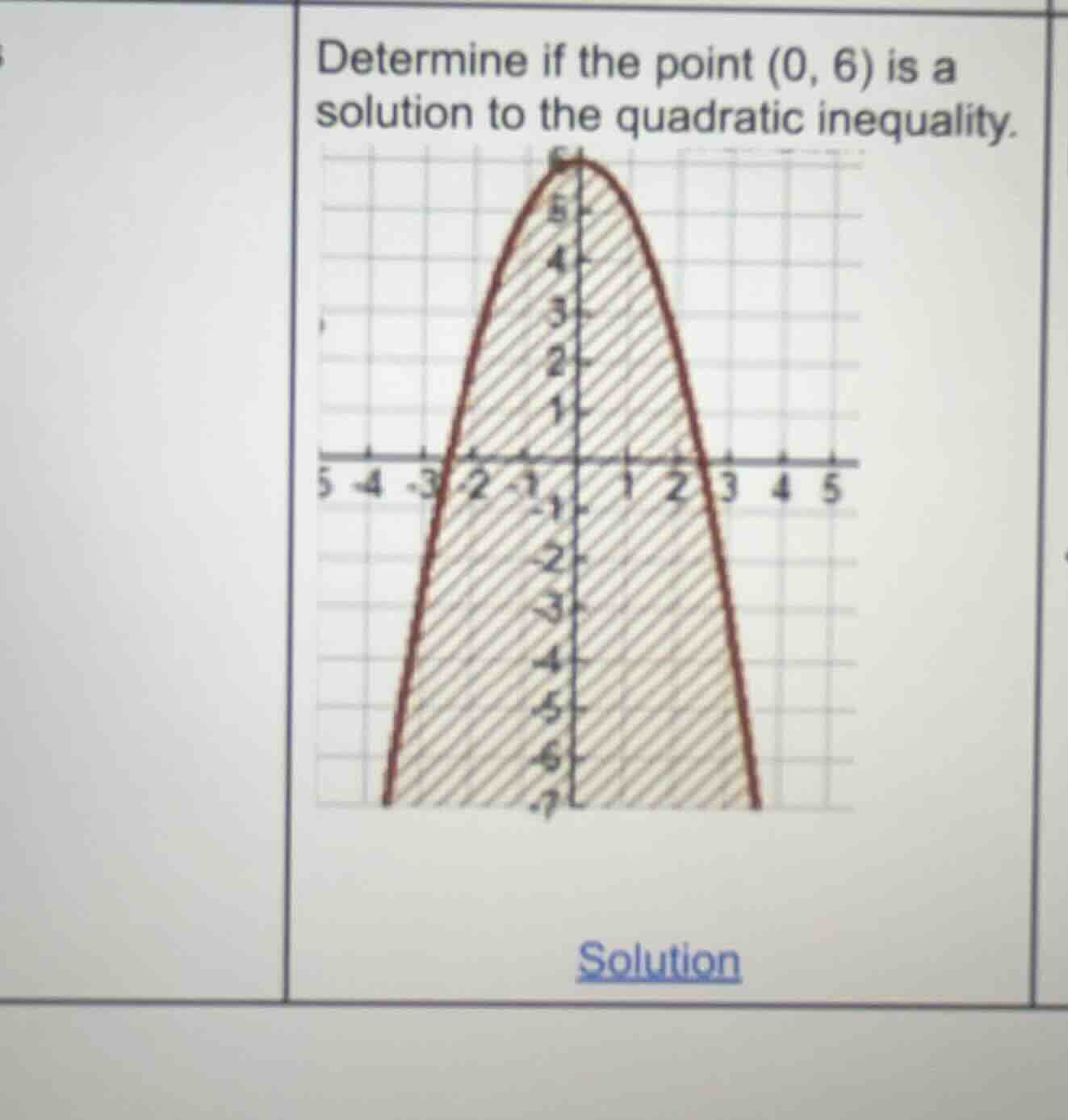
determine if the point \\((0, 6)\\) is a solution to the quadratic inequality.
<pre_analysis>
{
"quality": "clear",
"question_count": 1,
"skills_matched": [
"step_cot",
"explain_then_answer",
"tutor"
],
"needs_drawing": true,
"concepts_used": [],
"new_concepts": [
"Quadratic Inequalities",
"Graphing Inequalities"
],
"current_concepts": [
"Quadratic Inequalities",
"Graphing Inequalities",
"Feasible Region"
]
}
</pre_analysis>
<reasoning>
Identify the point on the coordinate plane
Find the location of the point \((0, 6)\) on the given graph.
Check if the point lies in the shaded region
Observe whether the point \((0, 6)\) is inside the shaded area.
The shaded region represents the solution set of the quadratic inequality.
The boundary curve is a solid line, meaning points on the boundary are included.
The vertex of the parabola is at \((0, 6)\), which lies directly on the solid boundary line.
Determine the solution status
Since the boundary line is solid and the point \((0, 6)\) lies on this boundary, it is included in the solution set.
Therefore, the point \((0, 6)\) is a solution to the quadratic inequality.
</reasoning>
<answer>
Yes, the point \((0, 6)\) is a solution to the quadratic inequality because it lies on the solid boundary line of the shaded region.
</answer>
<plot>
{
"elements": [
{
"type": "inequality",
"params": [
{
"js": "6 - x*x",
"latex": "y \le 6 - x^2"
},
[0, 2]
],
"properties": {
"inverse": false,
"strict": false,
"strokeColor": "#8C55F2",
"strokeWidth": 3,
"fillColor": "rgba(140, 85, 242, 0.3)"
}
},
{
"type": "point",
"params": [
[0, 6]
],
"properties": {
"name": "(0, 6)",
"size": 5,
"color": "#F2557F",
"withLabel": true
}
}
],
"timestamps": [0.5]
}
</plot>
<post_analysis>
{
"subject": "Mathematics",
"question_type": "Free Response",
"knowledge_point": [
"Mathematics",
"Algebra",
"Quadratic Inequalities"
]
}
</post_analysis>
Snap & solve any problem in the app
Get step-by-step solutions on Sovi AI
Photo-based solutions with guided steps
Explore more problems and detailed explanations
<pre_analysis>
{
"quality": "clear",
"question_count": 1,
"skills_matched": [
"step_cot",
"explain_then_answer",
"tutor"
],
"needs_drawing": true,
"concepts_used": [],
"new_concepts": [
"Quadratic Inequalities",
"Graphing Inequalities"
],
"current_concepts": [
"Quadratic Inequalities",
"Graphing Inequalities",
"Feasible Region"
]
}
</pre_analysis>
<reasoning>
Identify the point on the coordinate plane
Find the location of the point \((0, 6)\) on the given graph.
Check if the point lies in the shaded region
Observe whether the point \((0, 6)\) is inside the shaded area.
The shaded region represents the solution set of the quadratic inequality.
The boundary curve is a solid line, meaning points on the boundary are included.
The vertex of the parabola is at \((0, 6)\), which lies directly on the solid boundary line.
Determine the solution status
Since the boundary line is solid and the point \((0, 6)\) lies on this boundary, it is included in the solution set.
Therefore, the point \((0, 6)\) is a solution to the quadratic inequality.
</reasoning>
<answer>
Yes, the point \((0, 6)\) is a solution to the quadratic inequality because it lies on the solid boundary line of the shaded region.
</answer>
<plot>
{
"elements": [
{
"type": "inequality",
"params": [
{
"js": "6 - x*x",
"latex": "y \le 6 - x^2"
},
[0, 2]
],
"properties": {
"inverse": false,
"strict": false,
"strokeColor": "#8C55F2",
"strokeWidth": 3,
"fillColor": "rgba(140, 85, 242, 0.3)"
}
},
{
"type": "point",
"params": [
[0, 6]
],
"properties": {
"name": "(0, 6)",
"size": 5,
"color": "#F2557F",
"withLabel": true
}
}
],
"timestamps": [0.5]
}
</plot>
<post_analysis>
{
"subject": "Mathematics",
"question_type": "Free Response",
"knowledge_point": [
"Mathematics",
"Algebra",
"Quadratic Inequalities"
]
}
</post_analysis>