QUESTION IMAGE
Question
describing conditional probabilities
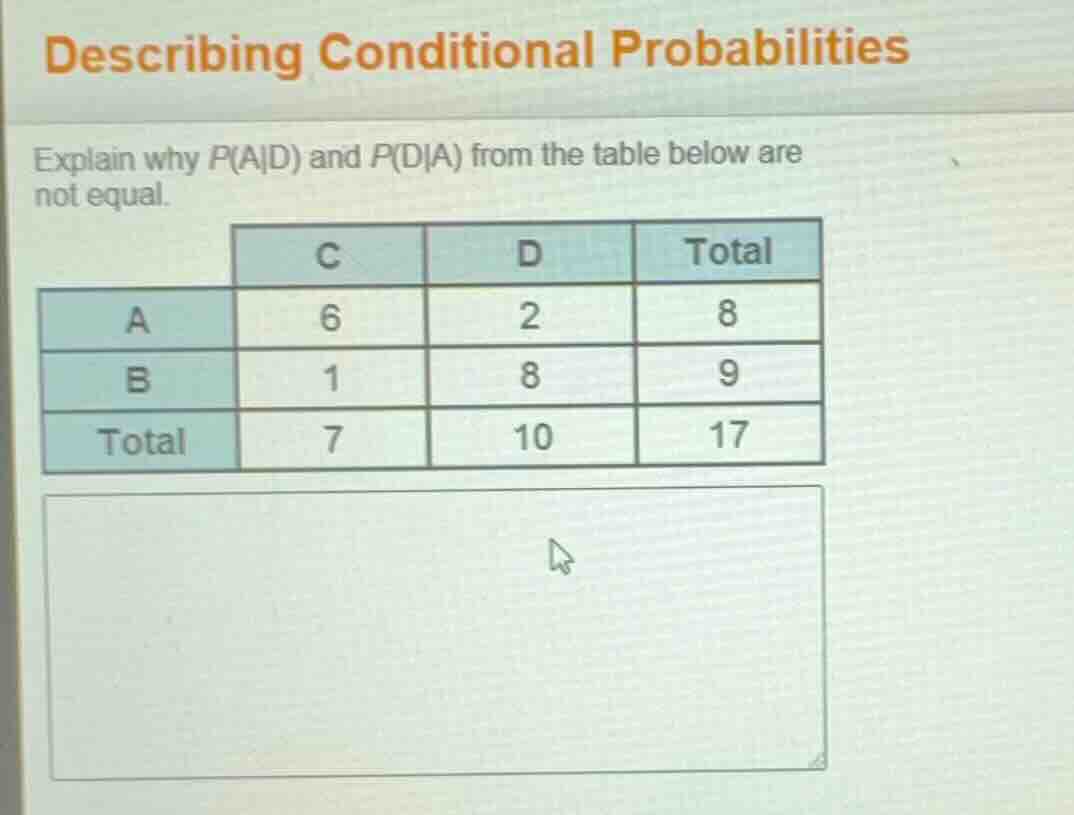
explain why \\(p(a|d)\\) and \\(p(d|a)\\) from the table below are not equal.
\
$$\begin{tabular}{|c|c|c|c|}
\\hline
& c & d & total \\\\
\\hline
a & 6 & 2 & 8 \\\\
\\hline
b & 1 & 8 & 9 \\\\
\\hline
total & 7 & 10 & 17 \\\\
\\hline
\\end{tabular}$$
Calculate P(A|D)
Using the Conditional Probability Calculation knowledge point
$$
P(A|D) = \frac{P(A \cap D)}{P(D)} = \frac{2}{10} = 0.2
$$
Calculate P(D|A)
Using the Conditional Probability Calculation knowledge point
$$
P(D|A) = \frac{P(A \cap D)}{P(A)} = \frac{2}{8} = 0.25
$$
Compare the denominators
Using the Conditional Probability knowledge point
$$
LATEXBLOCK0
$$

Snap & solve any problem in the app
Get step-by-step solutions on Sovi AI
Photo-based solutions with guided steps
Explore more problems and detailed explanations
The conditional probabilities \(P(A|D)\) and \(P(D|A)\) are not equal because they restrict the sample space to different totals:
- \(P(A|D) = \frac{2}{10} = 0.2\) (the probability of \(A\) given that \(D\) has occurred, which uses the total of column \(D\), \(10\), as the denominator).
- \(P(D|A) = \frac{2}{8} = 0.25\) (the probability of \(D\) given that \(A\) has occurred, which uses the total of row \(A\), \(8\), as the denominator).
Since the condition restricts the sample space to different subgroups with different totals (\(10
eq 8\)), the resulting probabilities are different.