QUESTION IMAGE
Question
describe the transformation \\(f(x) = \sqrt{x+1} - 5\\) in words.
the parent function \\(f(x) = \sqrt{x}\\) has been shifted left 1 unit and down 5 units.
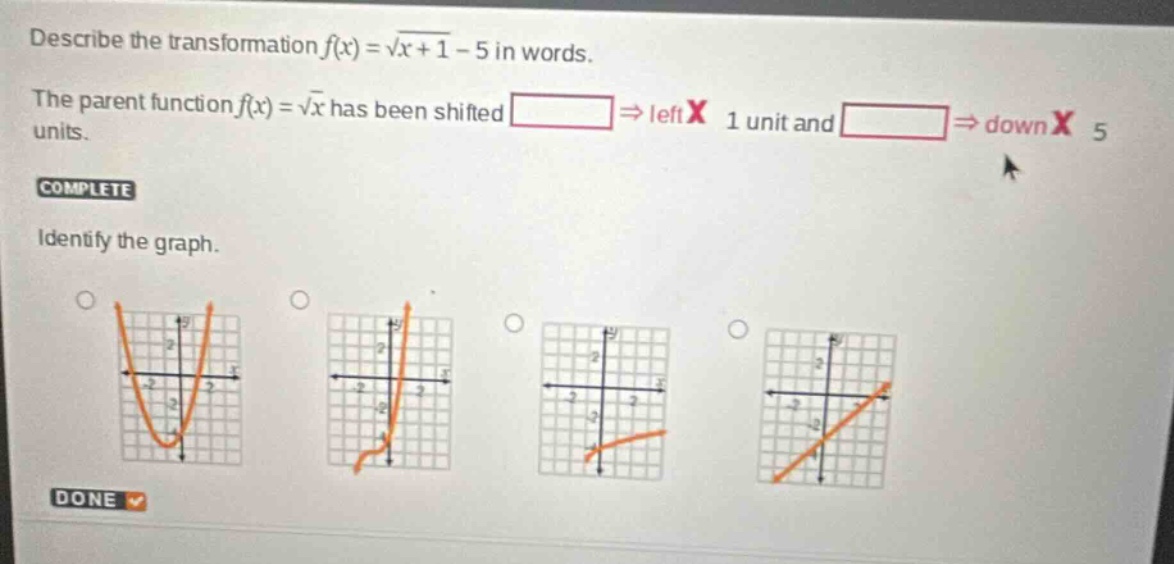
identify the graph.
⚡ Using what you learned: combining transformations
Step 1: Analyze the horizontal shift
The parent function is \( f(x) = \sqrt{x} \).
In the transformed function \( f(x) = \sqrt{x + 1} - 5 \), the term inside the radical is \( x + 1 \).
Adding a positive constant inside the function's argument shifts the graph horizontally to the left:
Thus, the graph is shifted left by \( 1 \) unit.
Step 2: Analyze the vertical shift
The constant term outside the radical is \( -5 \).
Subtracting a constant outside the function shifts the graph vertically downward:
Thus, the graph is shifted down by \( 5 \) units.
Step 3: Identify the correct graph
The starting point (vertex) of the parent square root function \( f(x) = \sqrt{x} \) is at \( (0,0) \).
Applying the shifts:
- Shift left by \( 1 \) unit: \( x = -1 \)
- Shift down by \( 5 \) units: \( y = -5 \)
The new starting point of the curve must be at \( (-1, -5) \).
Looking at the given options:
- Graph 1: A parabola (quadratic function).
- Graph 2: A cubic-like curve.
- Graph 3: A square root curve starting at \( (-1, -5) \).
- Graph 4: A straight line (linear function).
The correct graph is the third graph.

Snap & solve any problem in the app
Get step-by-step solutions on Sovi AI
Photo-based solutions with guided steps
Explore more problems and detailed explanations
- First blank: left
- Second blank: down
- Correct Graph: The third graph (the square root curve starting at \( (-1, -5) \))