QUESTION IMAGE
Question
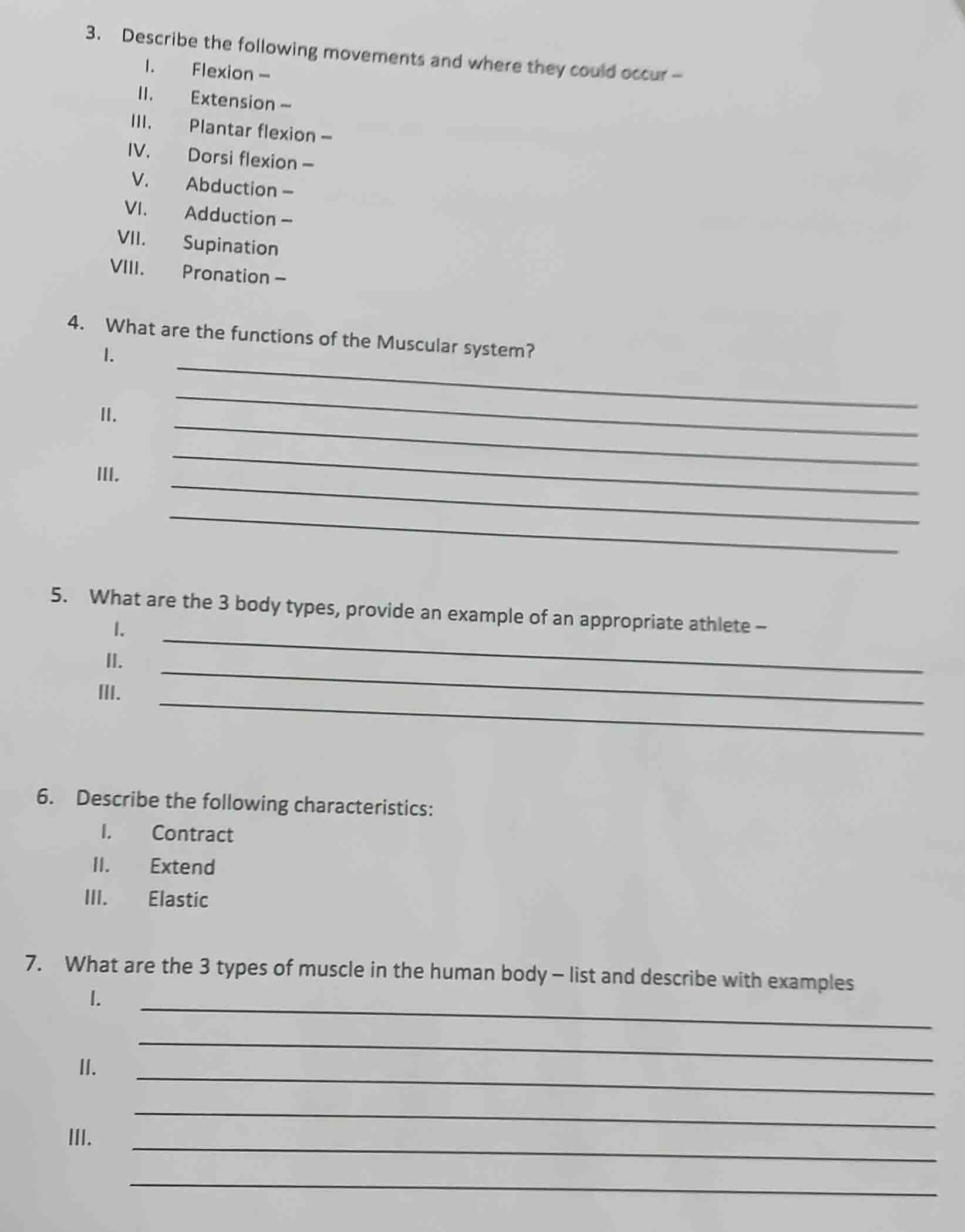
- describe the following movements and where they could occur -
i. flexion -
ii. extension -
iii. plantar flexion -
iv. dorsi flexion -
v. abduction -
vi. adduction -
vii. supination
viii. pronation -
- what are the functions of the muscular system?
i. __________________________________________________
ii. __________________________________________________
iii. __________________________________________________
- what are the 3 body types, provide an example of an appropriate athlete -
i. __________________________________________________
ii. __________________________________________________
iii. __________________________________________________
- describe the following characteristics:
i. contract
ii. extend
iii. elastic
- what are the 3 types of muscle in the human body - list and describe with examples
i. __________________________________________________
ii. __________________________________________________
iii. __________________________________________________
Analyze anatomical movements and locations
We define each movement and identify a joint where it occurs:
- Flexion: Decreasing the angle between two bones (e.g., bending the elbow).
- Extension: Increasing the angle between two bones (e.g., straightening the knee).
- Plantar flexion: Pointing the toes downward (occurs at the ankle).
- Dorsi flexion: Pulling the toes upward toward the shin (occurs at the ankle).
- Abduction: Moving a limb away from the midline of the body (e.g., raising the arm sideways at the shoulder).
- Adduction: Moving a limb toward the midline of the body (e.g., bringing the arm back down to the side).
- Supination: Rotating the forearm so the palm faces upward/forward (occurs at the radioulnar joint).
- Pronation: Rotating the forearm so the palm faces downward/backward (occurs at the radioulnar joint).
Identify functions of the muscular system
The muscular system serves several vital roles in the human body:
- Movement production: Skeletal muscles pull on bones to create voluntary movement.
- Posture and body position maintenance: Continuous muscle contractions keep us upright against gravity.
- Heat generation: Muscle activity produces heat as a byproduct, helping maintain normal body temperature.
Classify somatotypes and athletic examples
The three primary human body types (somatotypes) are:
- Ectomorph: Lean, slender, and narrow build with fast metabolism. Example: Marathon runner or high jumper.
- Mesomorph: Muscular, athletic, and strong build with broad shoulders. Example: Sprinter, gymnast, or weightlifter.
- Endomorph: Rounder, stockier build with a tendency to store fat. Example: Shot putter, rugby prop, or sumo wrestler.
Describe muscle tissue characteristics
We define the key physiological properties of muscle tissue:
- Contract: The ability of muscle tissue to shorten forcefully to generate tension and pull on bones.
- Extend: The ability of muscle tissue to stretch or lengthen beyond its resting state without being damaged.
- Elastic: The ability of muscle tissue to return to its original resting length and shape after being stretched or contracted.
Classify and describe muscle types
The three types of muscle tissue in the human body are:
- Skeletal muscle: Striated, voluntary muscles attached to bones. They control conscious movement. Example: Biceps brachii.
- Cardiac muscle: Striated, involuntary muscle found exclusively in the heart wall. It pumps blood. Example: Myocardium.
- Smooth muscle: Non-striated, involuntary muscle found in the walls of internal hollow organs. It moves substances through tracts. Example: Walls of the stomach or blood vessels.

Snap & solve any problem in the app
Get step-by-step solutions on Sovi AI
Photo-based solutions with guided steps
Explore more problems and detailed explanations
Question 3
I. Flexion
- Description: Decreasing the angle between two bones at a joint.
- Location: Elbow joint (bending the arm).
II. Extension
- Description: Increasing the angle between two bones at a joint.
- Location: Knee joint (straightening the leg).
III. Plantar flexion
- Description: Pointing the toes downward, moving the sole of the foot away from the shin.
- Location: Ankle joint.
IV. Dorsi flexion
- Description: Pulling the toes upward, moving the top of the foot closer to the shin.
- Location: Ankle joint.
V. Abduction
- Description: Moving a limb laterally away from the midline of the body.
- Location: Shoulder joint (raising the arm out to the side).
VI. Adduction
- Description: Moving a limb medially toward the midline of the body.
- Location: Shoulder joint (bringing the arm back down to the side).
VII. Supination
- Description: Rotating the forearm so that the palm faces upward or forward.
- Location: Radioulnar joint of the forearm.
VIII. Pronation
- Description: Rotating the forearm so that the palm faces downward or backward.
- Location: Radioulnar joint of the forearm.
Question 4
I. Movement production: Skeletal muscles contract to pull on tendons and move bones, allowing for locomotion, facial expressions, and other voluntary actions.
II. Maintenance of posture and body position: Continuous, subconscious muscle contractions stabilize joints and support the body against gravity to keep us upright.
III. Heat generation (Thermogenesis): Muscle contractions produce heat as a metabolic byproduct, which is essential for maintaining normal core body temperature.
Question 5
I. Ectomorph
- Description: Characterized by a lean, slender frame, narrow shoulders, and low body fat.
- Athlete Example: Marathon runner.
II. Mesomorph
- Description: Characterized by an athletic, muscular build with broad shoulders, a narrow waist, and low body fat.
- Athlete Example: 100m sprinter.
III. Endomorph
- Description: Characterized by a stockier, rounder build with a larger bone structure and a tendency to store body fat.
- Athlete Example: Shot putter.
Question 6
I. Contract: The ability of muscle fibers to shorten and generate force, pulling on skeletal structures to create movement.
II. Extend: The ability of muscle fibers to stretch and lengthen beyond their resting state without tearing.
III. Elastic: The ability of muscle fibers to return to their original resting length and shape after being stretched or contracted.
Question 7
I. Skeletal Muscle
- Description: Striated, voluntary muscle tissue attached to bones. It is controlled consciously to produce body movements.
- Example: Biceps brachii.
II. Cardiac Muscle
- Description: Striated, involuntary muscle tissue found only in the walls of the heart. It contracts rhythmically to pump blood throughout the body.
- Example: Myocardium (heart muscle).
III. Smooth Muscle
- Description: Non-striated, involuntary muscle tissue found in the walls of hollow internal organs and vessels. It controls internal movements automatically.
- Example: Walls of the stomach or blood vessels.