QUESTION IMAGE
Question
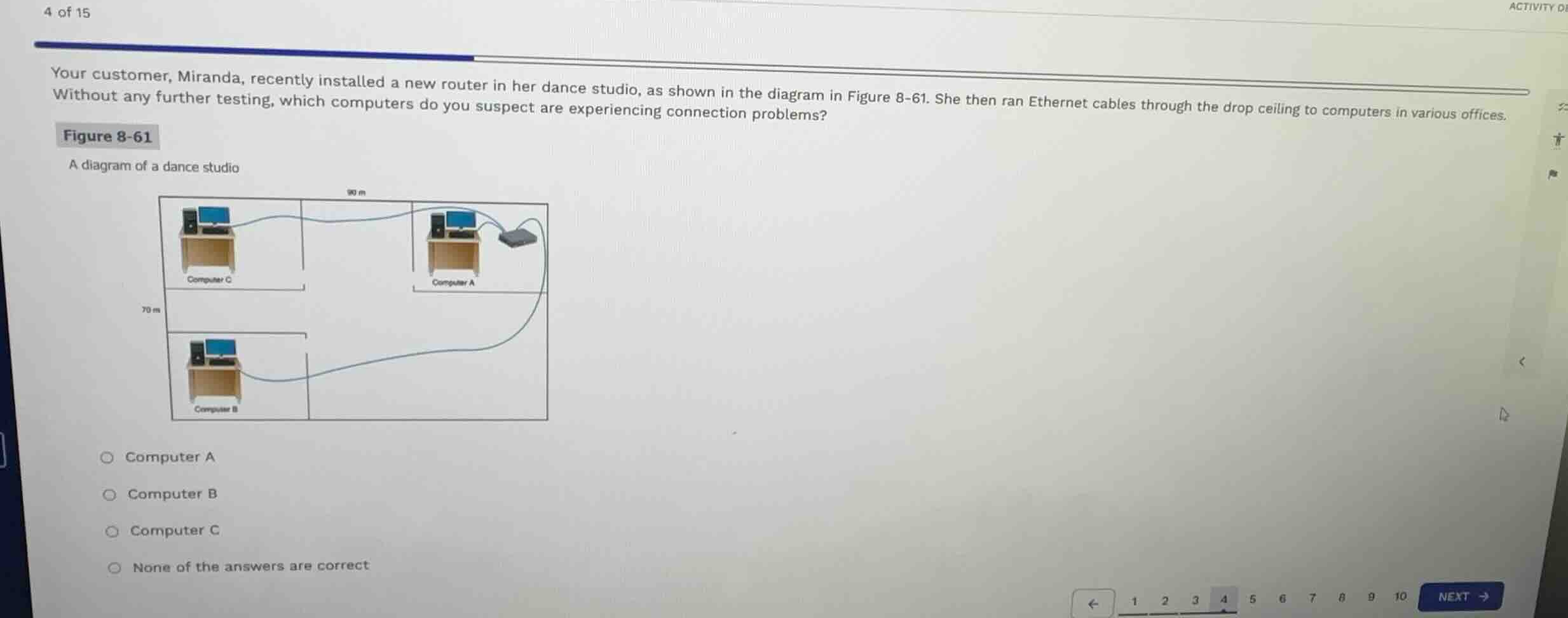
your customer, miranda, recently installed a new router in her dance studio, as shown in the diagram in figure 8-61. she then ran ethernet cables through the drop ceiling to computers in various offices. without any further testing, which computers do you suspect are experiencing connection problems?
figure 8-61
a diagram of a dance studio
computer a
computer b
computer c
none of the answers are correct
Analyze the physical layout and dimensions
We first examine the dimensions of the dance studio provided in Figure 8-61. The horizontal length of the main area is labeled as \(90\text{ m}\), and the vertical width is labeled as \(70\text{ m}\). The router is located in the top-right corner near Computer A.
Estimate the cable run lengths
Next, we estimate the physical path and length of the Ethernet cables run through the drop ceiling from the router to each computer:
- Computer A: Located in the same room/area very close to the router. The cable run is extremely short, well under \(10\text{ m}\).
- Computer B: Located in the bottom-left corner. To reach Computer B from the top-right corner, the cable must run horizontally across the studio (\(90\text{ m}\)) and vertically down (\(70\text{ m}\)). Even a direct diagonal path would be \(\sqrt{90^2 + 70^2} \approx 114\text{ m}\). Following the walls or drop ceiling pathways, the cable run is at least \(90\text{ m} + 70\text{ m} = 160\text{ m}\).
- Computer C: Located in the top-left corner. The horizontal distance from the router is approximately \(90\text{ m}\). Following a realistic routing path through the ceiling, this run will be very close to or slightly exceed \(90\text{ m}\).
Apply standard Ethernet specifications
Under the TIA/EIA 568 standard for twisted-pair Ethernet cabling (such as Cat 5e or Cat 6), the maximum allowable length for a solid-core horizontal cable run is \(90\text{ m}\), with an additional \(10\text{ m}\) allowed for patch cables, making the absolute channel limit \(100\text{ m}\).
- The cable run to Computer B (estimated at over \(114\text{ m}\) to \(160\text{ m}\)) significantly exceeds the \(100\text{ m}\) limit. This will cause severe signal attenuation, timing issues, and connection failures.
- Therefore, Computer B is the primary suspect experiencing connection problems due to exceeding standard cable length limits.

Snap & solve any problem in the app
Get step-by-step solutions on Sovi AI
Photo-based solutions with guided steps
Explore more problems and detailed explanations
- Computer A
- Computer B (Correct answer)
- Computer C
- None of the answers are correct