QUESTION IMAGE
Question
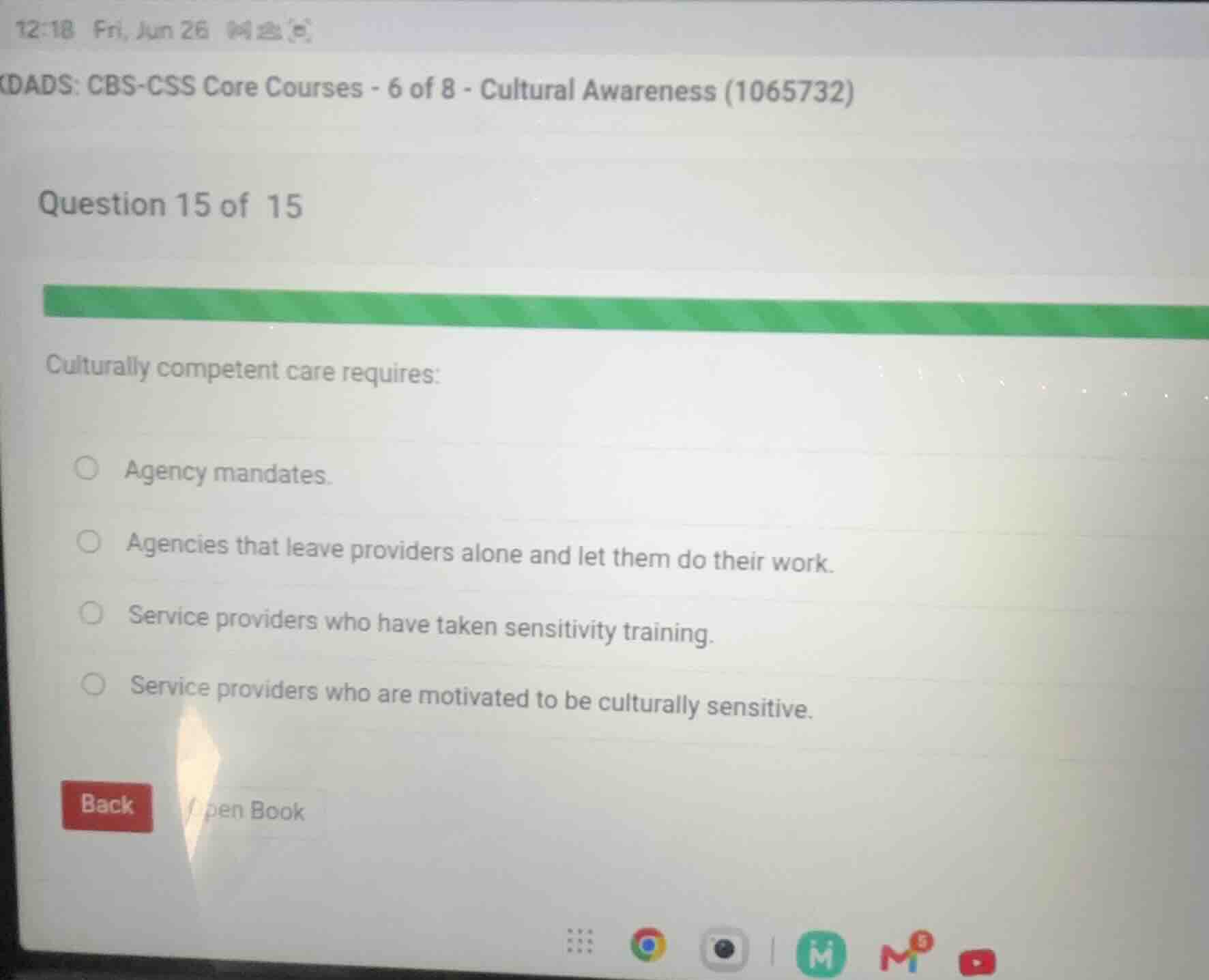
culturally competent care requires:
- agency mandates.
- agencies that leave providers alone and let them do their work.
- service providers who have taken sensitivity training.
- service providers who are motivated to be culturally sensitive.
Analyze the definition of cultural competence
Cultural competence is not merely about passive compliance with agency mandates, isolated sensitivity training, or hands-off administration. It is an ongoing, active process that relies fundamentally on the intrinsic motivation, awareness, and commitment of individual service providers to understand, respect, and adapt to the diverse cultural backgrounds of their clients.
Evaluate the given options
- Agency mandates: Mandates enforce compliance but do not guarantee genuine, empathetic, or competent care.
- Agencies that leave providers alone: Isolation or lack of organizational support does not foster cultural competence.
- Service providers who have taken sensitivity training: Completing a training course is a passive event that does not automatically translate into ongoing competent practice.
- Service providers who are motivated to be culturally sensitive: Intrinsic motivation is the foundational driver for actively acquiring cultural knowledge, developing self-awareness, and continuously adapting clinical skills to meet diverse client needs.

Snap & solve any problem in the app
Get step-by-step solutions on Sovi AI
Photo-based solutions with guided steps
Explore more problems and detailed explanations
- Agency mandates.
- Agencies that leave providers alone and let them do their work.
- Service providers who have taken sensitivity training.
- Service providers who are motivated to be culturally sensitive. (Correct answer)