QUESTION IMAGE
Question
crhs : advanced algebra: concepts and connections - block (27.0831030)
rational equations
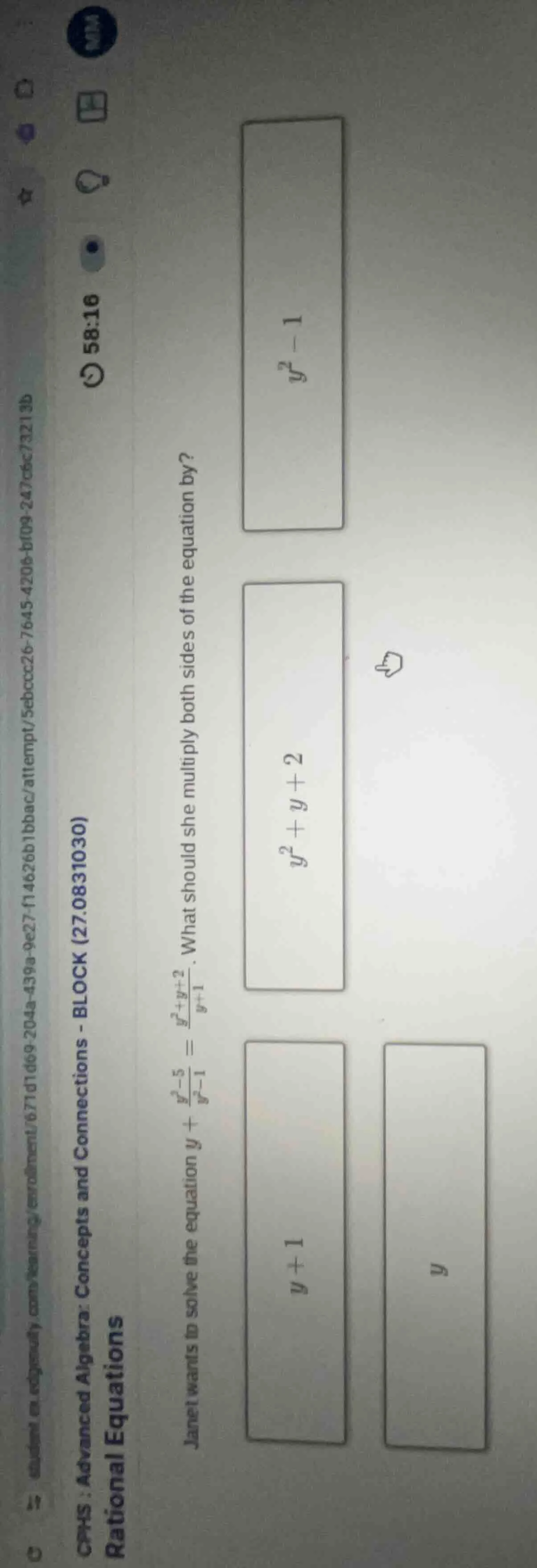
janet wants to solve the equation $y + \frac{y^2 - 5}{y - 1} = \frac{y^2 + y + 2}{y + 1}$. what should she multiply both sides of the equation by?
options: $y + 1$, $y^2 + y + 2$, $y$, $y^2 - 1$
Step1: Factor denominators and numerators
First, factor the expressions:
- Denominator of the left - hand side (LHS) fraction: \(y - 1\) (already factored). Numerator of LHS: \(y^{2}-5\) (we can also consider the other term \(y\) as a fraction with denominator 1, but for the rational equation, we focus on the denominators of the fractions).
- Denominator of the right - hand side (RHS) fraction: \(y + 1\). Numerator of RHS: \(y^{2}+y + 2=y(y + 1)+2\), and also, we can factor \(y^{2}-1=(y - 1)(y + 1)\) (difference of squares), \(y^{2}+y + 2\) doesn't factor nicely over integers, but let's look at the denominators of the fractions in the equation. The equation is \(y+\frac{y^{2}-5}{y - 1}=\frac{y^{2}+y + 2}{y + 1}\). First, rewrite \(y\) as \(\frac{y(y - 1)}{y - 1}\) to have a common denominator with \(\frac{y^{2}-5}{y - 1}\), but when we want to eliminate the denominators, we need to find the least common denominator (LCD) of the denominators \(y - 1\) and \(y + 1\) and also consider the non - fraction term \(y\) (which has a denominator of 1). Wait, actually, the denominators of the rational terms are \(y-1\) and \(y + 1\). But let's re - examine the equation. Wait, maybe there is a typo or mis - writing in the original problem, and the equation is supposed to be \(y+\frac{y^{2}-5}{y - 1}=\frac{y^{2}+y + 2}{y + 1}\)? No, looking at the options, the denominators and numerators: Let's factor \(y^{2}-1=(y - 1)(y + 1)\), \(y^{2}+y + 2\) is as is, \(y^{2}-5\) is as is. Wait, the correct approach to solve a rational equation \(\frac{A}{B}+\frac{C}{D}=\frac{E}{F}\) (where \(A,B,C,D,E,F\) are polynomials) is to multiply both sides by the LCD of \(B,D,F\). In this case, the denominators are \(y - 1\) (from \(\frac{y^{2}-5}{y - 1}\)) and \(y + 1\) (from \(\frac{y^{2}+y + 2}{y + 1}\)) and the term \(y\) has a denominator of 1. But also, let's look at the options: \(y^{2}-1=(y - 1)(y + 1)\), \(y^{2}+y + 2\) is a quadratic, \(y + 1\) and \(y\) are linear. Wait, maybe the original equation is \(y+\frac{y^{2}-5}{y - 1}=\frac{y^{2}+y + 2}{y + 1}\), and we need to multiply both sides by \((y - 1)(y + 1)=y^{2}-1\) to eliminate the denominators. Let's check:
If we multiply each term by \(y^{2}-1=(y - 1)(y + 1)\):
- For the term \(y\): \(y\times(y^{2}-1)=y^{3}-y\)
- For the term \(\frac{y^{2}-5}{y - 1}\): \(\frac{y^{2}-5}{y - 1}\times(y^{2}-1)=\frac{y^{2}-5}{y - 1}\times(y - 1)(y + 1)=(y^{2}-5)(y + 1)\)
- For the term \(\frac{y^{2}+y + 2}{y + 1}\): \(\frac{y^{2}+y + 2}{y + 1}\times(y^{2}-1)=\frac{y^{2}+y + 2}{y + 1}\times(y - 1)(y + 1)=(y^{2}+y + 2)(y - 1)\)
So the least common denominator (LCD) of the denominators \(y - 1\) and \(y + 1\) is \((y - 1)(y + 1)=y^{2}-1\). So Janet should multiply both sides by \(y^{2}-1\) to eliminate the denominators.
Step2: Verify the LCD
The denominators of the rational expressions in the equation are \(y - 1\) (from \(\frac{y^{2}-5}{y - 1}\)) and \(y + 1\) (from \(\frac{y^{2}+y + 2}{y + 1}\)). The least common multiple of two distinct linear factors \(y - 1\) and \(y + 1\) is their product \((y - 1)(y + 1)=y^{2}-1\). The non - fraction term \(y\) has a denominator of 1, so multiplying by \(y^{2}-1\) will not affect it (since \(1\times(y^{2}-1)=y^{2}-1\)).

Snap & solve any problem in the app
Get step-by-step solutions on Sovi AI
Photo-based solutions with guided steps
Explore more problems and detailed explanations
\(y^{2}-1\)