QUESTION IMAGE
Question
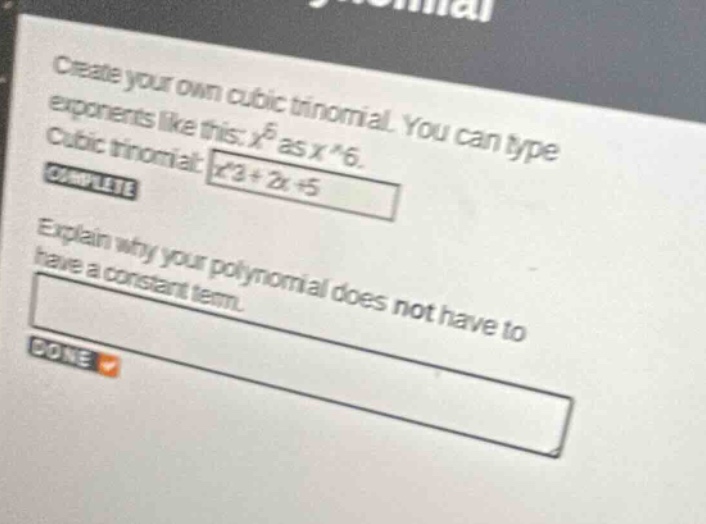
create your own cubic trinomial. you can type exponents like this: \\(x^6\\) as x^6.
cubic trinomial: \\(x^3 + 2x + 5\\)
explain why your polynomial does not have to have a constant term.
🆕 New Concept Discovered: Classifying Polynomials
Identifying polynomials by degree and number of terms.
Step 1: Define the terms
A cubic polynomial is a polynomial where the highest exponent (degree) of the variable is \(3\).
A trinomial is a polynomial that contains exactly three terms separated by addition or subtraction.
Step 2: Analyze the requirements
To make a cubic trinomial, we need:
- Exactly three terms.
- The highest exponent on any variable term to be \(3\).
The polynomial you entered, \(x^3 + 2x + 5\), is indeed a cubic trinomial because it has three terms and its highest degree is \(3\). It also happens to have a constant term (\(5\)).
Step 3: Explain why a constant term is not required
A constant term (a number without a variable, like \(5\)) is not required to satisfy either of the definitions:
- The "cubic" requirement only dictates that the highest exponent must be \(3\) (e.g., \(x^3\)).
- The "trinomial" requirement only dictates that there must be exactly three terms.
We can easily create a cubic trinomial using three terms that all contain variables of different powers (as long as the highest power is \(3\)). For example, \(x^3 + x^2 + x\) has three terms and a highest degree of \(3\), making it a cubic trinomial without any constant term.

Snap & solve any problem in the app
Get step-by-step solutions on Sovi AI
Photo-based solutions with guided steps
Explore more problems and detailed explanations
A cubic trinomial only requires that the highest exponent is \(3\) and that there are exactly three terms. It does not need a constant term because you can have three variable terms with different exponents, such as \(x^3 + x^2 + x\), which still satisfies both conditions.