Sovi.AI - AI Math Tutor

Scan to solve math questions

QUESTION IMAGE

course exam shelby isnt sure if her forklift can safely handle the weig…

Question

course exam

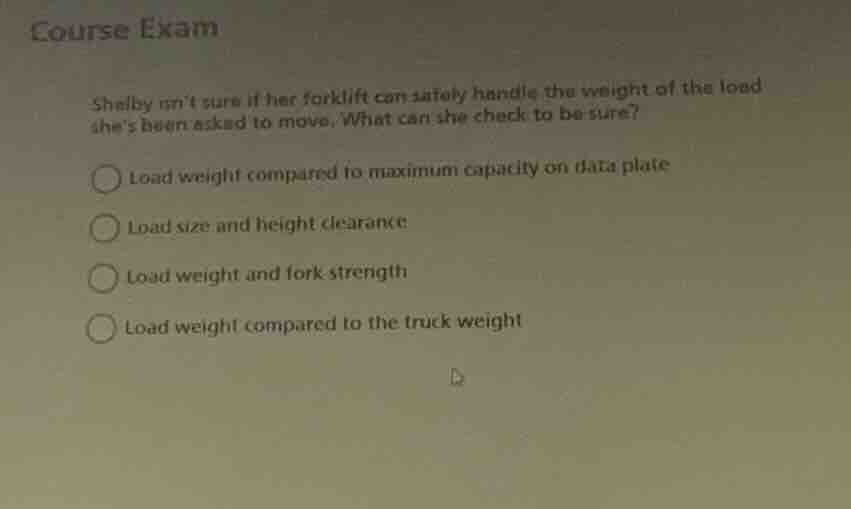
shelby isnt sure if her forklift can safely handle the weight of the load shes been asked to move. what can she check to be sure?

load weight compared to maximum capacity on data plate
load size and height clearance
load weight and fork strength
load weight compared to the truck weight

Explanation:

Response

<pre_analysis>
{
"quality": "clear",
"question_count": 1,
"skills_matched": [
"direct_cot",
"multiple_choice_formatter",
"explain_then_answer",
"tutor"
],
"needs_drawing": false,
"concepts_used": [
"Forklift Safety"
],
"new_concepts": [],
"current_concepts": [
"Forklift Safety",
"Forklift Mechanics"
]
}
</pre_analysis>

<reasoning>

Identify the core safety question

The question asks what Shelby can check to ensure her forklift can safely handle the weight of a load she needs to move.

Analyze forklift safety standards

Using the Forklift Safety knowledge point, every forklift is equipped with a manufacturer's data plate (also known as a capacity plate). This plate lists critical safety specifications, including the maximum load capacity, load center, and lift height.

Evaluate the given options

  • Load weight compared to maximum capacity on data plate: This is the correct procedure. Comparing the actual weight of the load to the rated maximum capacity on the forklift's data plate ensures the vehicle operates within safe limits.
  • Load size and height clearance: While important for navigation, this does not determine if the forklift can structurally and mechanically support the weight of the load.
  • Load weight and fork strength: Fork strength is not a standard field variable a worker can measure or check on the fly; capacity is rated for the entire vehicle system.
  • Load weight compared to the truck weight: The total weight of the truck alone does not directly tell the operator the safe lifting capacity.

Select the correct option

The first option is the standard safety practice mandated by OSHA and general industrial safety guidelines.
</reasoning>

<answer>
<mcq-correct>Load weight compared to maximum capacity on data plate</mcq-correct>
<mcq-option>Load size and height clearance</mcq-option>
<mcq-option>Load weight and fork strength</mcq-option>
<mcq-option>Load weight compared to the truck weight</mcq-option>
</answer>

<post_analysis>
{
"subject": "Others",
"question_type": "Multiple Choice",
"knowledge_point": [
"Others",
"Workplace Safety",
"Forklift Safety"
]
}
</post_analysis>

Answer:

<pre_analysis>
{
"quality": "clear",
"question_count": 1,
"skills_matched": [
"direct_cot",
"multiple_choice_formatter",
"explain_then_answer",
"tutor"
],
"needs_drawing": false,
"concepts_used": [
"Forklift Safety"
],
"new_concepts": [],
"current_concepts": [
"Forklift Safety",
"Forklift Mechanics"
]
}
</pre_analysis>

<reasoning>

Identify the core safety question

The question asks what Shelby can check to ensure her forklift can safely handle the weight of a load she needs to move.

Analyze forklift safety standards

Using the Forklift Safety knowledge point, every forklift is equipped with a manufacturer's data plate (also known as a capacity plate). This plate lists critical safety specifications, including the maximum load capacity, load center, and lift height.

Evaluate the given options

  • Load weight compared to maximum capacity on data plate: This is the correct procedure. Comparing the actual weight of the load to the rated maximum capacity on the forklift's data plate ensures the vehicle operates within safe limits.
  • Load size and height clearance: While important for navigation, this does not determine if the forklift can structurally and mechanically support the weight of the load.
  • Load weight and fork strength: Fork strength is not a standard field variable a worker can measure or check on the fly; capacity is rated for the entire vehicle system.
  • Load weight compared to the truck weight: The total weight of the truck alone does not directly tell the operator the safe lifting capacity.

Select the correct option

The first option is the standard safety practice mandated by OSHA and general industrial safety guidelines.
</reasoning>

<answer>
<mcq-correct>Load weight compared to maximum capacity on data plate</mcq-correct>
<mcq-option>Load size and height clearance</mcq-option>
<mcq-option>Load weight and fork strength</mcq-option>
<mcq-option>Load weight compared to the truck weight</mcq-option>
</answer>

<post_analysis>
{
"subject": "Others",
"question_type": "Multiple Choice",
"knowledge_point": [
"Others",
"Workplace Safety",
"Forklift Safety"
]
}
</post_analysis>