Sovi.AI - AI Math Tutor

Scan to solve math questions

QUESTION IMAGE

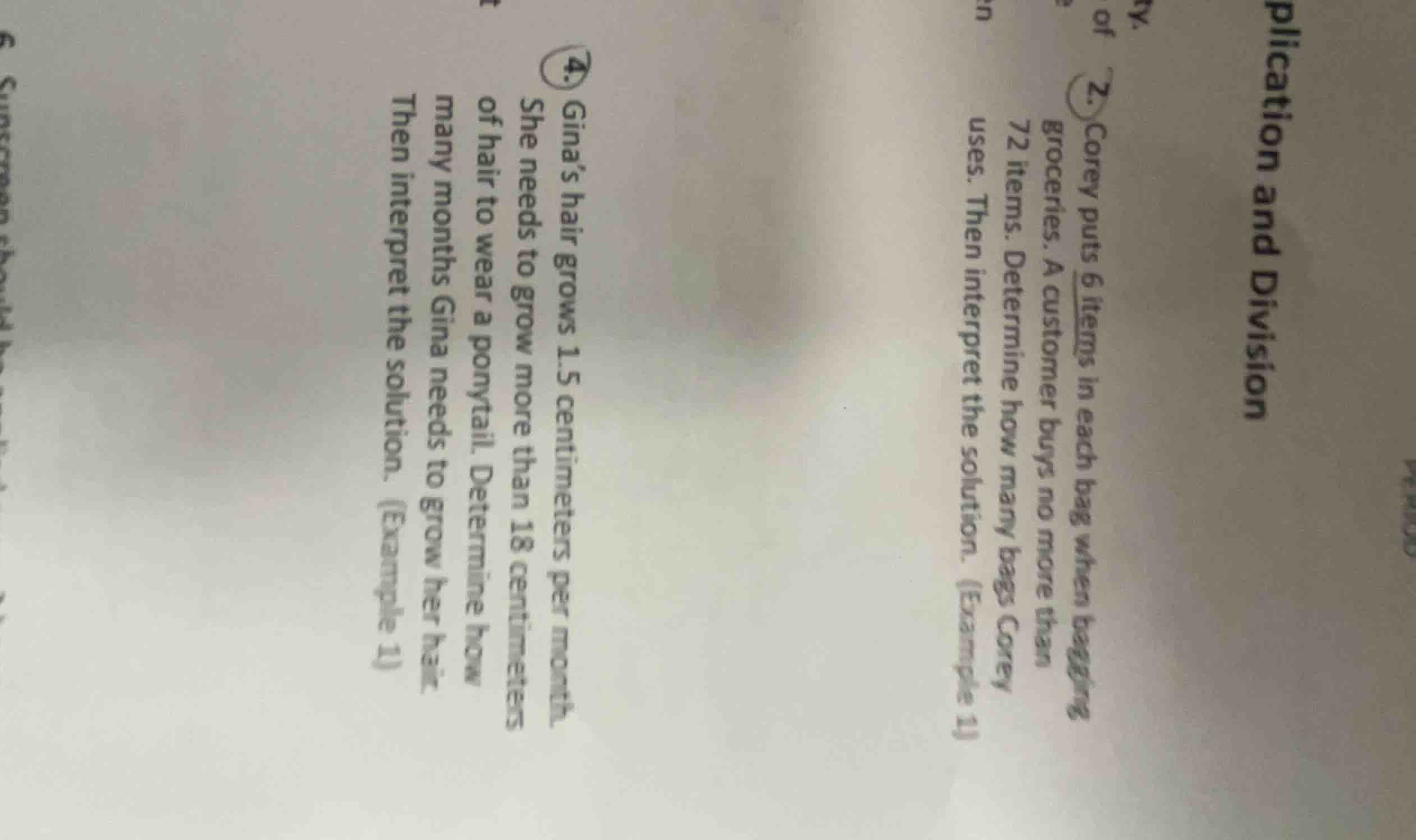
2. corey puts 6 items in each bag when bagging groceries. a customer bu…

Question

  1. corey puts 6 items in each bag when bagging groceries. a customer buys no more than 72 items. determine how many bags corey uses. then interpret the solution. (example 1)
  1. ginas hair grows 1.5 centimeters per month. she needs to grow more than 18 centimeters of hair to wear a ponytail. determine how many months gina needs to grow her hair. then interpret the solution. (example 1)

Explanation:

Response

<pre_analysis>
{
"quality": "clear",
"question_count": 2,
"skills_matched": [
"step_cot",
"explain_then_answer",
"tutor"
],
"needs_drawing": false,
"concepts_used": [
"Linear Modeling"
],
"new_concepts": [
"Linear Inequalities",
"Modeling Inequalities"
],
"current_concepts": [
"Linear Modeling",
"Linear Inequalities",
"Modeling Inequalities"
]
}
</pre_analysis>

<reasoning>

Set up inequality for Question 2

Using the Linear Modeling knowledge point:
Let \(b\) represent the number of bags Corey uses.
Corey puts 6 items in each bag, so the total number of items is \(6b\).
The customer buys no more than 72 items, which means:
\[6b \le 72\]

Solve inequality for Question 2

Divide both sides by 6:
\[b \le 12\]
Corey uses at most 12 bags.

Set up inequality for Question 4

Using the Linear Modeling knowledge point:
Let \(m\) represent the number of months Gina grows her hair.
Her hair grows 1.5 centimeters per month, so the growth is \(1.5m\).
She needs to grow more than 18 centimeters, which means:
\[1.5m > 18\]

Solve inequality for Question 4

Divide both sides by 1.5:
\[m > 12\]
Gina needs to grow her hair for more than 12 months.
</reasoning>

<answer>

Question 2

The inequality is \(6b \le 72\), which simplifies to \(b \le 12\).
Interpretation: Corey uses at most 12 bags.

Question 4

The inequality is \(1.5m > 18\), which simplifies to \(m > 12\).
Interpretation: Gina needs to grow her hair for more than 12 months.
</answer>

<post_analysis>
{
"subject": "Mathematics",
"question_type": "Multi-part",
"knowledge_point": [
"Mathematics",
"Algebra",
"Linear Inequalities"
]
}
</post_analysis>

Answer:

<pre_analysis>
{
"quality": "clear",
"question_count": 2,
"skills_matched": [
"step_cot",
"explain_then_answer",
"tutor"
],
"needs_drawing": false,
"concepts_used": [
"Linear Modeling"
],
"new_concepts": [
"Linear Inequalities",
"Modeling Inequalities"
],
"current_concepts": [
"Linear Modeling",
"Linear Inequalities",
"Modeling Inequalities"
]
}
</pre_analysis>

<reasoning>

Set up inequality for Question 2

Using the Linear Modeling knowledge point:
Let \(b\) represent the number of bags Corey uses.
Corey puts 6 items in each bag, so the total number of items is \(6b\).
The customer buys no more than 72 items, which means:
\[6b \le 72\]

Solve inequality for Question 2

Divide both sides by 6:
\[b \le 12\]
Corey uses at most 12 bags.

Set up inequality for Question 4

Using the Linear Modeling knowledge point:
Let \(m\) represent the number of months Gina grows her hair.
Her hair grows 1.5 centimeters per month, so the growth is \(1.5m\).
She needs to grow more than 18 centimeters, which means:
\[1.5m > 18\]

Solve inequality for Question 4

Divide both sides by 1.5:
\[m > 12\]
Gina needs to grow her hair for more than 12 months.
</reasoning>

<answer>

Question 2

The inequality is \(6b \le 72\), which simplifies to \(b \le 12\).
Interpretation: Corey uses at most 12 bags.

Question 4

The inequality is \(1.5m > 18\), which simplifies to \(m > 12\).
Interpretation: Gina needs to grow her hair for more than 12 months.
</answer>

<post_analysis>
{
"subject": "Mathematics",
"question_type": "Multi-part",
"knowledge_point": [
"Mathematics",
"Algebra",
"Linear Inequalities"
]
}
</post_analysis>