QUESTION IMAGE
Question
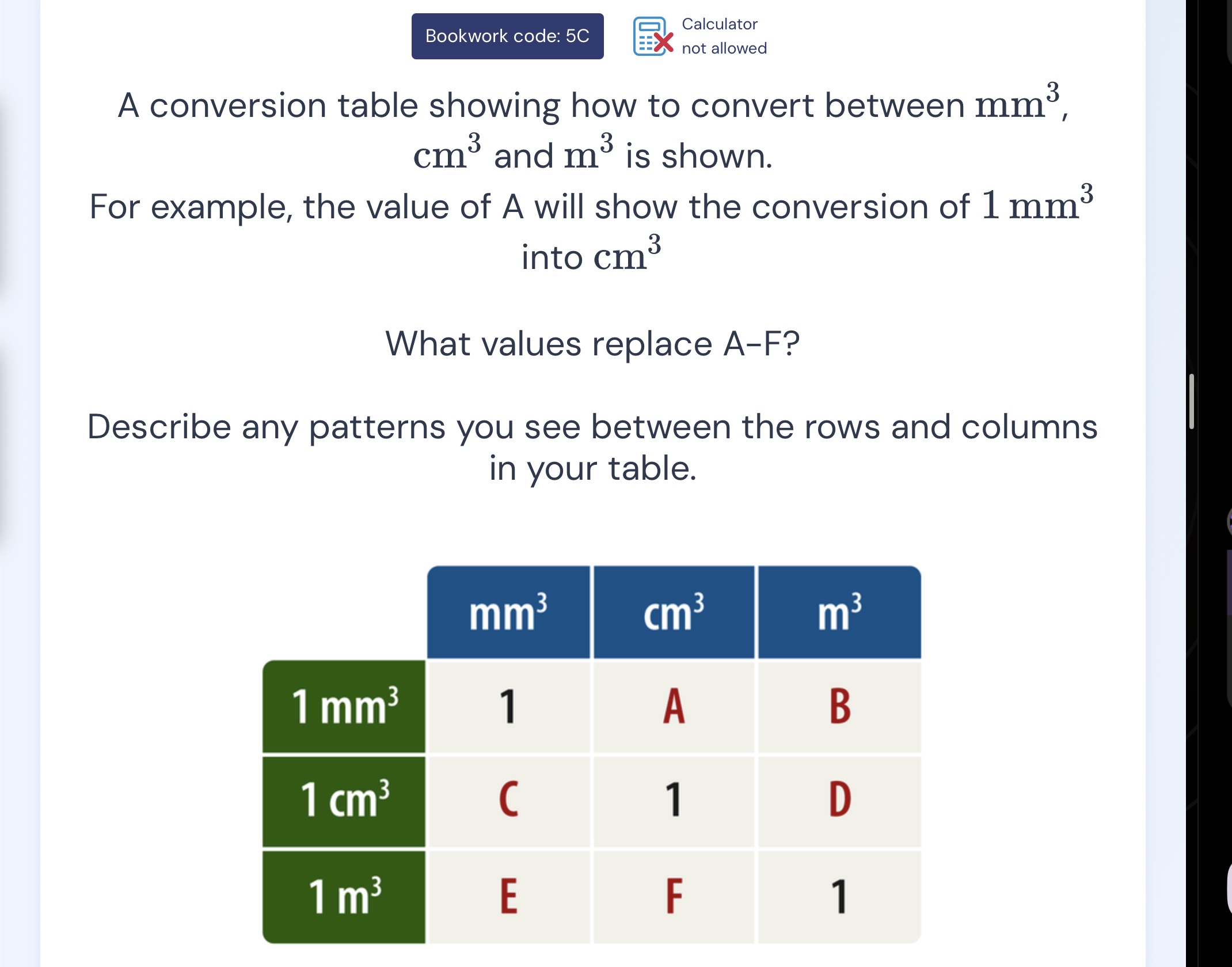
a conversion table showing how to convert between \\(\text{mm}^3\\), \\(\text{cm}^3\\) and \\(\text{m}^3\\) is shown.
for example, the value of a will show the conversion of \\(1\text{ mm}^3\\) into \\(\text{cm}^3\\)
what values replace a-f?
describe any patterns you see between the rows and columns in your table.
🆕 New Concept Discovered: Converting Cubic Units
Converting volume units requires cubing the linear conversion factors.
Step 1: Understand linear conversions
To convert between cubic units, we first look at the linear relationships between millimeters (\(\text{mm}\)), centimeters (\(\text{cm}\)), and meters (\(\text{m}\)):
- \(1\text{ cm} = 10\text{ mm}\)
- \(1\text{ m} = 100\text{ cm} = 1,000\text{ mm}\)
Step 2: Convert cubic units by cubing the linear factors
Since volume is three-dimensional, we cube the linear conversion factors:
- From \(\text{cm}^3\) to \(\text{mm}^3\):
This gives us \(C = 1,000\) (or \(10^3\)).
- From \(\text{mm}^3\) to \(\text{cm}^3\):
This gives us \(A = 0.001\) (or \(10^{-3}\)).
- From \(\text{m}^3\) to \(\text{cm}^3\):
This gives us \(F = 1,000,000\) (or \(10^6\)).
- From \(\text{cm}^3\) to \(\text{m}^3\):
This gives us \(D = 0.000001\) (or \(10^{-6}\)).
- From \(\text{m}^3\) to \(\text{mm}^3\):
This gives us \(E = 1,000,000,000\) (or \(10^9\)).
- From \(\text{mm}^3\) to \(\text{m}^3\):
This gives us \(B = 0.000000001\) (or \(10^{-9}\)).
Step 3: Identify patterns in the table
- Symmetry of Reciprocals: The values diagonally opposite across the main diagonal (the \(1\)s) are reciprocals of each other. For example, \(C = 1,000\) and \(A = \frac{1}{1,000}\).
- Powers of 10: Every value in the table is a power of \(10\) (specifically, powers of \(10^3\) or \(1,000\)).
- Scale Factor: Moving one column to the right divides the value by \(1,000\) (or \(1,000,000\) when moving from \(\text{cm}^3\) to \(\text{m}^3\)), and moving one row down multiplies the value by those same factors.

Snap & solve any problem in the app
Get step-by-step solutions on Sovi AI
Photo-based solutions with guided steps
Explore more problems and detailed explanations
Values:
- A = \(0.001\) (or \(10^{-3}\))
- B = \(0.000000001\) (or \(10^{-9}\))
- C = \(1,000\) (or \(10^3\))
- D = \(0.000001\) (or \(10^{-6}\))
- E = \(1,000,000,000\) (or \(10^9\))
- F = \(1,000,000\) (or \(10^6\))
Patterns:
- Reciprocal Pairs: Values reflected across the main diagonal of \(1\)s are reciprocals of each other (e.g., \(C = 10^3\) and \(A = 10^{-3}\)).
- Powers of 10: All conversion factors are powers of \(1,000\) (which is \(10^3\)).