QUESTION IMAGE
Question
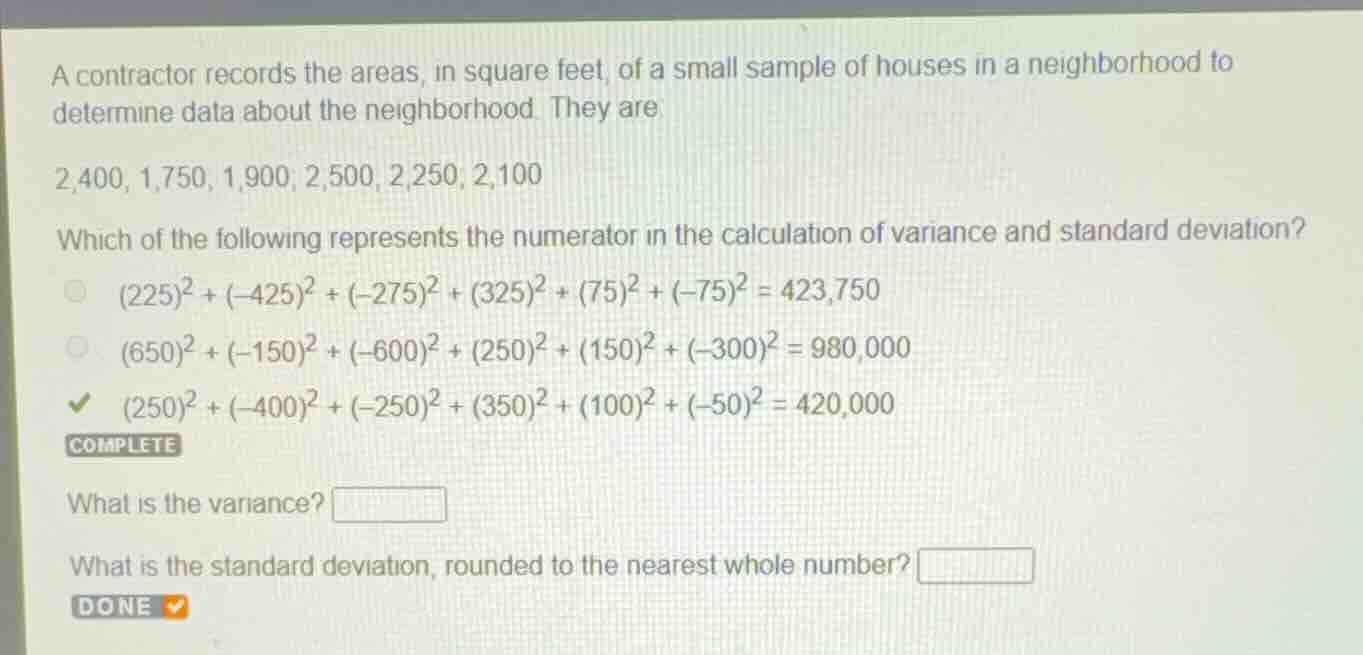
a contractor records the areas, in square feet, of a small sample of houses in a neighborhood to determine data about the neighborhood. they are:
2,400, 1,750, 1,900, 2,500, 2,250, 2,100
which of the following represents the numerator in the calculation of variance and standard deviation?
\\((225)^2 + (-425)^2 + (-275)^2 + (325)^2 + (75)^2 + (-75)^2 = 423,750\\)
\\((650)^2 + (-150)^2 + (-600)^2 + (250)^2 + (150)^2 + (-300)^2 = 980,000\\)
\\((250)^2 + (-400)^2 + (-250)^2 + (350)^2 + (100)^2 + (-50)^2 = 420,000\\)
what is the variance?
what is the standard deviation, rounded to the nearest whole number?
Calculate the sample mean
The given data set represents a small sample of house areas in square feet:
First, we find the sample size \(n\):
Next, we calculate the sample mean \(\bar{x}\):
Determine the sum of squared deviations
Using the Sample Variance Formula, the numerator is the sum of squared deviations from the mean, \(\sum (x_i - \bar{x})^2\):
Summing these squared values:
This matches the third multiple-choice option, which is already selected in the image.
Calculate the sample variance
Since the data is a "small sample of houses", we use the Sample Variance Formula with Bessel's correction, dividing by \(n - 1\):
Calculate the sample standard deviation
Using the Sample Standard Deviation Formula, we take the square root of the sample variance:
Rounding to the nearest whole number:

Snap & solve any problem in the app
Get step-by-step solutions on Sovi AI
Photo-based solutions with guided steps
Explore more problems and detailed explanations
Question 1
Which of the following represents the numerator in the calculation of variance and standard deviation?
- (A) \((225)^2 + (-425)^2 + (-275)^2 + (325)^2 + (75)^2 + (-75)^2 = 423,750\)
- (B) \((650)^2 + (-150)^2 + (-600)^2 + (250)^2 + (150)^2 + (-300)^2 = 980,000\)
- (C) \((250)^2 + (-400)^2 + (-250)^2 + (350)^2 + (100)^2 + (-50)^2 = 420,000\) (Correct answer)
Question 2
What is the variance?
<blank>84000</blank>
Question 3
What is the standard deviation, rounded to the nearest whole number?
<blank>290</blank>