QUESTION IMAGE
Question
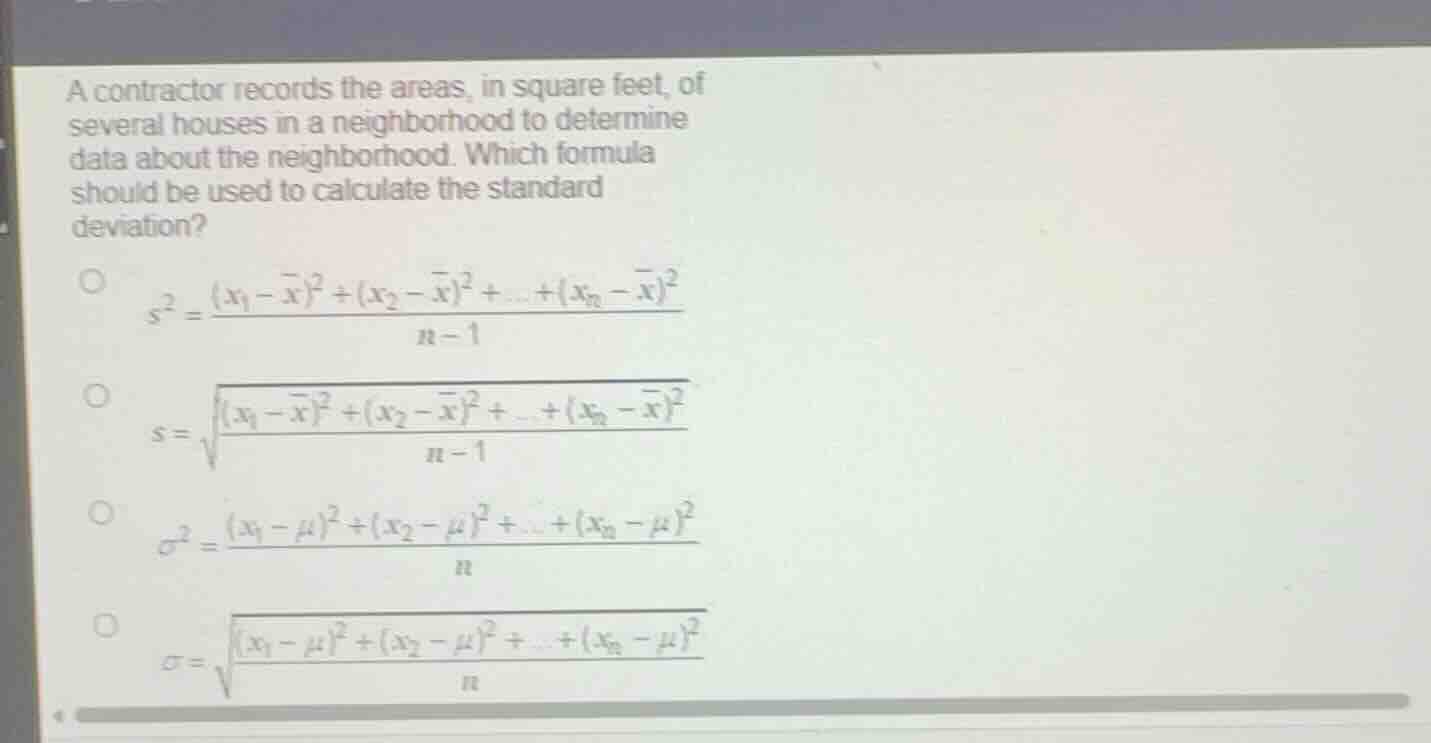
a contractor records the areas, in square feet, of several houses in a neighborhood to determine data about the neighborhood. which formula should be used to calculate the standard deviation?
\\(s^2 = \frac{(x_1 - \bar{x})^2 + (x_2 - \bar{x})^2 + \dots + (x_n - \bar{x})^2}{n - 1}\\)
\\(s = \sqrt{\frac{(x_1 - \bar{x})^2 + (x_2 - \bar{x})^2 + \dots + (x_n - \bar{x})^2}{n - 1}}\\)
\\(\sigma^2 = \frac{(x_1 - \mu)^2 + (x_2 - \mu)^2 + \dots + (x_n - \mu)^2}{n}\\)
\\(\sigma = \sqrt{\frac{(x_1 - \mu)^2 + (x_2 - \mu)^2 + \dots + (x_n - \mu)^2}{n}}\\)
Identify sample vs population context
Using the Sample Standard Deviation Formula knowledge point
The problem states that a contractor records the areas of "several houses in a neighborhood" to determine data about the neighborhood. Since the contractor is only measuring a subset (a sample) of all houses in the neighborhood rather than every single house, we must use sample statistics rather than population parameters.
Determine standard deviation vs variance
Using the Sample Standard Deviation Formula knowledge point
Variance is denoted by squared terms (\(s^2\) or \(\sigma^2\)), whereas standard deviation is the square root of the variance (\(s\) or \(\sigma\)). Since the question asks for the standard deviation, the formula must contain a square root.
Select the correct formula
Using the Sample Standard Deviation Formula knowledge point
The sample standard deviation \(s\) uses the sample mean \(\bar{x}\) and divides by \(n-1\):
This matches the second option.

Snap & solve any problem in the app
Get step-by-step solutions on Sovi AI
Photo-based solutions with guided steps
Explore more problems and detailed explanations
- (A) \(s^2 = \frac{(x_1 - \bar{x})^2 + (x_2 - \bar{x})^2 + \dots + (x_n - \bar{x})^2}{n-1}\)
- (B) \(s = \sqrt{\frac{(x_1 - \bar{x})^2 + (x_2 - \bar{x})^2 + \dots + (x_n - \bar{x})^2}{n-1}}\) (Correct answer)
- (C) \(\sigma^2 = \frac{(x_1 - \mu)^2 + (x_2 - \mu)^2 + \dots + (x_n - \mu)^2}{n}\)
- (D) \(\sigma = \sqrt{\frac{(x_1 - \mu)^2 + (x_2 - \mu)^2 + \dots + (x_n - \mu)^2}{n}}\)