QUESTION IMAGE
Question
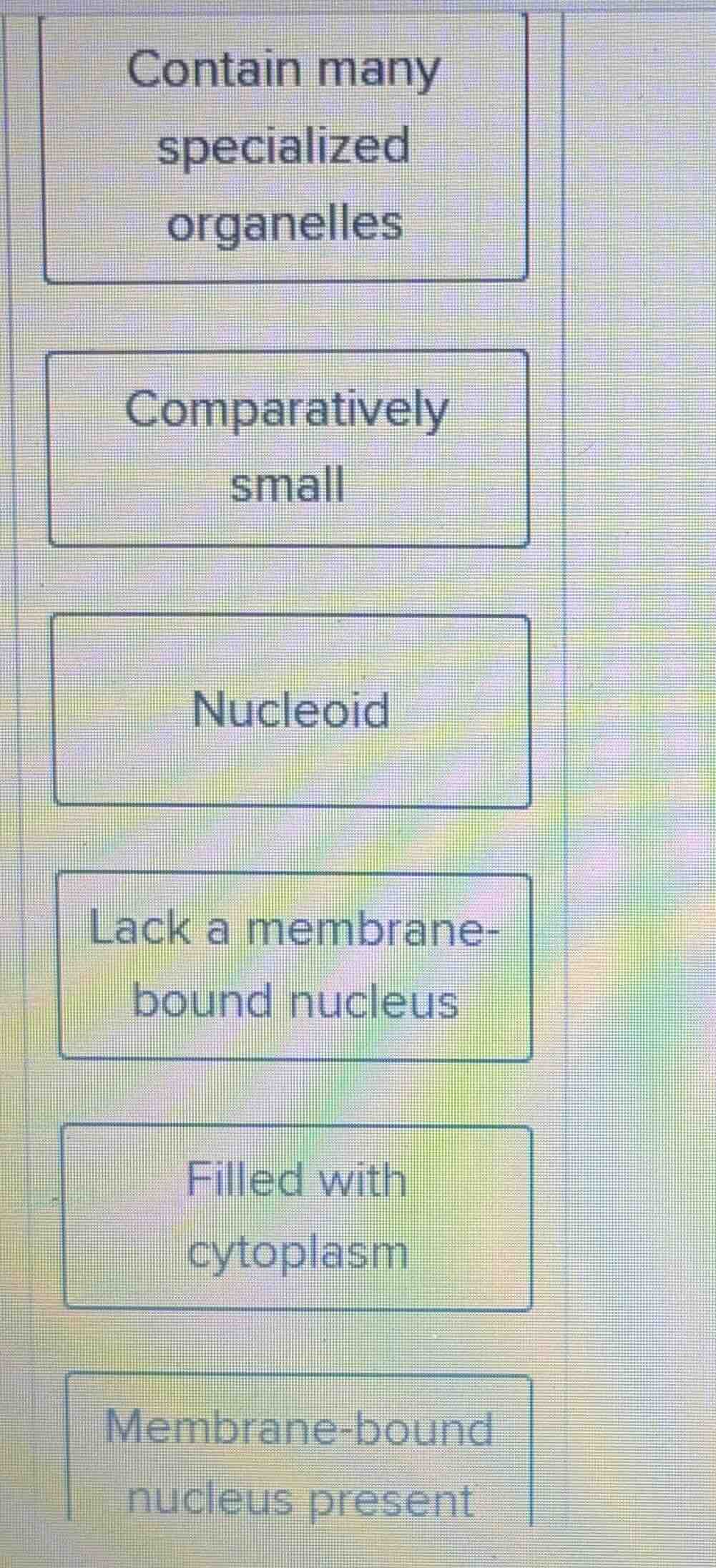
contain many specialized organelles
comparatively small
nucleoid
lack a membrane-bound nucleus
filled with cytoplasm
membrane-bound nucleus present
Classify cellular structures
Using the Cellular Classification knowledge point, we categorize the listed characteristics based on whether they describe prokaryotic cells, eukaryotic cells, or both.
Analyze prokaryotic characteristics
Using the Prokaryotic Cells knowledge point:
- "Comparatively small": Prokaryotes are typically \(0.1 - 5.0\ \mu\text{m}\) in diameter.
- "Nucleoid": Prokaryotes lack a nucleus; their circular DNA is concentrated in an unbound region called the nucleoid.
- "Lack a membrane-bound nucleus": This is the defining feature of prokaryotes.
Analyze eukaryotic characteristics
Using the Eukaryotic Cells knowledge point:
- "Contain many specialized organelles": Eukaryotes possess membrane-bound organelles like mitochondria, chloroplasts, and the Golgi apparatus.
- "Membrane-bound nucleus present": This is the defining feature of eukaryotes, housing their linear DNA.
Identify shared features
Using the Cellular Classification knowledge point:
- "Filled with cytoplasm": Both prokaryotic and eukaryotic cells contain cytoplasm, the semifluid gel-like substance filling the cell's interior.

Snap & solve any problem in the app
Get step-by-step solutions on Sovi AI
Photo-based solutions with guided steps
Explore more problems and detailed explanations
Based on the principles of cellular biology, the characteristics are classified as follows:
- Prokaryotic Cells only:
- Comparatively small
- Nucleoid
- Lack a membrane-bound nucleus
- Eukaryotic Cells only:
- Contain many specialized organelles
- Membrane-bound nucleus present
- Both Prokaryotic and Eukaryotic Cells:
- Filled with cytoplasm