QUESTION IMAGE
Question
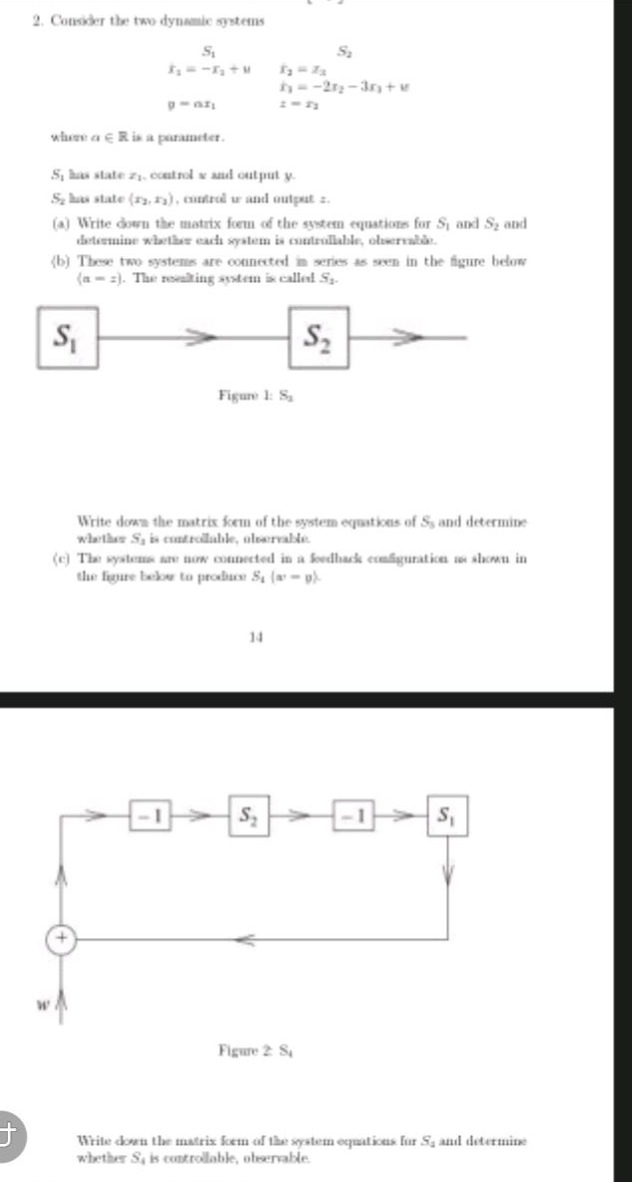
- consider the two dynamic systems
\\ s_1: \
\\
\\ s_2: \
\\
where \\( \alpha \in \mathbb{r} \\) is a parameter.
\\( s_1 \\) has state \\( x_1 \\), control \\( u \\) and output \\( y \\).
\\( s_2 \\) has state \\( (x_2, x_3) \\), control \\( v \\) and output \\( z \\).
(a) write down the matrix form of the system equations for \\( s_1 \\) and \\( s_2 \\) and determine whether each system is controllable, observable.
(b) these two systems are connected in series as seen in the figure below (\\( u = z \\)). the resulting system is called \\( s_3 \\).
write down the matrix form of the system equations of \\( s_3 \\) and determine whether \\( s_3 \\) is controllable, observable.
(c) the systems are now connected in a feedback configuration as shown in the figure below to produce \\( s_4 \\) (\\( u = y \\)).
write down the matrix form of the system equations for \\( s_4 \\) and determine whether \\( s_4 \\) is controllable, observable.
🆕 New Concept Discovered: State-Space Representation and Controllability/Observability
Representing systems in matrix form and analyzing structural properties.
---
Step 1: Matrix Form and Analysis of $S_1$
The system equations for $S_1$ are:
In state-space matrix form:
where:
Controllability of $S_1$:
The controllability matrix $\mathcal{C}_1$ is:
Since $\text{rank}(\mathcal{C}_1) = 1$ (full rank), $S_1$ is always controllable for any $\alpha \in \mathbb{R}$.
Observability of $S_1$:
The observability matrix $\mathcal{O}_1$ is:
For $S_1$ to be observable, we require $\text{rank}(\mathcal{O}_1) = 1$, which means:
- If $\alpha
eq 0$, $S_1$ is observable.
- If $\alpha = 0$, $S_1$ is not observable.
---
Step 2: Matrix Form and Analysis of $S_2$
The system equations for $S_2$ are:
Let the state vector be $x_{S2} =
$. In matrix form:
where:
Controllability of $S_2$:
The controllability matrix $\mathcal{C}_2$ is:
Since $\det(\mathcal{C}_2) = -1
eq 0$, $\text{rank}(\mathcal{C}_2) = 2$. Thus, $S_2$ is controllable.
Observability of $S_2$:
The observability matrix $\mathcal{O}_2$ is:
Since $\det(\mathcal{O}_2) = 1
eq 0$, $\text{rank}(\mathcal{O}_2) = 2$. Thus, $S_2$ is observable.
---
Step 3: Series Connection $S_3$
In the series connection, the output of $S_1$ becomes the input to $S_2$ with $u = z$ (as stated in the text, though the diagram shows $S_1$ feeding into $S_2$, meaning the output of $S_1$ is the input to $S_2$, i.e., $v = y = \alpha x_1$).
Let the state vector of the combined system $S_3$ be $x_{S3} =
$.
The equations are:
In matrix form:
where:
Controllability of $S_3$:
The controllability matrix $\mathcal{C}_3$ is:
The determinant of $\mathcal{C}_3$ is:
- If $\alpha
eq 0$, $\text{rank}(\mathcal{C}_3) = 3$, so $S_3$ is controllable.
- If $\alpha = 0$, $\t…

Snap & solve any problem in the app
Get step-by-step solutions on Sovi AI
Photo-based solutions with guided steps
Explore more problems and detailed explanations
(a) Systems $S_1$ and $S_2$
- $S_1$ Matrix Form:
- Controllability: Always controllable.
- Observability: Observable if and only if $\alpha
eq 0$.
- $S_2$ Matrix Form:
- Controllability: Always controllable.
- Observability: Always observable.
(b) Series System $S_3$
- $S_3$ Matrix Form:
- Controllability: Controllable if and only if $\alpha
eq 0$.
- Observability: Observable if and only if $\alpha
eq 0$.
(c) Feedback System $S_4$
- $S_4$ Matrix Form:
- Controllability: Always controllable.
- Observability: Observable if and only if $\alpha
eq 0$.