QUESTION IMAGE
Question
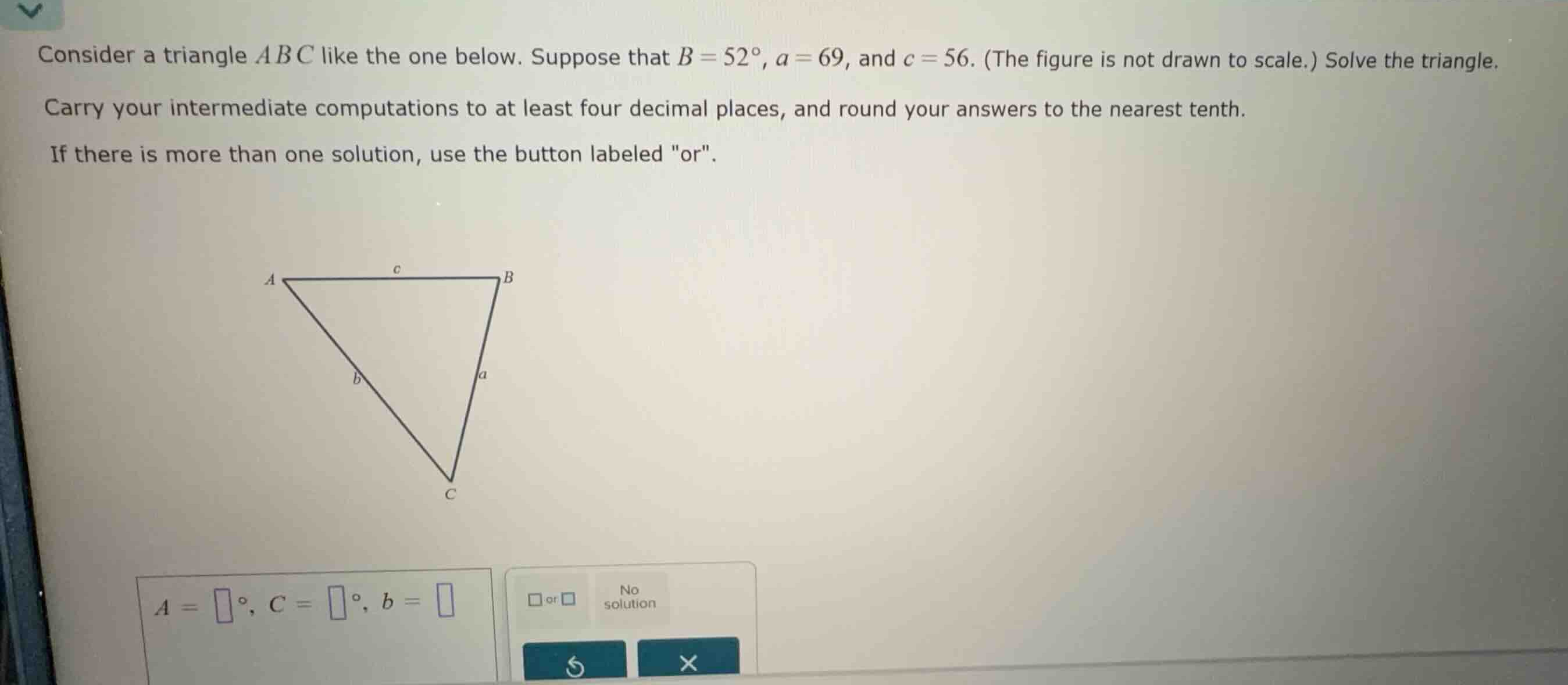
consider a triangle \\(abc\\) like the one below. suppose that \\(b = 52^{\circ}\\), \\(a = 69\\), and \\(c = 56\\). (the figure is not drawn to scale.) solve the triangle.
carry your intermediate computations to at least four decimal places, and round your answers to the nearest tenth.
if there is more than one solution, use the button labeled \or\.
\\(a = \square^{\circ}\\), \\(c = \square^{\circ}\\), \\(b = \square\\)
Identify given values and target unknowns
We are given a triangle \(ABC\) with:
- Angle \(B = 52^\circ\)
- Side \(a = 69\)
- Side \(c = 56\)
We need to solve the triangle, which means finding:
- Side \(b\)
- Angle \(A\)
- Angle \(C\)
Apply the Law of Cosines to find side b
To find side \(b\) when we know sides \(a\), \(c\), and the included angle \(B\), we use the Law of Cosines:
Substitute the given values:
Rounding to the nearest tenth:
Apply the Law of Sines to find angle A
Now we use the Law of Sines to find one of the remaining angles. Let's find angle \(A\):
Substitute the values (using high-precision intermediate values):
Find the angle \(A\):
Since \(a > c\), angle \(A\) must be larger than angle \(C\). Let's check if \(A\) could be obtuse:
If \(A \approx 180^\circ - 76.03^\circ = 103.97^\circ\), then \(A + B = 103.97^\circ + 52^\circ = 155.97^\circ < 180^\circ\), which is geometrically possible.
However, since \(b \approx 56.0283\) is very close to \(c = 56\), angle \(B\) and angle \(C\) must be very close in measure.
Let's calculate angle \(C\) directly using the Law of Sines to resolve any ambiguity:
Since \(c < b\) (\(56 < 56.0283\)), angle \(C\) must be slightly smaller than angle \(B\) (\(52^\circ\)), which matches \(51.96^\circ\).
Thus, angle \(C\) is acute:
Calculate angle A using the angle sum of a triangle
Now we find angle \(A\) using the sum of angles in a triangle:
Rounding to the nearest tenth:
- \(A \approx 76.0^\circ\)
- \(C \approx 52.0^\circ\)
- \(b \approx 56.0\)

Snap & solve any problem in the app
Get step-by-step solutions on Sovi AI
Photo-based solutions with guided steps
Explore more problems and detailed explanations
Consider a triangle \(ABC\) like the one below. Suppose that \(B = 52^\circ\), \(a = 69\), and \(c = 56\). Solve the triangle.
\(A =\) <blank>\(76.0\)</blank>\(^\circ\), \(C =\) <blank>\(52.0\)</blank>\(^\circ\), \(b =\) <blank>\(56.0\)</blank>