QUESTION IMAGE
Question
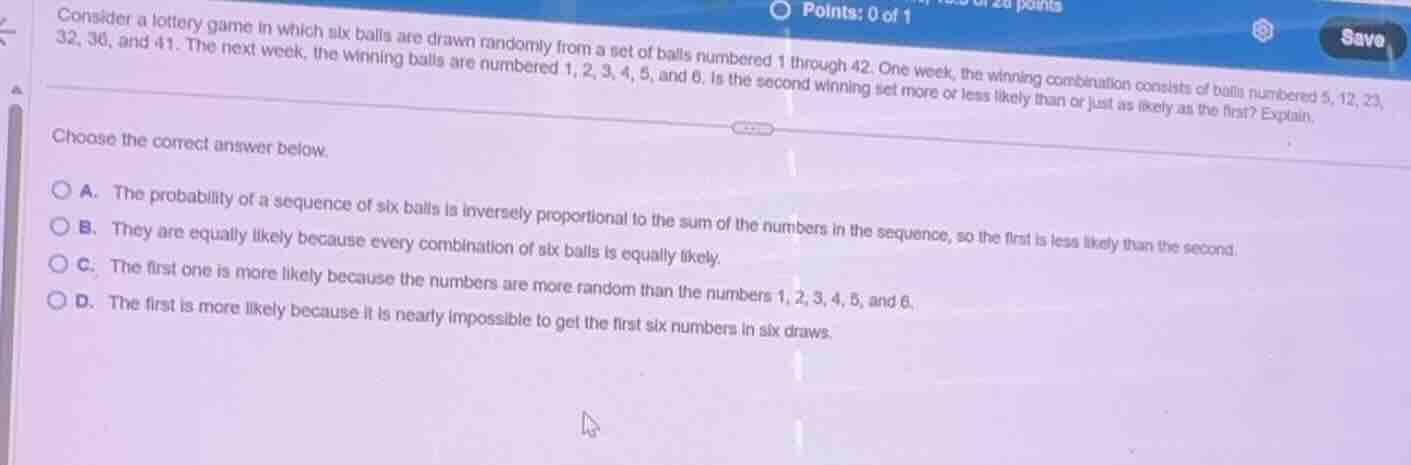
consider a lottery game in which six balls are drawn randomly from a set of balls numbered 1 through 42. one week, the winning combination consists of balls numbered 5, 12, 23, 32, 36, and 41. the next week, the winning balls are numbered 1, 2, 3, 4, 5, and 6. is the second winning set more or less likely than or just as likely as the first? explain.
choose the correct answer below.
a. the probability of a sequence of six balls is inversely proportional to the sum of the numbers in the sequence, so the first is less likely than the second.
b. they are equally likely because every combination of six balls is equally likely.
c. the first one is more likely because the numbers are more random than the numbers 1, 2, 3, 4, 5, and 6.
d. the first is more likely because it is nearly impossible to get the first six numbers in six draws.
Calculate total possible combinations
Using the Probability knowledge point
Determine probability of each combination
Using the Probability knowledge point
Analyze psychological misconceptions
Using the Gamblers Fallacy knowledge point

Snap & solve any problem in the app
Get step-by-step solutions on Sovi AI
Photo-based solutions with guided steps
Explore more problems and detailed explanations
- A. The probability of a sequence of six balls is inversely proportional to the sum of the numbers in the sequence, so the first is less likely than the second.
- B. They are equally likely because every combination of six balls is equally likely. (Correct answer)
- C. The first one is more likely because the numbers are more random than the numbers 1, 2, 3, 4, 5, and 6.
- D. The first is more likely because it is nearly impossible to get the first six numbers in six draws.