QUESTION IMAGE
Question
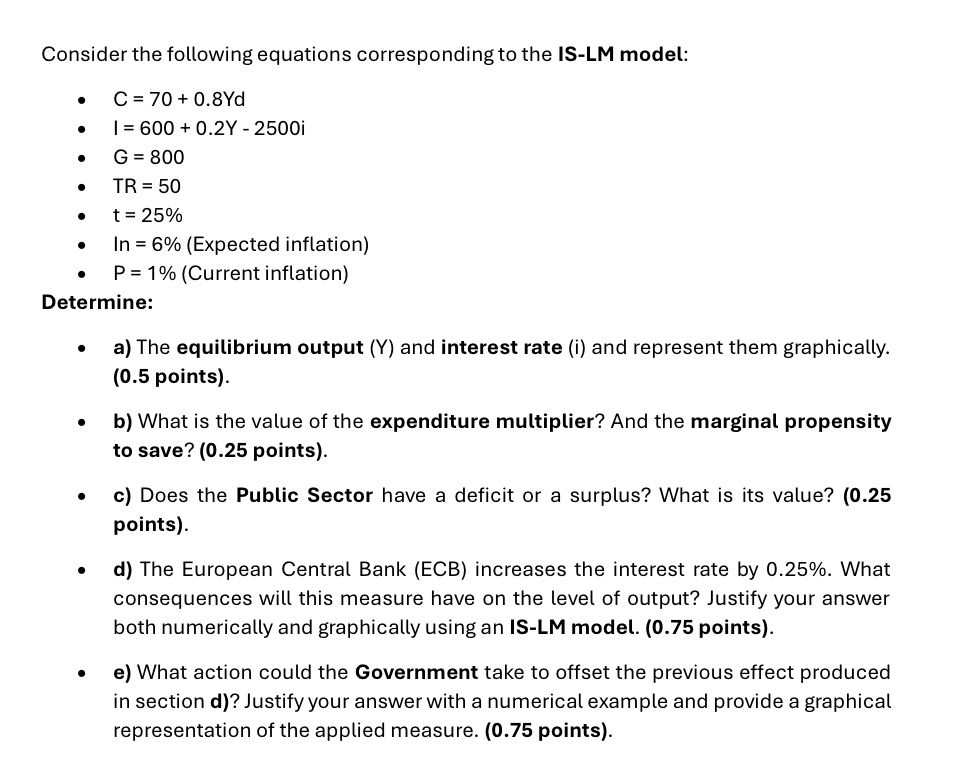
consider the following equations corresponding to the is-lm model:
- \\(c = 70 + 0.8yd\\)
- \\(i = 600 + 0.2y - 2500i\\)
- \\(g = 800\\)
- \\(tr = 50\\)
- \\(t = 25\\%\\)
- \\(in = 6\\%\\) (expected inflation)
- \\(p = 1\\%\\) (current inflation)
determine:
- a) the equilibrium output (y) and interest rate (i) and represent them graphically. (0.5 points).
- b) what is the value of the expenditure multiplier? and the marginal propensity to save? (0.25 points).
- c) does the public sector have a deficit or a surplus? what is its value? (0.25 points).
- d) the european central bank (ecb) increases the interest rate by 0.25%. what consequences will this measure have on the level of output? justify your answer both numerically and graphically using an is-lm model. (0.75 points).
- e) what action could the government take to offset the previous effect produced in section d)? justify your answer with a numerical example and provide a graphical representation of the applied measure. (0.75 points).
🆕 New Concept Discovered: IS-LM Equilibrium
Finding balance in goods and money markets.
Step 1: Derive the IS Curve Equation
To find the IS curve, we start with the goods market equilibrium condition where total output equals aggregate demand:
First, express disposable income \( Y_d \) using the tax rate \( t = 25\% = 0.25 \) and government transfers \( TR = 50 \):
Now, substitute \( Y_d \) into the consumption function:
Next, substitute \( C \), \( I \), and \( G \) into the equilibrium condition:
Isolate \( Y \) to find the IS curve equation:
Step 2: Determine Equilibrium Output and Interest Rate
The problem provides the expected inflation rate \( I_n = 6\% \) and current inflation \( P = 1\% \). In a standard IS-LM framework where the central bank sets the nominal interest rate or we look at the policy rate, if the nominal interest rate is determined by the central bank's policy or if the interest rate \( i \) is treated as the policy variable, we look at the given interest rate.
From part (d), we see the central bank directly controls the interest rate \( i \). In this economy, the interest rate is determined by the central bank's monetary policy. The nominal interest rate is:
Using \( i = 0.06 \) in our IS equation:
Graphical Representation: The IS curve is downward-sloping on a graph with interest rate \( i \) on the vertical axis and output \( Y \) on the horizontal axis. The LM curve is a horizontal line at the policy interest rate set by the central bank (\( i = 6\% \)). Their intersection yields the equilibrium point \( (Y = 6800, i = 6\%) \).
Step 3: Calculate Multiplier and Marginal Propensity to Save
The expenditure multiplier (\( \alpha \)) measures how much equilibrium output changes in response to a change in autonomous spending:
where \( c = 0.8 \) (marginal propensity to consume), \( t = 0.25 \) (tax rate), and \( b = 0.2 \) (marginal propensity to invest with respect to income).
The marginal propensity to save (\( MPS \)) out of disposable income is:
Step 4: Calculate Public Sector Budget Balance
The public sector budget balance (\( BS \)) is defined as government tax revenues minus government purchases and transfers:
Since \( BS > 0 \), the Public Sector has a surplus of 850.
Step 5: Analyze Interest Rate Increase by the ECB
The ECB increases the interest rate by \( 0.25\% \), so the new interest rate is:
Substitute the new interest rate into the IS curve equation:
The change in output is:
Justification: An increase in the interest rate raises the cost of borrowing, which reduces investment spending (\( I \)). Through the multiplier effect, this reduction in investment leads to a larger contraction in total equilibrium output.
Graphical Representation: The horizontal LM curve shifts upward from \( i…

Snap & solve any problem in the app
Get step-by-step solutions on Sovi AI
Photo-based solutions with guided steps
Explore more problems and detailed explanations
- a) Equilibrium output \( Y = 6800 \), interest rate \( i = 6\% \).
- b) Expenditure multiplier \( \alpha = 5 \); Marginal propensity to save \( MPS = 0.2 \).
- c) Public Sector has a surplus of 850.
- d) Output decreases by 31.25 to a new level of 6768.75 due to reduced investment.
- e) The government can increase government spending \( G \) by 6.25 to fully offset the contraction.