QUESTION IMAGE
Question
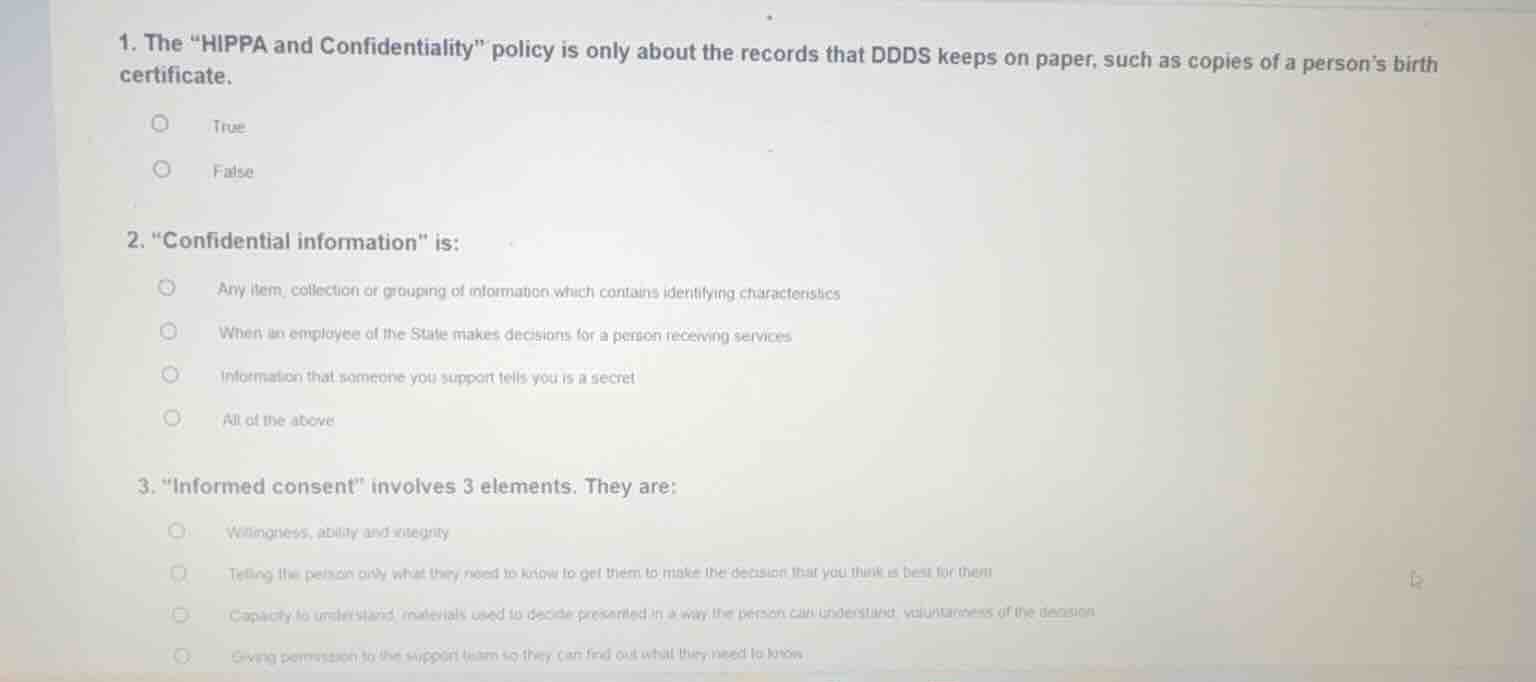
- the \hippa and confidentiality\ policy is only about the records that ddds keeps on paper, such as copies of a persons birth certificate.
true
false
- \confidential information\ is:
any item, collection or grouping of information which contains identifying characteristics
when an employee of the state makes decisions for a person receiving services
information that someone you support tells you is a secret
all of the above
- \informed consent\ involves 3 elements. they are:
willingness, ability and integrity
telling the person only what they need to know to get them to make the decision that you think is best for them
capacity to understand, materials used to decide presented in a way the person can understand, voluntariness of the decision
giving permission to the support team so they can find out what they need to know
Analyze HIPAA and confidentiality scope
The first question states that the "HIPAA and Confidentiality" policy is only about paper records. HIPAA (Health Insurance Portability and Accountability Act) and general confidentiality policies protect Protected Health Information (PHI) in all forms, including electronic (ePHI), oral, and written/paper formats. Therefore, limiting it only to paper records is incorrect.
Define confidential information
The second question asks for the definition of "Confidential information". Confidential information in a healthcare or social services context (such as DDDS) refers to any item, collection, or grouping of information that contains identifying characteristics of a person. The other options, such as an employee making decisions or secrets told by someone, do not represent the formal, legal definition of confidential information.
Identify elements of informed consent
The third question asks for the three elements of "Informed consent". Legally and ethically, informed consent requires three core components:
- Capacity (the ability to understand the information and make a decision).
- Information/Disclosure (materials presented in an understandable way so the person can decide).
- Voluntariness (the decision is made freely without coercion).
This matches the third option: "Capacity to understand, materials used to decide presented in a way the person can understand, voluntariness of the decision".

Snap & solve any problem in the app
Get step-by-step solutions on Sovi AI
Photo-based solutions with guided steps
Explore more problems and detailed explanations
Question 1
- True
- False (Correct answer)
Question 2
- Any item, collection or grouping of information which contains identifying characteristics (Correct answer)
- When an employee of the State makes decisions for a person receiving services
- Information that someone you support tells you is a secret
- All of the above
Question 3
- Willingness, ability and integrity
- Telling the person only what they need to know to get them to make the decision that you think is best for them
- Capacity to understand, materials used to decide presented in a way the person can understand, voluntariness of the decision (Correct answer)
- Giving permission to the support team so they can find out what they need to know