QUESTION IMAGE
Question
6 - complex adaptive systems
learning objective: compare and contrast complex adaptive systems with traditional change models.
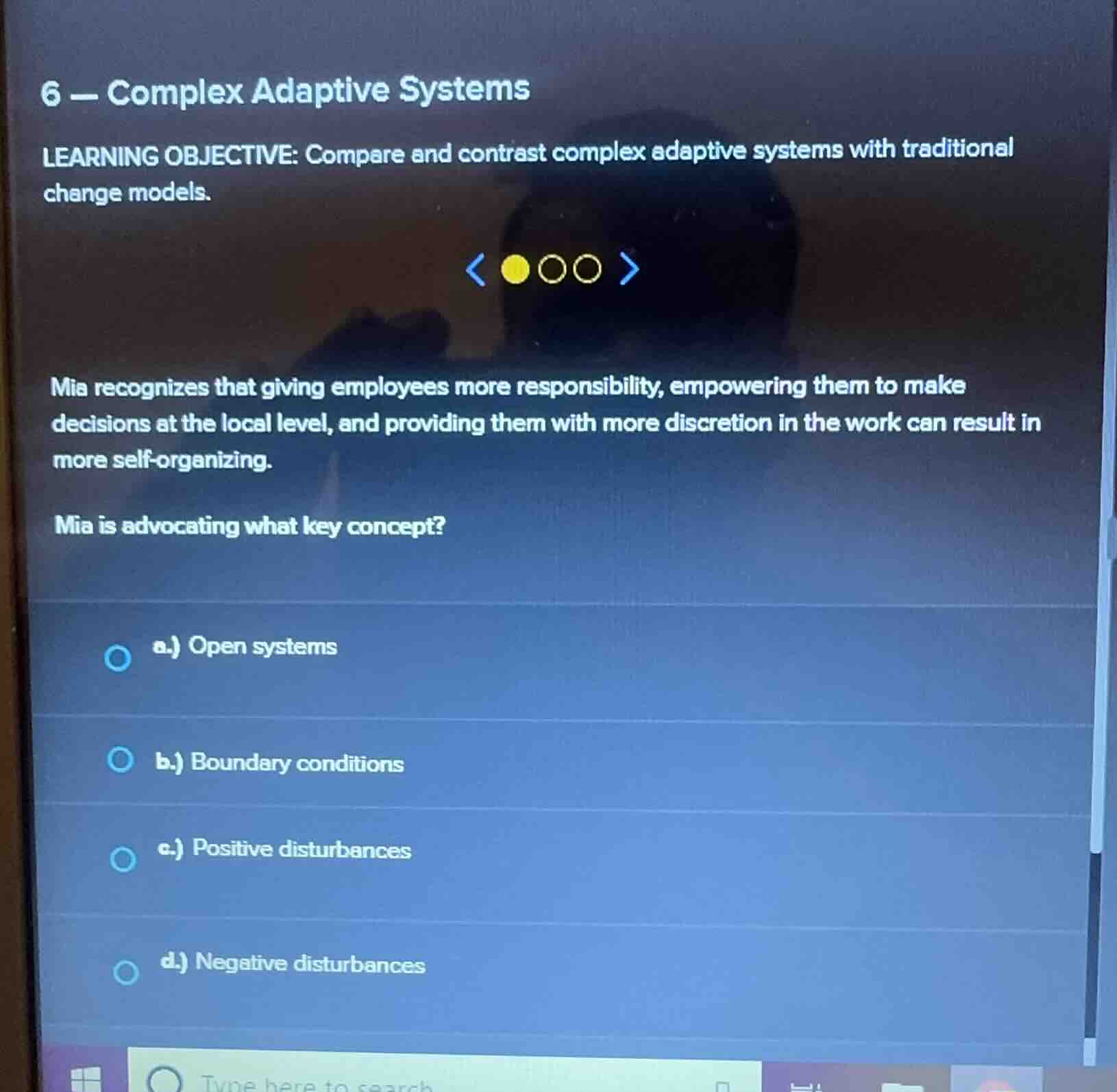
mia recognizes that giving employees more responsibility, empowering them to make decisions at the local level, and providing them with more discretion in the work can result in more self-organizing.
mia is advocating what key concept?
a.) open systems
b.) boundary conditions
c.) positive disturbances
d.) negative disturbances
Analyze the scenario
The scenario describes Mia empowering employees by giving them more responsibility, local decision-making authority, and discretion in their work to encourage self-organizing. We need to identify which key concept of complex adaptive systems (CAS) this represents.
Evaluate the options
- Open systems: Refers to systems that interact with their external environment. While relevant to organizations, it does not specifically define the set of limits or rules that enable local self-organization.
- Boundary conditions: In complex adaptive systems, self-organization does not occur in a complete vacuum. Instead, leaders establish "boundary conditions" (such as delegation of authority, resource limits, and decision-making discretion) within which autonomous agents (employees) are free to self-organize and adapt. By defining what employees can do at the local level, Mia is setting these enabling boundaries.
- Positive/Negative disturbances: These refer to external or internal disruptions that push a system out of equilibrium to stimulate change, rather than the structural parameters of empowerment and discretion.
Connect to organizational concepts
Under Organizational Change and complex adaptive systems theory, establishing clear limits while maximizing autonomy within those limits is the definition of setting boundary conditions to facilitate emergence and self-organization.

Snap & solve any problem in the app
Get step-by-step solutions on Sovi AI
Photo-based solutions with guided steps
Explore more problems and detailed explanations
- a.) Open systems
- b.) Boundary conditions (Correct answer)
- c.) Positive disturbances
- d.) Negative disturbances