QUESTION IMAGE
Question
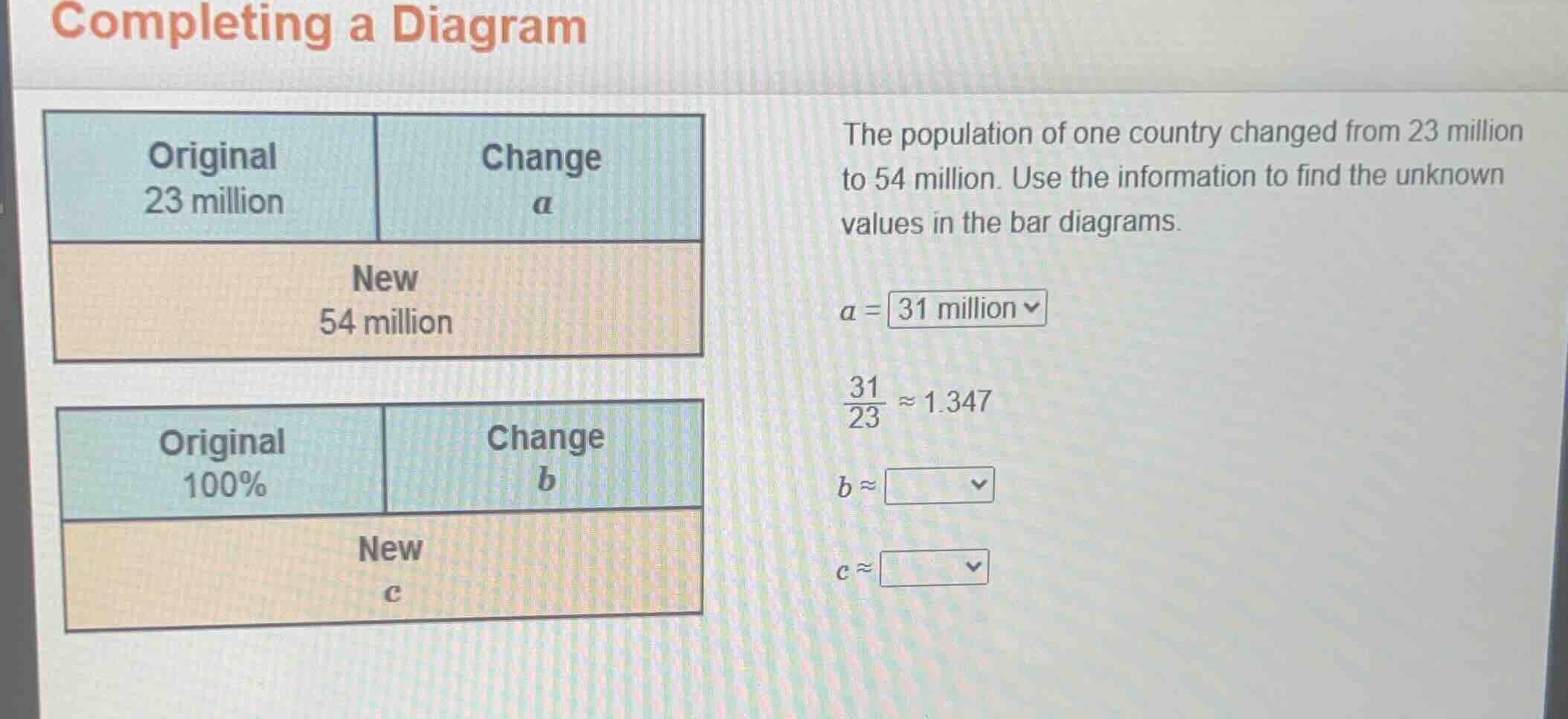
completing a diagram
the population of one country changed from 23 million to 54 million. use the information to find the unknown values in the bar diagrams.
\\(a = 31\text{ million}\\)
\\(\frac{31}{23} \approx 1.347\\)
\\(b \approx\\)
\\(c \approx\\)
<pre_analysis>
{
"quality": "clear",
"question_count": 1,
"skills_matched": [
"step_cot",
"explain_then_answer",
"tutor"
],
"needs_drawing": false,
"concepts_used": [],
"new_concepts": [
"Percent of Change",
"Bar Diagram Models"
],
"current_concepts": [
"Percent of Change",
"Bar Diagram Models",
"Decimal to Percent"
]
}
</pre_analysis>
<reasoning>
Identify the given values
The original population is \(23\text{ million}\).
The new population is \(54\text{ million}\).
The change in population is \(a = 31\text{ million}\).
Calculate the percent change b
The ratio of the change to the original is:
\[
\frac{31}{23} \approx 1.3478
\]
To convert this decimal to a percentage:
\[
1.3478 \times 100\% \approx 134.8\%
\]
Rounding to the nearest tenth of a percent gives:
\[
b \approx 134.8\%
\]
(Or if rounded to the nearest whole percent, \(135\%\)).
Calculate the new percent c
The new percentage represents the total new population relative to the original \(100\%\).
Using the bar diagram:
\[
c = 100\% + b
\]
Substituting the value of \(b\):
\[
c \approx 100\% + 134.8\% = 234.8\%
\]
Alternatively, using the ratio of the new value to the original value:
\[
\frac{54}{23} \approx 2.3478 \approx 234.8\%
\]
Rounding to the nearest tenth of a percent gives:
\[
c \approx 234.8\%
\]
(Or if rounded to the nearest whole percent, \(235\%\)).
</reasoning>
<answer>
Based on the calculations:
- \(b \approx 134.8\%\) (or \(135\%\))
- \(c \approx 234.8\%\) (or \(235\%\))
</answer>
<post_analysis>
{
"subject": "Mathematics",
"question_type": "Fill-in-the-blank",
"knowledge_point": [
"Mathematics",
"Algebra",
"Percent of Change"
]
}
</post_analysis>
Snap & solve any problem in the app
Get step-by-step solutions on Sovi AI
Photo-based solutions with guided steps
Explore more problems and detailed explanations
<pre_analysis>
{
"quality": "clear",
"question_count": 1,
"skills_matched": [
"step_cot",
"explain_then_answer",
"tutor"
],
"needs_drawing": false,
"concepts_used": [],
"new_concepts": [
"Percent of Change",
"Bar Diagram Models"
],
"current_concepts": [
"Percent of Change",
"Bar Diagram Models",
"Decimal to Percent"
]
}
</pre_analysis>
<reasoning>
Identify the given values
The original population is \(23\text{ million}\).
The new population is \(54\text{ million}\).
The change in population is \(a = 31\text{ million}\).
Calculate the percent change b
The ratio of the change to the original is:
\[
\frac{31}{23} \approx 1.3478
\]
To convert this decimal to a percentage:
\[
1.3478 \times 100\% \approx 134.8\%
\]
Rounding to the nearest tenth of a percent gives:
\[
b \approx 134.8\%
\]
(Or if rounded to the nearest whole percent, \(135\%\)).
Calculate the new percent c
The new percentage represents the total new population relative to the original \(100\%\).
Using the bar diagram:
\[
c = 100\% + b
\]
Substituting the value of \(b\):
\[
c \approx 100\% + 134.8\% = 234.8\%
\]
Alternatively, using the ratio of the new value to the original value:
\[
\frac{54}{23} \approx 2.3478 \approx 234.8\%
\]
Rounding to the nearest tenth of a percent gives:
\[
c \approx 234.8\%
\]
(Or if rounded to the nearest whole percent, \(235\%\)).
</reasoning>
<answer>
Based on the calculations:
- \(b \approx 134.8\%\) (or \(135\%\))
- \(c \approx 234.8\%\) (or \(235\%\))
</answer>
<post_analysis>
{
"subject": "Mathematics",
"question_type": "Fill-in-the-blank",
"knowledge_point": [
"Mathematics",
"Algebra",
"Percent of Change"
]
}
</post_analysis>