QUESTION IMAGE
Question
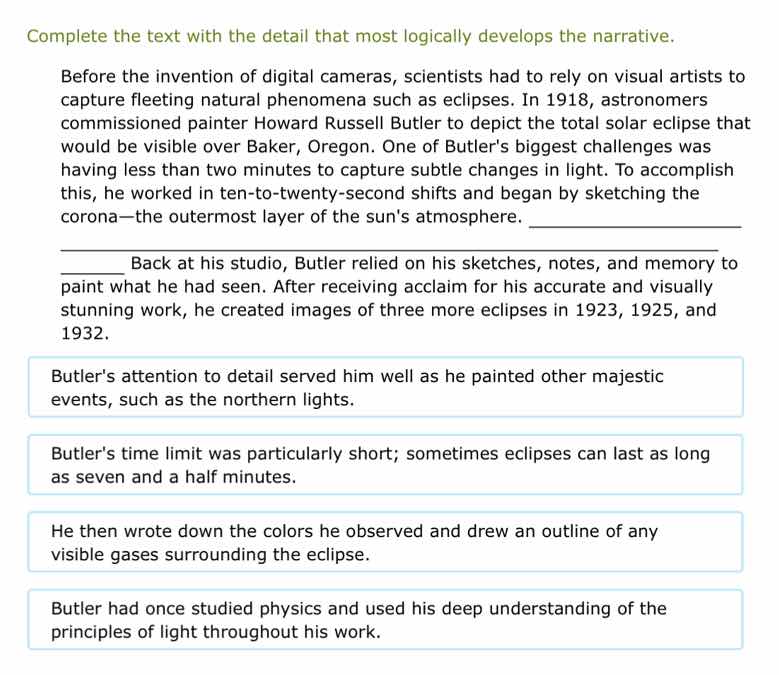
complete the text with the detail that most logically develops the narrative. before the invention of digital cameras, scientists had to rely on visual artists to capture fleeting natural phenomena such as eclipses. in 1918, astronomers commissioned painter howard russell butler to depict the total solar eclipse that would be visible over baker, oregon. one of butlers biggest challenges was having less than two minutes to capture subtle changes in light. to accomplish this, he worked in ten - to - twenty - second shifts and began by sketching the corona—the outermost layer of the suns atmosphere. ______ back at his studio, butler relied on his sketches, notes, and memory to paint what he had seen. after receiving acclaim for his accurate and visually stunning work, he created images of three more eclipses in 1923, 1925, and 1932. butlers attention to detail served him well as he painted other majestic events, such as the northern lights. butlers time limit was particularly short; sometimes eclipses can last as long as seven and a half minutes. he then wrote down the colors he observed and drew an outline of any visible gases surrounding the eclipse. butler had once studied physics and used his deep understanding of the principles of light throughout his work.
The original text describes Butler's process of capturing the eclipse: he started with sketching the corona. The next logical step in his process would be documenting other details like colors and gases. The option "He then wrote down the colors he observed and drew an outline of any visible gases surrounding the eclipse" continues the sequence of his actions during the eclipse observation (after sketching the corona, then noting colors and gases), which fits the narrative flow of how he gathered details to paint later. Other options either introduce unrelated events (northern lights), compare time limits (not part of the immediate action sequence), or talk about his physics background (which is not part of the step - by - step observation process described here).

Snap & solve any problem in the app
Get step-by-step solutions on Sovi AI
Photo-based solutions with guided steps
Explore more problems and detailed explanations
He then wrote down the colors he observed and drew an outline of any visible gases surrounding the eclipse.