QUESTION IMAGE
Question
complete the statements.
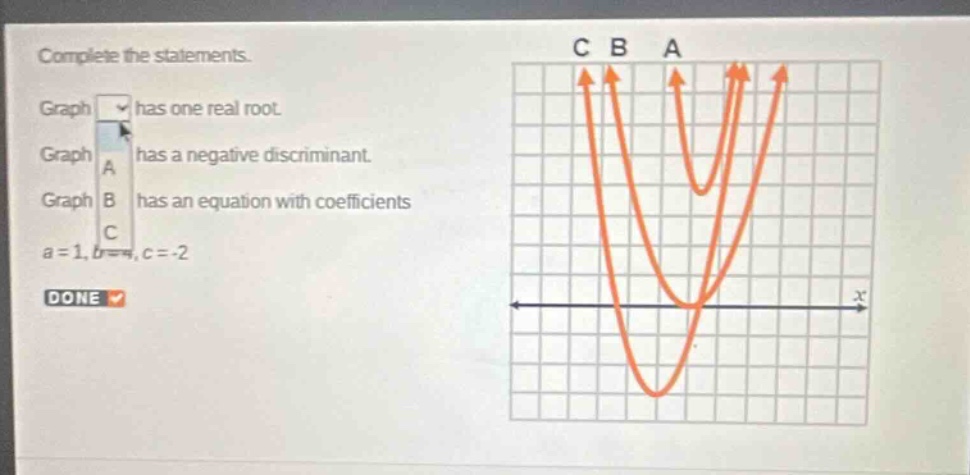
graph dropdown has one real root.
graph dropdown has a negative discriminant.
graph dropdown has an equation with coefficients (a = 1, b = 4, c = -2).
⚡ Using what you learned: graphing quadratic functions
Step 1: Analyze the number of real roots
The real roots (or zeros) of a quadratic function correspond to the \(x\)-intercepts of its graph:
- Graph A lies entirely above the \(x\)-axis, meaning it has no \(x\)-intercepts (zero real roots).
- Graph B touches the \(x\)-axis at exactly one point (its vertex), meaning it has exactly one real root.
- Graph C crosses the \(x\)-axis at two distinct points, meaning it has two real roots.
Therefore, Graph B has one real root.
Step 2: Analyze the discriminant
The discriminant of a quadratic equation determines the number of real roots:
- A positive discriminant (\(b^2 - 4ac > 0\)) corresponds to two real roots.
- A discriminant of zero (\(b^2 - 4ac = 0\)) corresponds to one real root.
- A negative discriminant (\(b^2 - 4ac < 0\)) corresponds to no real roots (complex roots).
Since Graph A does not intersect the \(x\)-axis, it has no real roots.
Therefore, Graph A has a negative discriminant.
Step 3: Analyze the equation coefficients
We are given the coefficients:
The \(y\)-intercept of a quadratic function in standard form \(y = ax^2 + bx + c\) is given by the value of \(c\) (where \(x = 0\)). Here, the \(y\)-intercept is:
Looking at the graphs:
- Graph A has a vertex above the \(x\)-axis and does not go below it, so its \(y\)-intercept is positive.
- Graph B has its vertex touching the \(x\)-axis at a positive \(y\)-value relative to the lowest curve, and its \(y\)-intercept is positive.
- Graph C goes below the \(x\)-axis and crosses the \(y\)-axis (the vertical line passing through the grid) at a negative value, specifically at \(y = -2\).
Therefore, Graph C has an equation with coefficients \(a = 1, b = 4, c = -2\).

Snap & solve any problem in the app
Get step-by-step solutions on Sovi AI
Photo-based solutions with guided steps
Explore more problems and detailed explanations
- Graph B has one real root.
- Graph A has a negative discriminant.
- Graph C has an equation with coefficients \(a = 1, b = 4, c = -2\).